Analysis of the Mental State of American Garden Birds When Facing Human Observation During Feeding
Within the ecological context of American gardens, interactions between birds and humans occur frequently, particularly the human behavior of observing birds feeding. This behavior conceals complex psychological responses and behavioral strategies in birds. This “mindset” differs from traditional human emotional cognition, instead forming a comprehensive behavioral pattern rooted in survival instincts, environmental adaptation, and risk assessment. It can be analyzed through three core dimensions: vigilance trade-offs, resource dependency, and environmental domestication.
I. Core Mentality: Vigilance-Driven “Risk-Benefit” Tradeoffs
For most American backyard birds, human observation first triggers their innate predator vigilance mechanism. Physiologically, avian visual systems are highly sensitive to the movement and gaze direction of large mammals, leading humans standing still to be initially assessed as potential threats. At this point, birds enter a rapid “risk-reward” assessment: on one hand, artificially provided food resources like grains and fruits in gardens significantly reduce foraging energy expenditure, serving as vital survival supplements; on the other hand, human proximity carries risks of capture or disturbance.
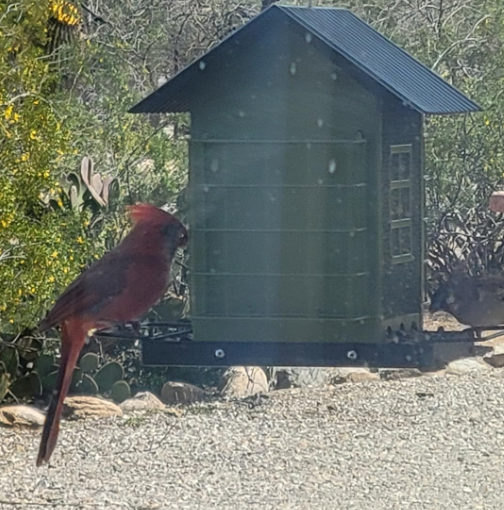
This balancing act manifests in observable behaviors. For instance, when spotting observers, the Northern Cardinal will halt feeding, tense its body, turn its head toward the human, and adopt a pre-flight posture with wings slightly spread—a classic “alert posture.” If the human remains still and avoids sudden movements, the bird will reassess the risk within seconds to tens of seconds. If it judges “reward (food) > risk (human threat),” it will resume feeding but frequently glance upward to monitor the human's movements, with its feeding pace noticeably slowing. If the human makes gestures like reaching out or moving, the bird will immediately spread its wings and flee to a nearby branch, returning to forage only after the human has departed. This behavioral pattern indicates that the core mindset of birds is a pragmatic choice of “vigilance as a prerequisite, food as the priority,” rather than a simple ‘resistance’ or “acceptance.”
II. Environmental Acclimation: “Vigilance Downgrade” and “Habituation” Through Long-Term Interaction
In American gardens with long-term human presence, birds gradually develop an “environmental habituation” effect. Their mindset shifts from “high alertness” to “limited acceptance” when observed by humans—a process fundamentally rooted in habituation learning. Habituation is an adaptive behavioral response where animals gradually reduce their reaction intensity to non-threatening stimuli through repeated exposure, a phenomenon particularly evident in garden birds.
Take the common American Robin as an example. In gardens where food is consistently provided daily without harmful human behavior, their tolerance distance for human observation shortens from an initial 5-8 meters to 2-3 meters. Specifically: when humans approach, they no longer immediately cease feeding but merely observe through eye movements while maintaining consistent pecking frequency. Even when humans move slowly, they only slightly adjust their perching position rather than flee. This “alertness downgrade” does not signify the elimination of vigilance, but rather a reclassification of humans from “high-risk predators” to “neutral disturbers.” Their mindset shifts toward “ignoring non-threatening human activities and focusing on food acquisition.”
Additionally, some more curious birds (such as the Eurasian Jay) exhibit “proactive observation of humans” — — during feeding breaks, they fly to branches closer to humans, tilting their heads to watch human movements. This behavior may serve to further confirm whether humans pose a threat, reflecting an “updated cognition” of humans in birds after environmental habituation, shifting their mindset from “passive vigilance” to “active assessment.”
III. Mindset Shifts in Special Scenarios: Heightened Vigilance During Breeding Seasons and Resource Scarcity
Birds' attitudes toward human feeding observations are not static; they adjust according to survival needs. Breeding seasons and periods of food scarcity mark two critical turning points where vigilance is re-escalated, significantly reducing tolerance for human spectators.
Birds during the breeding season (especially parent birds raising chicks) perceive humans as “nest threats” rather than mere “food observers.” For example, Carolina Wrens nesting in gardens will abandon foraging near their nests when humans approach. They fly toward observers, chirp frequently, perform wing-flapping displays, or even feign wing injuries (“mimicry of injury”) to lure humans away from the nest. At this point, the birds' mindset is entirely focused on “protecting offspring,” with food acquisition yielding to reproductive safety. Their response to human observation shifts from “risk assessment” to “active deterrence.”
During winter food scarcity, when birds' need for food peaks, their mindset becomes “contradictory”: On one hand, to obtain food, they tolerate closer human proximity (even within about 1 meter); on the other hand, due to intense food competition, any slight human movement may be perceived as a “threat to food acquisition.” This causes them to frequently look up while feeding. Upon detecting the approach of other birds or humans, they will immediately launch an attack (such as chasing away conspecifics) or swiftly grab food and flee. This mindset fundamentally reflects an “instinct to protect resources under survival pressure,” associating human observation with “food competition risks.” Their response manifests as “both dependence on human-provided food and vigilance against human interference in food acquisition.”
Conclusion: The Essence of Bird “Mentality” — Survival-Driven Behavioral Adaptation
In summary, the “mentality” exhibited by American backyard birds when feeding under human observation is fundamentally a set of behavioral strategies shaped by survival instincts, environmental adaptation, and shifting needs. It is not a “psychological activity” driven by subjective emotions. Its core logic revolves around “food acquisition” and “risk avoidance,” dynamically adjusting responses to human observation through vigilance balancing, environmental acclimation, and demand adaptation. This ultimately achieves the goal of “efficient survival within human activity zones.”
This interaction pattern also reflects the delicate relationship between humans and nature—humans establish a “mutual benefit connection” with birds by providing food, while birds respond to this connection through behavioral adaptation, creating a unique “human-bird symbiosis” scenario in gardens. Understanding this shift in birds' mindset not only helps us better observe and protect garden birds but also deepens our appreciation for the survival wisdom underlying animal behavior.
We recommend our Flowafoli bird feeder!