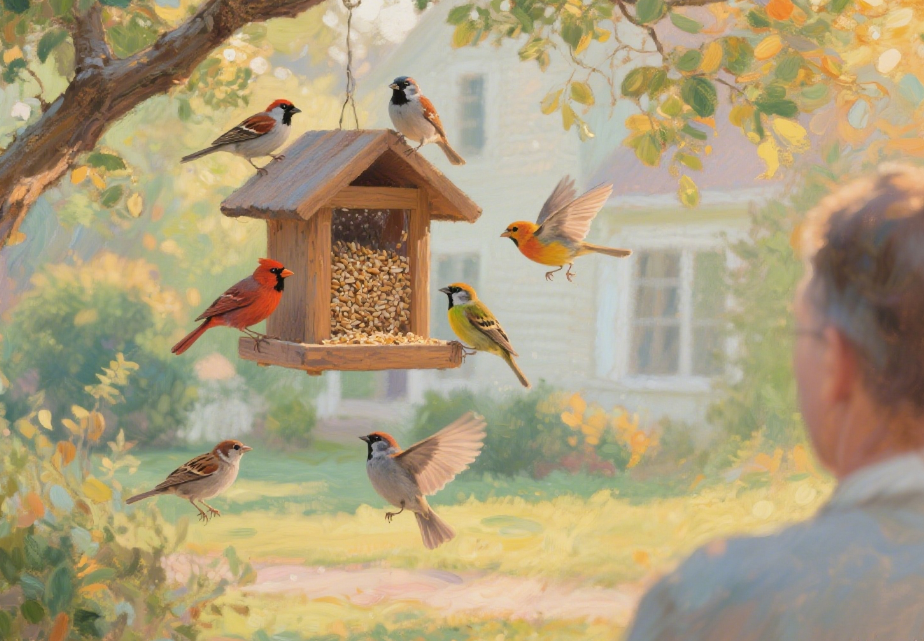
When humans gaze at the birds hopping around in American gardens through bird feeders, this seemingly casual interaction actually holds profound meaning and value. This behavior is by no means mere leisure; it is a unique window into the dialogue between humans and nature, reflecting the delicate balance of ecological relationships while also mirroring humanity's understanding and responsibility toward the natural world.
From an ecological perspective, the presence of bird feeders reshapes the survival trajectories of local bird populations. During seasons of food scarcity, artificial feeding may become a critical factor in the survival of certain species, particularly for small songbirds overwintering in the area, as a stable food source can significantly increase their survival rates. However, this intervention also carries hidden risks: prolonged reliance on human provisioning may weaken birds' natural foraging abilities, alter their migratory patterns, and even disrupt the competitive balance among species. For example, dominant species may overpopulate due to the aggregation effect of bird feeders, squeezing out the living space of weaker bird species. Therefore, observing behavior itself should include an examination of ecological chain reactions—are we repairing nature, or disrupting its inherent rhythms under the guise of goodwill?
From a cognitive perspective, bird feeders serve as natural laboratories for humans to understand bird behavior. Through sustained observation, people can directly perceive birds' social structures, reproductive strategies, and individual intelligence: how male birds use calls to assert territory, how parent birds collaborate to raise chicks, and even how certain species remember the faces of specific feeders. This close interaction shatters humanity’s abstract imagination of “wildlife,” transforming it into concrete living beings. When we can distinguish the sparrow with the damaged tail feathers among the regular visitors, or notice that a particular blue tit always appears at dawn, the concept of species gains a human touch. This emotional connection is the fertile soil from which ecological conservation awareness sprouts.
The deeper value lies in how this interaction forces humans to reflect on their place in nature. The bird feeder serves as a miniature stage, where the tug-of-war between dependence and independence, intervention and respect unfolds. It reminds us that every human action, no matter how small—such as placing a single seed—can have profound implications for other lives. This awareness can awaken a latent sense of responsibility—while we enjoy the pleasure of observation, should we also take on the obligation to maintain ecological balance? For example, choosing natural foods suitable for local bird species, avoiding feeding bread or salty foods that may harm their health; regularly cleaning the bird feeder to prevent disease transmission; or even preserving native plants in garden design to provide birds with a more natural habitat.
Additionally, this behavior carries cultural and emotional significance. In the fast-paced modern life, pausing before a bird feeder becomes a ritual of slowing down. The presence of birds infuses vitality into the cracks of concrete cities, and their songs serve as the natural background music of life, alleviating anxiety and healing fatigue. This spiritual comfort may be difficult to quantify, yet it forms an important emotional bond between humans and nature. When children first see the North American redbird in books, and when the elderly find joy in life through feeding birds, bird feeders transcend their utilitarian function to become a medium for conveying the beauty of nature.
Of course, the purpose of reflection is not to negate such behavior but to allow it to unfold with greater awareness. Humans need not abandon opportunities to connect with nature out of fear of interference; the key lies in acting with humility—acknowledging the limitations of our understanding, learning through observation, and adjusting through interaction. As ecologist Aldo Leopold once said, “We must think like mountains.” In a fleeting glance, we see both the vibrant feathers and the complex ecological web; we enjoy the joy of the present while anticipating the responsibilities of the future.
Therefore, when our gaze once again turns to the birds by the feeder, this observation transforms into a journey of self-reflection. It teaches us that every encounter with nature is an opportunity to reinterpret life and redefine ourselves, and that contemplating the meaning behind our actions is the inevitable path toward a mature ecological ethics.
When observing birds in American gardens through bird feeders, should humans consider the meaning and value of this behavior
Jul 28, 2025 Bird knowledge presenters