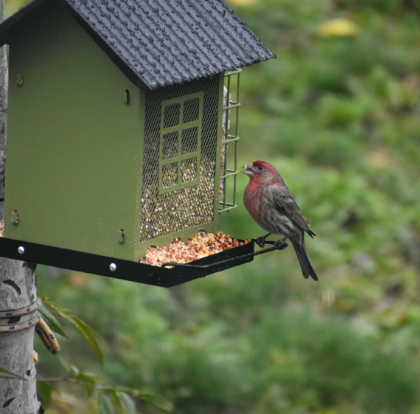
On the American continent, from the New England region in the northeastern United States to the edge of the Amazon Basin in South America, courtyard bird watching has become a cultural practice that permeates daily life. This bird watching activity, carried out through family courtyards and community gardens, is not only a bridge for dialogue between humans and nature, but also creates irreplaceable value and significance for humanity in multiple dimensions such as ecological protection, physical and mental health, and cultural inheritance.
1、 Ecological Value: A "Health Monitor" for Microenvironment and a Guardian of Biodiversity
The existence and activities of courtyard birds in the Americas are essentially a barometer of the regional ecosystem. Different bird species have strict requirements for vegetation types, water source quality, and insect populations in their habitats - for example, the North American main Cardinals prefer courtyards covered with shrubs, while hummingbirds rely on flowers rich in nectars. When people observe and record changes in the species of birds in their courtyards, they are actually completing a "citizen science" monitoring: if the number of a certain carnivorous bird species (such as warblers) sharply decreases, it may indicate pesticide abuse around the courtyard; The emergence of raptors such as peregrine falcons and red tailed pheasants indicates a high degree of integrity in the regional food chain.
This kind of viewing activity can also promote the optimization of courtyard ecology in reverse. To attract more birds, people actively plant local plants (such as holly trees that provide berries for mockingbirds and dead wood that provides nesting sites for woodpeckers), build artificial bird nests, and set up chemical free drinking water pools. According to the National Wildlife Federation, in 2023 alone, over 12 million households in the United States have transformed their courtyards to provide temporary habitats for more than 200 species of birds, such as thrushes and blue jays, indirectly alleviating the problem of fragmented bird habitats in urbanization.
2、 Health Value: A "Green Prescription" for Natural Healing and a "Pressure Reducing Valve" for Emotional Regulation
Modern medical and psychological research has confirmed that bird watching in courtyards has a significant positive impact on human physical and mental health. A research report released by the Harvard School of Public Health in 2024 showed that people who observe birds in their yards for more than 15 minutes a day have a 28% lower incidence of anxiety symptoms and smoother fluctuations in blood pressure compared to the general population. This healing effect stems from the dual effects of the dynamic beauty of birds and natural sounds - the color contrast of feathers (such as the emerald blue of bluebirds and the bright red of main cardinals) can stimulate the visual nerves and relieve visual fatigue; And bird songs (such as the morning singing of thrushes and the buzzing of hummingbirds) have been shown to lower cortisol levels and relieve stress.
For special groups, the value of courtyard bird watching is more prominent. In the elderly population, observing the nesting and brooding behavior of birds can effectively alleviate loneliness and enhance life participation; Tracking bird activities in children can cultivate focus and observation skills, and reduce dependence on electronic devices. Experiments conducted by the University of Montreal in Canada have shown that children who regularly participate in backyard bird watching have a 34% higher natural cognitive ability score than their peers and are more inclined to practice environmental behaviors.
3、 Culture and Social Values: The Link between Cross Regional 'Natural Language' and Community Connection
The bird watching in American courtyards carries rich cultural connotations and has become a "natural language" shared by different regions and ethnic groups. In North America, the main Cardinals are seen as a "symbol of hope" due to their red feathers that contrast sharply with winter landscapes, often appearing in holiday decorations and literary works; In Mexico, hummingbirds are included in the totem of "vitality" in Indian culture due to their agile flying posture. This shared concern for birds transcends regional and cultural differences, forming a cross regional natural and cultural identity.
At the societal level, bird watching in courtyards has become a link connecting communities. Many communities organize activities such as "Courtyard Bird Watching Competition" and "Bird Photography Exhibition" to encourage residents to share bird watching records and exchange experiences in courtyard renovation. The "Great Backyard Bird Count" campaign initiated by the Cornell Lab of Ornithology in the United States attracts over 100000 households to participate annually. Participants submit bird watching data through an online platform, providing valuable information for bird research and enhancing community cohesion. In addition, courtyard bird watching has also driven the development of related industries, such as the production of bird feed, nest boxes, bird watching telescopes and other products, injecting vitality into the local economy.
4、 Educational Value: The "Living Textbook" of Nature Education and the Enlightener of Environmental Awareness
The courtyard, as a "miniature natural classroom," provides humans with the opportunity to observe bird ecological behavior up close. By observing the feeding behavior of birds, people can understand the dietary differences of different birds (such as woodpeckers pecking at insects in tree trunks, sparrows feeding on grass seeds on the ground); By recording the migration time of birds, we can intuitively understand the relationship between "seasonal changes" and "ecological adaptation". This practice based nature education is more infectious than textbook knowledge, and can make people deeply realize the close connection between human activities and bird survival - for example, when native plants planted in the courtyard attract more birds, people will intuitively feel the importance of plant conservation to biodiversity.
More importantly, bird watching in the courtyard can enlighten environmental awareness and promote changes in human behavior. When people discover that a certain type of bird has decreased due to the use of chemical pesticides in the courtyard, they will actively choose organic planting; When it is learned that plastic waste may lead to bird ingestion and death, more attention will be paid to garbage classification. The transformation from observation to action is the core goal of environmental education, and courtyard bird watching provides the most direct driving force for this transformation.
Conclusion
Bird watching in American courtyards is not simply a "leisure activity", but an important way for humans to interact with nature. It safeguards the balance of the micro environment at the ecological level, provides natural healing power at the health level, connects people and communities at the cultural and social level, and enlightens environmental awareness at the educational level. With the acceleration of urbanization, the value of courtyards as the "last mile" of dialogue between humans and nature will become increasingly prominent. In the future, when more people start paying attention to the birds in their courtyards, they are actually guarding the possibility of "harmonious coexistence between humans and nature" - not only for the protection of birds, but also for the improvement of human's own quality of life.
What value and significance does birdwatching in the Americas hold for humans?
Aug 27, 2025 Bird knowledge presenters