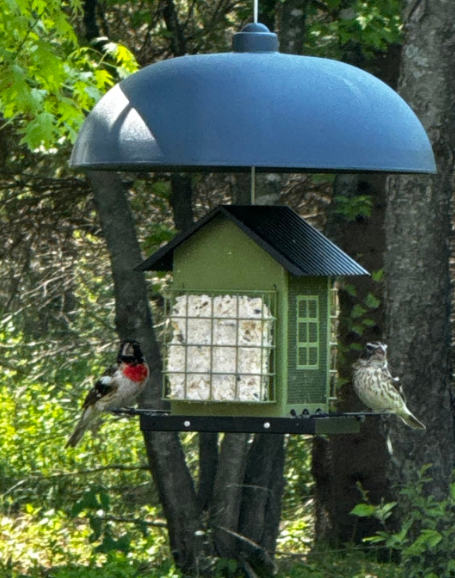
In the early morning of the American courtyard, when the first ray of sunlight passes through the branches and leaves of the oak tree, the tufted tit will land first on the feeder hanging sunflower seeds, pecking quickly and accurately; On the lawn in the afternoon, the American mockingbird takes light and agile steps, lowers its head to explore the earthworms in the soil, and occasionally looks around vigilantly. Behind the seemingly casual eating behavior of these little elves shuttling through the courtyard, there are actually "ideas" and "propositions" based on survival instincts, and whether they should eat on time also needs to be found in their survival logic.
From the perspective of birds, the core proposition of feeding always revolves around "energy acquisition" and "safety first". For smaller birds, such as the dark eyed bunting, their metabolism is extremely fast and they need to consume food equivalent to 1/4 of their body weight every day to maintain body temperature and activity. Therefore, their "feeding thoughts" are very direct - they seize all available foraging opportunities without strictly following the "time rule". In the courtyard, as long as there are seeds in the feeders or fallen berries on the lawn, they will visit at any time, even if it has only been half an hour since their last feeding. This "eat less, eat more" pattern is to avoid energy depletion caused by prolonged fasting, as missing a foraging opportunity in the wild could mean facing a survival crisis.
For slightly larger birds, such as blue jays, their feeding "claims" have an additional layer of "reserve consciousness". Blue ravens not only peck at nuts and seeds on the spot, but also take away some of the hidden tree holes, grass or soil in the courtyard as a "reserve food" in case of food shortage. In their 'cognition', eating is not only about meeting current needs, but also about preparing for the future, so 'when to eat' depends on the availability of food: if they find the feeder filled with peanuts in the morning, they will prioritize eating and storing them here; If the afternoon rainstorm makes it difficult to catch earthworms on the ground, they will take out the nuts stored before, and the time rule is no longer important in front of the "survival needs".
In addition, "safety" is another important consideration for birds when feeding. Whether it's mourning doves foraging on the ground or main Cardinals pecking at fruits on branches, they always pay attention to the presence of natural enemies (such as eagles and cats) around them. Once danger is detected, even if it is during the "habitual" eating time, they will immediately fly away to avoid it. In this case, bird feeding behavior tends to be more "opportunistic" rather than following a fixed time, and the principle of "safety first" far outweighs the rule of "eating on time".
So, from the perspective of human observation and care, should birds "eat" on time? There is actually no absolute answer, the key is to respect the natural habits of birds. If the owner of the courtyard hopes to attract birds through feeding, a fixed feeding time (such as once in the morning and once in the evening) can actually help birds form a "conditioned reflex" - they will gradually become familiar with a stable food source at this time point, reduce unnecessary energy consumption, especially in winter when food is scarce. Regular feeding can significantly improve the survival rate of birds. However, it should be noted that this "on-time" approach does not strictly restrict the feeding freedom of birds, but provides "predictable food supplementation". Birds will still search for natural foods (such as insects and fruits) at other times according to their own needs, and will not rely entirely on artificial feeding.
On the contrary, if birds are forcibly constrained by the "human concept of time", such as only opening feeders at fixed times and consuming very little food, it may actually disrupt their natural foraging rhythm. For example, during the breeding season, female birds need to eat frequently to ensure energy for laying eggs and raising chicks. If the feeding time is too fixed at this time, it may cause them to miss the critical energy replenishment opportunity, affecting the success rate of reproduction. Therefore, the core of "eating on time" should be "providing stable support" rather than "mandatory rules", allowing birds to find a balance between natural foraging and artificial supplementation, which is the most suitable way for their survival needs.
Overall, the feeding "ideas" of courtyard birds in the Americas stem from survival instincts - obtaining sufficient food with minimal energy consumption and the highest safety factor; Whether to eat on time or not requires humans to provide flexible and stable food support while respecting their natural habits. When we see birds in the courtyard pecking in the morning light and foraging under the shade of trees in the afternoon, we understand that for them, the best "feeding pattern" is to follow the natural survival wisdom.
We recommend our bird feeder!