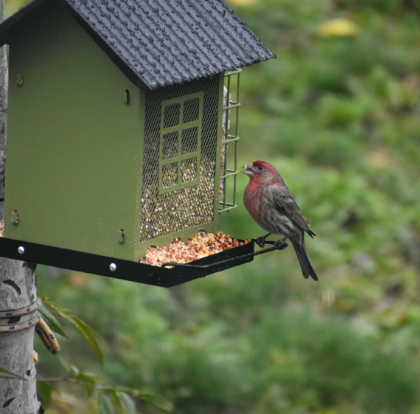
In the courtyard ecosystems of the American continent, frequent rainfall is both an environmental challenge and a catalyst for natural selection. The birds living here have evolved over a long period of time and developed a complete response system that covers habitat, foraging, and physiological regulation. From tiny hummingbirds to larger blue jays, each bird has its unique "rain protection wisdom". These strategies not only ensure their survival in rainy weather, but also reflect the exquisite adaptation of organisms to the environment.
1、 Habitat: Building a 'Rainproof Shelter'
The primary rainproof strategy for courtyard birds in the Americas is to find or construct safe habitats to avoid direct rainwater intrusion. For most bird species in the Passeriformes order, such as the main Cardinals and the Vermilion, the trees in the courtyard are natural shelters - they choose dense coniferous trees (such as pine and spruce) or the middle branches of broad-leaved trees, which can block rainwater through dense branches and leaves, and reduce the slanting rain caused by strong winds with the help of tree trunks. Research has found that in the rainy southeastern United States, house sparrows even actively gather in shrubs in their yards to resist moisture and low temperatures through group gathering. Group dwelling can increase local temperatures by 2-3 ℃ and reduce the rate of heat loss.
Some birds also take advantage of the convenience of artificial environments. Blue ravens and crown ravens often enter bird houses, garage eaves, or balcony corners built by humans, and the rain blocking effect of these artificial structures is far beyond that of natural vegetation. And birds like hummingbirds, which are small in size, tend to choose more concealed micro spaces, such as "natural tents" formed by vines entwining in the courtyard, or hanging behind flower pots under the eaves, which only require a very small dry area to avoid rainfall. It is worth noting that when the rain is heavy, most birds will reduce their activity, keep their bodies still, tighten their feathers tightly against their bodies, reduce the gaps where rainwater seeps in, and lower energy consumption.
2、 Feather: Comes with a "waterproof coat" and "temperature control system"
The feathers of birds are the core "equipment" for coping with rainy days. The feather structure of courtyard birds in the Americas has been highly specialized, with dual functions of waterproofing and insulation. The surface of the outer feathers is covered with a layer of oil secreted by the tail fat gland. Birds frequently comb their feathers before or after rain, and use their beaks to evenly apply the oil from the tail fat gland to the feathers, forming a hydrophobic film. This "self waxing" behavior is more common among waterbirds, but birds such as thrushes and bluebirds in the yard are also proficient in this technique - experimental observations have shown that feathers treated with oil can quickly slide down rainwater, avoiding weight gain and affecting flight after the feathers are soaked.
The inner layer of feathers bears the responsibility of insulation. The fluffy feathers are slender and soft, rich in air, and can form a thermal insulation layer around the body. Even if the outer feathers are dampened by a small amount of rainwater, the air in the down feathers can effectively prevent heat loss. In continuous rainy weather, birds will compress the air layer in their feathers by contracting their bodies and tightening their feathers, further enhancing the insulation effect. For example, the dark eyed bunting will curl up its body into a spherical shape on rainy days, burying its head in feathers and only exposing its eyes to observe the surrounding environment. This posture can minimize heat loss and reduce the area of rainwater in contact with its body.
3、 Foraging: Adjusting the "Recipe" and "Time"
Frequent rainfall can alter the distribution of food in the courtyard, leading to the development of flexible foraging strategies by American courtyard birds. When the rain is low, birds that forage on the ground (such as thrushes and mockingbirds) will adjust their foraging locations - they, who originally searched for earthworms and insects on the lawn, will move to areas under shrubs or tree roots where soil moisture is lower and insects and invertebrates are more concentrated, while also avoiding direct eye wash from rainwater. Birds that feed on seeds and berries, such as the main cardinals and goldfinches, are less affected by rainfall. They will continue to forage on bird feeders or fruit trees, and even use the fruits washed away by rainwater - rainwater can soften the fruit skin, making it easier for them to peck at the flesh.
During rainfall, birds also adjust their foraging time. Most courtyard birds will concentrate on foraging during the intervals when the rain stops, using the brief dry period to replenish energy. For example, in the rainy Pacific Northwest region, the Anna hummingbird quickly flies to the flowers in the yard during each rainfall pause, feeding on nectar and preying on small insects between the flowers, completing an efficient foraging process in just 10-15 minutes. For birds with a larger appetite, such as blue jays, they also store food before rain - hiding nuts and seeds in the crevices of tree bark or soil in the yard, relying on the stored food to survive when continuous rainfall prevents them from going out to forage.
4、 Breeding: Guarding the 'nest' and 'offspring'
For courtyard birds in the breeding season in the Americas, frequent rainfall means more severe challenges, and they need to make every effort to protect their nests and chicks. Firstly, birds tend to choose nesting sites with better shelter from rain - for example, building their nests at the branching points of the middle branches of trees, or using the eaves and windowsills of buildings, which can effectively block rainwater. Birds of the Oriole family (such as the Yellow breasted Bunting) also undergo "reinforcement and modification" of their nests, using materials such as moss, bark fibers, etc. to thicken the nest walls, and designing a slight tilt angle at the nest mouth to prevent rainwater from flowing into the nest.
When it rains, the parent birds take turns guarding the nest. The parent bird responsible for incubating the eggs will always lie on the nest, covering the eggs or chicks with its body, which not only provides temperature but also blocks rainwater from dripping onto the offspring. If the rain is heavy, the parent bird will spread its wings and form a "protective umbrella", completely covering the nest under its wings. For example, in rainy weather, the swallow will tightly stick its body to the nest wall, spread its wings to both sides, covering the entire nest mouth. Even if rainwater flows down the eaves, it can be blocked by its wings, ensuring that the nest is dry. For young birds that have already left the nest but have not yet become independent, the parent bird will guide them to hide in dense shrubs, while increasing their foraging frequency, providing more food for the young birds, and helping them cope with the energy consumption caused by humid environments.
5、 Special Adaptation: Emergency Plan for Extreme Rainfall
When encountering rainstorm or continuous heavy rainfall, American garden birds will initiate more special countermeasures. Smaller birds, such as the warbler, will seek more concealed "shelters", such as hollow branches in courtyards, abandoned woodpecker burrows, and even burrow into bird houses placed by humans, which can completely isolate rainwater. Larger birds, such as wild turkeys and mourning doves, will adopt a "squatting and sheltering" strategy - they will find areas with higher ground and no standing water, squat down, contract their heads and necks below their bodies, use their backs to withstand rainwater, and close their eyes tightly to reduce the stimulation of rainwater on their eyes.
Some birds also take advantage of the "advantage" of rainfall. For example, woodpeckers in the courtyard will peck at trees after rain - rainwater softens the bark and xylem of trees, making it easier for them to catch insect larvae under the bark; And waterbirds such as pelicans and cormorants will go out to fish during rainfall, and the ripples formed by the rainwater on the water surface can cover their figures and increase the success rate of fishing. These special adaptations not only reflect the survival wisdom of birds, but also demonstrate their coordinated development with rainfall environments in long-term evolution.
The response measures of American courtyard birds to frequent rainy days are the survival wisdom formed by their natural selection. From the selection of habitat space to self-regulation of feathers, from the adjustment of foraging strategies to the protection of breeding seasons, each behavior is precisely adapted to the environmental characteristics of rainy days. These strategies not only ensure their survival in changing climates, but also provide vivid examples for us to observe the interaction between organisms and the environment - when we see a small bird curled up under a shrub in a rainy courtyard, or a mockingbird grooming its feathers, we can feel the resilience and subtlety of life adapting to nature.
We recommend our Flowafoli bird feeder!