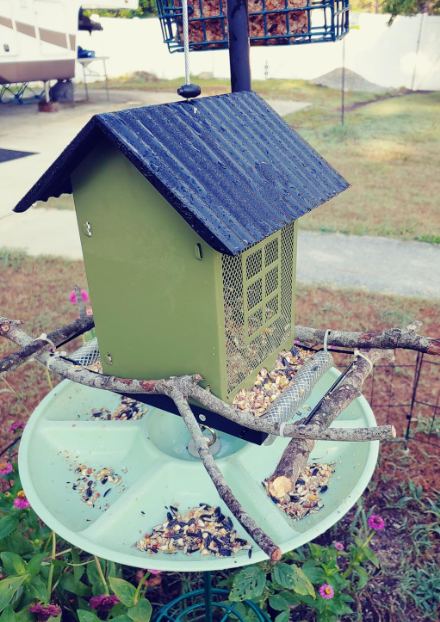
The Communication Mindset between Birds and Humans in American Courtyards
In the unique ecological space of the American courtyard, there is frequent and close interaction between birds and humans. In the courtyard, there are both carefully crafted green plant landscapes and artificial feeding points by humans, as well as natural nesting and foraging areas for birds. This semi natural and semi artificial environment determines that birds need to communicate and interact with humans with intelligence and flexibility in order to achieve harmonious coexistence between both parties.
1、 Peaceful mentality of equal coexistence: abandoning "opposition" and viewing humanity as a courtyard community
The birds in the American courtyard should first uphold a peaceful attitude of equal coexistence, not seeing humans as threats or "dominants", but as common members of the courtyard ecosystem. Many owners of American gardens actively create environments suitable for bird survival, such as planting plants that birds love, such as North American red maple and blueberry shrubs, setting up shallow pots filled with water for birds to drink and bathe, and even placing feeders filled with sunflower seeds and millet in winter. At this point, if birds can approach with a peaceful attitude and not panic excessively due to human proximity, they can gradually make humans feel their friendliness. For example, the common main Cardinals in North America, if they can calmly comb their feathers on nearby branches while humans are tending to their yards, or slowly approach and feed when humans are feeding, this calm and composed posture will make humans more willing to continue providing assistance, forming a virtuous cycle of "humans maintaining the environment and birds decorating the yard". The core of this mentality is that birds realize that not all human activities are harmful to themselves, and often provide convenience for their survival, thus viewing the coexistence relationship between both parties from an equal perspective.
2、 A rational mindset that combines vigilance and trust: Hold onto the safety bottom line and gradually establish trust
Although many courtyards in the Americas are friendly environments, birds still need to maintain a rational mindset of vigilance and trust, gradually building trust with humans while ensuring their own safety. In some parts of the Americas, there may be potential threats such as pet cats and dogs in the courtyards, and some sudden human behaviors (such as sudden sounds and rapid movements) may also make birds feel dangerous. Therefore, when birds communicate with humans, they need to always maintain a "safe distance awareness" - for example, when humans feed them, they should first observe from a distance, confirm that there is no danger, and then slowly approach; When humans attempt to capture or touch up close, if it exceeds the safe range, they should fly away in a timely manner. At the same time, birds also need to accumulate trust through continuous interaction, such as foraging in a specific area of the courtyard to familiarize humans with their activity patterns; During the breeding season, if humans do not interfere with the bird's nest, their vigilance towards humans gradually decreases. This rational mindset can not only help birds avoid potential risks, but also lay the foundation for establishing a stable interactive relationship between both parties.
3、 Proactively expressing needs with a positive mindset: using "signals" to convey demands and guide human assistance
In the interaction of American courtyards, birds should also have a positive attitude of actively expressing their needs, conveying survival demands to humans through specific behaviors or "signals", and guiding humans to provide assistance. For example, when the water source in the courtyard is insufficient, birds may frequently hover in front of humans or stop at the location where the water basin was previously placed, chirping to remind humans to replenish water; When food is scarce in winter, if it is found that humans have not added food to the feeder in a timely manner, birds may fly towards the feeder and make urgent calls when humans approach, indicating a food shortage. In addition, when facing potential threats, birds may also seek help from humans through special behaviors. For example, when a snake is found approaching the nest, birds may continuously dive and chirp around humans to attract their attention and drive away the snake. This proactive attitude of expressing needs can enable humans to more accurately understand the survival status of birds, provide timely assistance, and further strengthen the symbiotic relationship between both parties.
In short, in American gardens, the communication mentality between birds and humans is not a single dimension, but a combination of equality, rationality, and positivity. This mentality not only enables birds to ensure their own survival through interaction with humans, but also allows humans to feel the vitality and energy of nature, ultimately achieving harmonious coexistence between humans and nature in courtyard ecology.
We recommend our Flowafoli bird feeder!