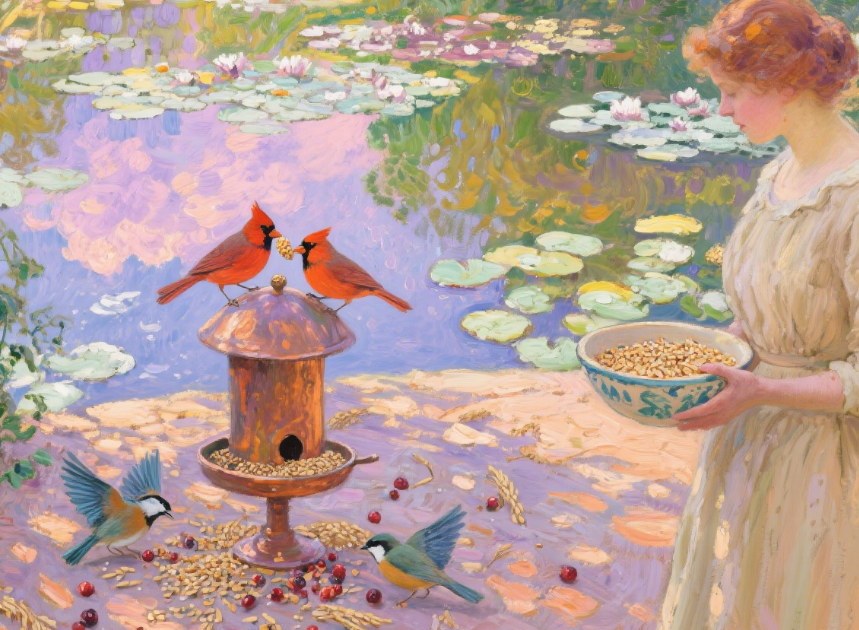
In the process of interacting with courtyard birds in the Americas, humans should uphold the mentality of respecting nature, moderate intervention, and scientific protection, and the use of bird feeders should become a concrete practice of this mentality, satisfying the pleasure of bird watching without disrupting the natural survival rhythm of birds.
Firstly, these feathered elves should be viewed from an equal perspective of life. The birds in American courtyards, whether they are the bright and lively of the North American Cardinals, the agile of the Tits, or the steady of the Thrush, are all important members of the ecosystem. Their migration, foraging, and reproduction follow the laws of millions of years of evolution. Humans should not consider them as "pets" or "landscape decorations", but rather recognize their independent survival value. This mentality means that we need to restrain excessive possessiveness and not attempt to change their natural behavior patterns through feeding, such as not deliberately luring rare birds away from their migration routes, nor disrupting the balance between species by feeding only one type of bird based on personal preferences.
Secondly, it is necessary to maintain a cautious attitude towards intervention. The existence of bird feeders should be a "supplement" to natural food shortages, rather than a "replacement". Moderate food can provide survival assistance for birds during harsh winters, dry seasons, or when habitats are compressed due to urbanization; However, during the abundant food seasons of spring and autumn, excessive feeding may lead to bird dependence on humans, weaken their ability to forage in the wild, and even pose a risk of disease transmission due to high population density. For example, if the common blue Jay in the Americas relies on bird feeders for a long time, it may reduce its feeding on insects and fruits in the forest, indirectly affecting plant pollination and seed dispersal. Therefore, humans need to adjust the feeding frequency and food types according to seasonal changes, so that bird feeders become natural "helpers" rather than "dominators".
Furthermore, we must use scientific methods to fulfill our protective responsibilities. When choosing a bird feeder, it is necessary to consider the habits of birds: smaller sparrows are suitable for hanging fine mouthed bird feeders, while sparrows that like to forage on the ground are more suitable for platform designs; The choice of food should be close to their natural diet, such as providing freeze-dried insects for carnivorous birds, preparing salt free grains for grain eating birds, and avoiding feeding human foods such as bread and potato chips - these foods not only lack nutrition, but may also cause indigestion in birds. At the same time, regular cleaning of bird feeders is an essential step. Residual food residues and feces may breed mold and bacteria, causing diseases such as avian influenza. This is not only responsible for the health of birds, but also for the protection of human beings and the surrounding ecology.
In addition, it is necessary to maintain a quiet observer posture during bird watching. Excessive proximity and frequent disturbance to the habitat of birds may put them in a state of stress, affecting their reproductive behavior. For example, North American Cardinals are extremely sensitive to disturbances during their nesting period, and frequent human observation may lead to parent birds abandoning their nests. Therefore, the location of bird feeders should be far away from areas with high human activity. When watching birds, try to use a telescope to observe from a distance, so that birds can live freely in a safe environment.
Ultimately, the core mentality towards courtyard birds in the Americas is to find a balance between "closeness" and "distance". The bird feeder should not be a tool for humans to control nature, but a bridge connecting humans and nature - through it, we can experience the vitality of life up close and understand more deeply that true protection is to allow birds to share the sunshine and greenery of this courtyard with humans while maintaining their wildness. 
What kind of attitude should humans have towards and use bird feeders for birds in American courtyards
Jul 25, 2025 Bird knowledge presenters