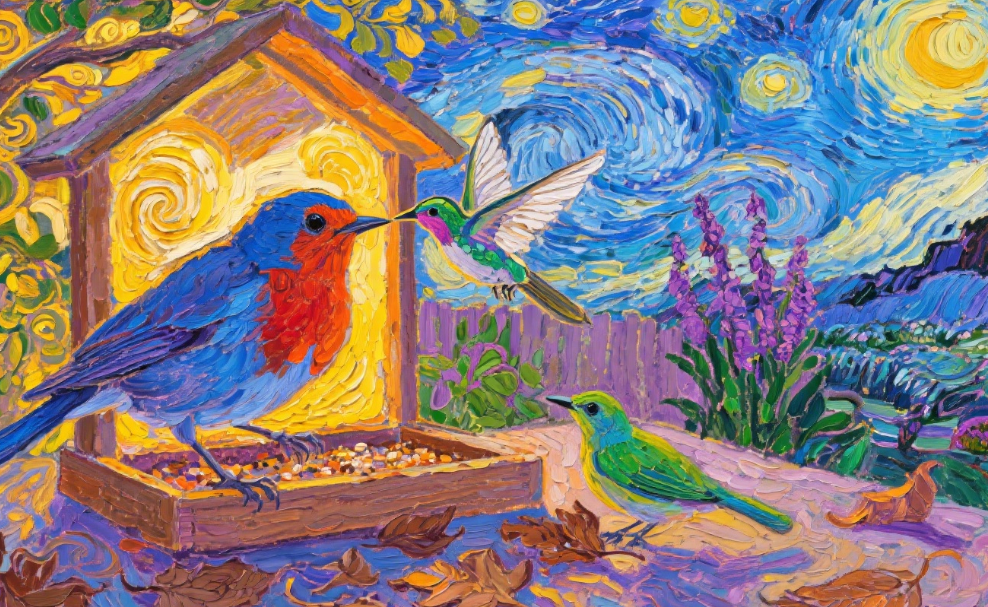
In the early morning of the American courtyard, sunlight filters through the leaves, casting dappled patterns of light and shadow. Various bird species gather around the feeder to begin their daily feeding activities. This seemingly ordinary natural scene actually hides a sophisticated “social order,” offering profound inspiration and insights for the construction of human social systems.
The Wisdom of Dynamic Resource Allocation Balance
When birds feed, different species form implicit “resource allocation agreements” based on their own habits. Larger blue jays use their physical advantage to claim the central position at the feeder, yet they voluntarily leave the edges for hummingbirds that dart in and out quickly—the latter require frequent feeding to maintain their metabolism. This “stronger yielding to the weaker” is not a moral constraint but an evolutionary strategy for coexistence. This suggests that human societies should not rely solely on rigid institutional divisions in resource allocation but should instead establish dynamic adaptive mechanisms: reserving flexible allocation channels for the survival needs of different groups (such as basic safeguards for vulnerable groups and trial-and-error space for innovative groups), ensuring that resource flows are both efficient and equitable.
Collaboration Codes Within Hierarchical Orders
Observations reveal that the “pecking order” hierarchy among North American redbirds is not an absolute authority. When predators like hawks appear, the weaker sparrows issue the first warning, while the dominant blue jays take charge of diving to drive them away. This “role reversal in crisis” reveals that a healthy social system requires the dialectical unity of hierarchy and collaboration. The hierarchical structure of human society should not be a rigid pyramid but, like bird communities, maintain order and efficiency in daily operations while activating cross-hierarchical collaboration during sudden challenges—as demonstrated by the rapid coordination between grassroots communities and research institutions during the pandemic, which proved the risk-resilient value of a flexible structure.
The symbiotic philosophy of ecological niche construction
Birds in courtyards unconsciously participate in “ecological niche complementarity”: robins flip through fallen leaves to find insects, and their droppings provide nutrients for flowers and plants; goldfinches scatter seeds while feeding, which become food sources for ground-foraging birds. This “each doing their part, cyclical symbiosis” model provides a blueprint for constructing industrial systems in human society. The excessive emphasis on competition in modern society, leading to resource depletion, may benefit from borrowing birds' “symbiosis logic” to establish functional complementary networks within industrial chains—such as the integration of agriculture and tourism, or the synergy between manufacturing and services—ensuring each sector finds its irreplaceable value anchor within the ecological cycle.
Adaptable Flexible Rules
When the type of food in the feeder changes (e.g., from grains to berries), bird populations quickly adjust their proportions: waxwings decrease, while cedar waxwings increase. This “rule flexibility” suggests that human societies should reserve evolutionary interfaces when establishing institutions. For example, tax policies should not be rigid but should dynamically adjust with changes in industrial structure; educational systems should break down disciplinary barriers to adapt to the demands of an era requiring cross-disciplinary innovation.
The feeding scenes of birds in American gardens are essentially “micro-social experiments” shaped by natural selection. They tell us that an ideal social system should not be a meticulously designed machine created by humans, but rather, like natural ecosystems, maintain the vitality to self-adjust through the balance of order and freedom, competition and collaboration. This wisdom derived from nature may be the key insight for human society to break through development bottlenecks.
What inspiration and insights can humans draw from the feeding behavior of birds in American gardens for the construction of human social systems?
Aug 12, 2025 Bird knowledge presenters