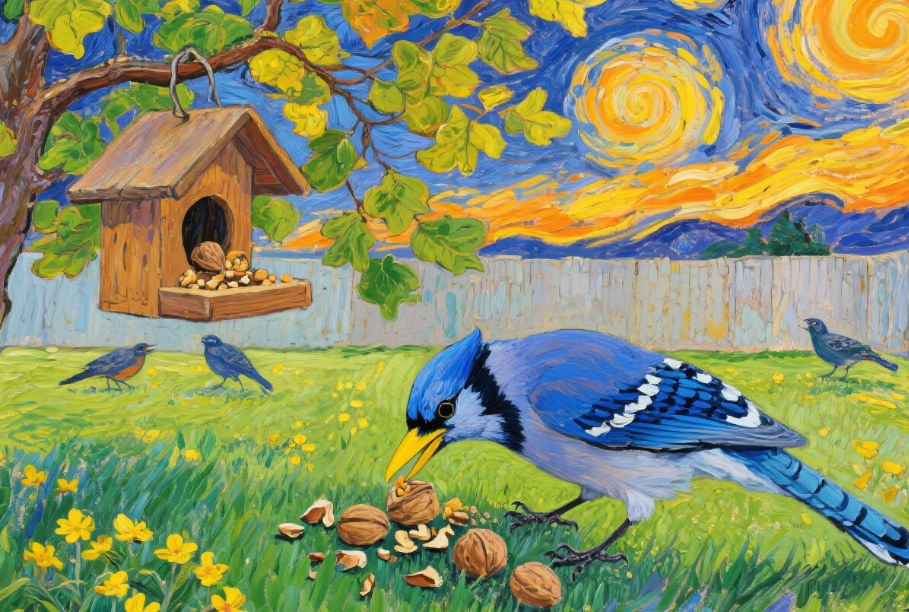
The Feeding Behavior of Birds in American Gardens and Its Implications for Humans
In American gardens, during the early morning or evening hours, one can often observe various bird species gathering around feeders or on lawns to feed. These agile creatures exhibit a series of intriguing behavioral patterns as they peck, compete for, and share food, and these patterns hold profound insights that can inform human life, social collaboration, and ecological conservation.
1. Mutualism and Symbiosis: Building a Win-Win Network of Relationships
In American gardens, the feeding behaviors of different bird species often exhibit characteristics of “mutualism and symbiosis.” For example, larger blue jays, while pecking at nuts, inadvertently scatter some nut fragments onto the ground, which smaller sparrows then peck at; Meanwhile, sparrows are more vigilant about their surroundings. When they detect danger (such as approaching eagles), they issue warnings through their calls. Upon hearing the warning, blue jays can promptly evade the threat. This interaction, where “larger birds provide food scraps and smaller birds provide safety warnings,” forms a stable symbiotic relationship.
This behavior offers insights for humans: mutual benefit is the core of building sustainable relationships. In human society, whether in business partnerships, team collaboration, or neighborhood interactions, we must abandon the “zero-sum game” mindset and actively seek areas where both parties' interests align. Just like the birds in the courtyard, each individual or group has its own strengths and weaknesses. By complementing each other's strengths and sharing resources, we can not only enhance overall efficiency and safety but also strengthen relationships through mutual assistance. For example, in technological cooperation between companies, one party provides R&D capabilities while the other provides market channels, ultimately achieving a “1+1>2” effect; among neighbors, young families help the elderly with electronic device issues, while the elderly assist in caring for children, creating a warmer community atmosphere.
II. Order and Inclusion: Balancing Competition and Harmony
Observing the feeding behavior of birds in an American backyard reveals a phenomenon of “orderly competition.” When multiple bird species gather around a feeder, they do not scramble chaotically for food. Typically, larger, more aggressive birds (such as the common redpoll) will prioritize occupying the central position at the feeder, but they do not completely exclude other birds. When smaller birds (such as the goldfinch) cautiously approach the edges, the common redpoll often tacitly allows their presence, only gently chasing them away if they overstep their boundaries. This “core area priority, peripheral area sharing” order ensures their own feeding needs while also leaving space for other species to survive.
When applied to human society, this behavior represents the **“balance between order and inclusivity”**. In human society, competition is ubiquitous—whether it be promotions in the workplace, resource争夺 in the market, or ideological clashes in academia—it is essential to establish a reasonable “order” to regulate competitive behavior and prevent chaotic internal conflicts. However, ‘order’ should not become a barrier that excludes others; it must also possess a certain degree of “inclusivity” . Just like the feeder in the courtyard, prioritizing core resources can incentivize individuals or groups to enhance their capabilities, but it must also leave room for vulnerable groups and emerging forces to develop. For example, in the workplace, senior employees may secure leadership roles in important projects based on their experience, but newcomers should also be given opportunities to collaborate and gain experience; In the allocation of social resources, while ensuring the development needs of core areas, attention must also be paid to the basic rights of remote regions and vulnerable groups. Only in an atmosphere of “orderly competition and inclusive coexistence” can society achieve sustainable development.
III. Moderate Extraction: Practicing a Sustainable Resource Perspective
Birds in the American courtyard also demonstrate the wisdom of “moderate extraction” when feeding. Most birds only consume the amount of food needed to meet their immediate needs and rarely engage in “excessive hoarding.” For example, hummingbirds, when sipping nectar from flowers, will linger briefly on one flower, consume a small amount of nectar, and then fly to another flower. They neither drain a single flower of all its nectar (leaving some for other hummingbirds or pollinating insects) nor collect large quantities for “storage”; Even birds that store food (such as jays) bury nuts in scattered locations, and the quantity buried is determined based on the estimated food requirements for winter, avoiding resource waste.
This “moderate taking” behavior holds significant implications for human ecological conservation and resource utilization. Currently, human society faces severe issues such as resource shortages and environmental pollution, largely stemming from an “excessive taking” mindset—pursuing economic gains through over-exploitation of mineral resources, deforestation, and overfishing, which disrupt ecological balance. Bird feeding behavior reminds us: resources are finite, and “moderation” is the prerequisite for sustainability. In daily life, we can practice the principle of “consuming according to need” to reduce unnecessary waste (such as saving food and reducing the use of disposable items); in industrial development, businesses should abandon the “pollute first, clean up later” model and instead enhance resource utilization through technological innovation to achieve “green development”; on a global scale, nations must collaborate to safeguard Earth's resources and avoid sacrificing long-term ecological security for short-term gains.
4. Adaptability and Flexibility: Survival Wisdom in the Face of Change
The seasonal changes in the American garden are distinct: spring brings fresh buds and insects, summer offers abundant fruits and nectar, autumn yields mature nuts, and winter brings scarcity of food. In response to the seasonal changes in food availability, birds adapt their feeding strategies flexibly: in spring, insect-eating birds (such as warblers) focus on catching insects; in summer, fruit-eating birds (such as thrushes) consume large quantities of berries in the garden; in autumn, nut-eating birds (such as woodpeckers) store nuts for winter; in winter, when natural food sources diminish, birds actively approach human-set feeders, relying on artificial feeding for survival.
This behavior of “adjusting strategies in response to environmental changes” teaches humans the survival wisdom of " adapt and be flexible **. In today's rapidly changing modern society, both personal life and business development may face various uncertainties—such as technological advancements, market fluctuations, and environmental changes. If one clings to outdated patterns without adapting flexibly, they risk being left behind by the times. Just like the birds in the garden, if they persist in seeking natural food in winter instead of adapting to artificial feeding, they may face survival crises. For humans, individuals must continuously learn new skills to adapt to changes in workplace demands; businesses must adjust their products and strategies based on market trends to avoid falling into “path dependence”; and society must flexibly optimize policies and systems according to technological advancements and public needs to ensure overall stability and progress.
The feeding behavior of birds in American gardens, though seemingly a simple survival activity, contains profound wisdom about relationships, competition, resources, and adaptation. These insights from nature remind humanity that while pursuing development, we must also learn from the life around us—to achieve mutual benefit through cooperation, embrace diversity through order, safeguard sustainability through moderation, and respond to change with flexibility. Only by doing so can humanity achieve more sustainable development through harmonious coexistence with nature and others.
What insights can human beings gain from the feeding behavior of birds in the American courtyard?
Aug 22, 2025 Bird knowledge presenters