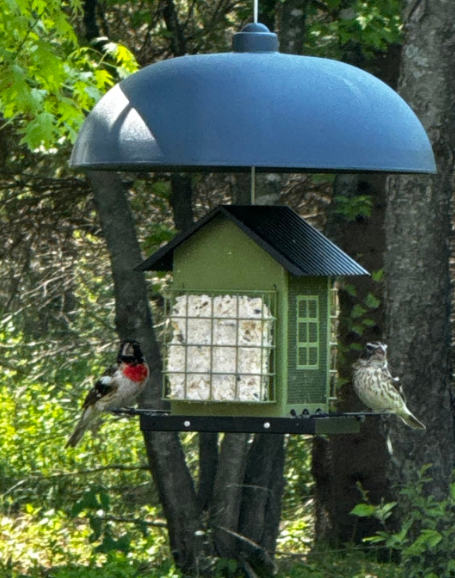
Setting up bird feeders in American courtyards can not only observe diverse bird activities, but also provide supplementary food for local birds, especially during the food scarce autumn and winter seasons. The dietary habits and feeding habits of different birds vary greatly, so choosing the appropriate type of bird feeder is the key to attracting specific birds. The following will provide a detailed introduction to the most common adapted birds in American gardens, as well as corresponding recommendations for selecting bird feeders.
1、 Small songbirds: the most easily attracted "regulars"
Small songbirds are the main visitors to courtyard bird feeders in the Americas. They are small in size, flexible in movement, and have strong adaptability to bird feeders. Common species and adaptation plans are as follows:
North American Cardinals
Medium in size, the male bird has bright red feathers that are highly recognizable, while the female bird has a light reddish brown color. They prefer seeds with shells (such as sunflower seeds and safflower seeds), which are suitable for using platform style bird feeders or tube style bird feeders with perches - platform style allows them to easily stand and feed, while tube style bird feeders have perches that are convenient to stay and prevent the seeds from being blown away by the wind. Please note that North American Cardinals do not prefer to feed upside down, so avoid using bird feeders that only support upside down feeding.
Home Vermilion Bird
Small in size, the male bird's head and chest are light red, while the female bird's entire body is gray brown. They are omnivores who eat both seeds (such as millet and thistle seeds) and small amounts of fruits and insects. They are suitable for tube type bird feeders (with multiple feeding ports for group feeding) or window type bird feeders (for close observation). Vermilion sparrows are not sensitive to the height of bird feeders and can be attracted by hanging them from branches or eaves that are 1.5-2 meters high.
Dark-eyed Junco
Round and chubby in body shape, with a gray brown back and a white belly, is a common visitor in autumn and winter seasons. They have a habit of feeding on the ground, but they also use bird feeders and prefer small particle seeds such as millet and barnyard grass. It is suitable to choose a low platform bird feeder (no more than 1 meter high) or sprinkle a small amount of seeds on the ground (be careful not to attract rodents).
2、 Climbing birds and arboreal birds: need to adapt to feeding posture
These birds are accustomed to moving on tree branches or trunks, and need to use their claws to grip when feeding. The bird feeder should meet the needs of "vertical feeding" or "upside down feeding":
Delichon urbica
The body is slender (about 15 centimeters), with a blue-green back and a white belly, and often moves in clusters. Although they mainly feed on insects, they eat berries and seeds in autumn and winter, making them suitable for using suspended tray feeders (with raised edges to prevent seeds from falling) and hanging in open areas (such as branches in the center of a yard) for easy flight and parking.
Ordinary woodpecker like bird
Small in size (about 17 centimeters), with black and white feathers and a red crest (male bird), it is a typical "arboreal bird". They prefer nuts, crushed peanuts, and insect larvae, and are suitable for wooden bird feeders or hanging bird feeders with nut clips - wooden bird feeders can simulate bark environments and allow them to grip with their claws; Nut clips can fix peanuts or walnuts for easy pecking. In addition, bird feeders should be installed on tree trunks or thick branches, with a height of 2-3 meters, in accordance with their arboreal habits.
We recommend our Flowafoli bird feeder!