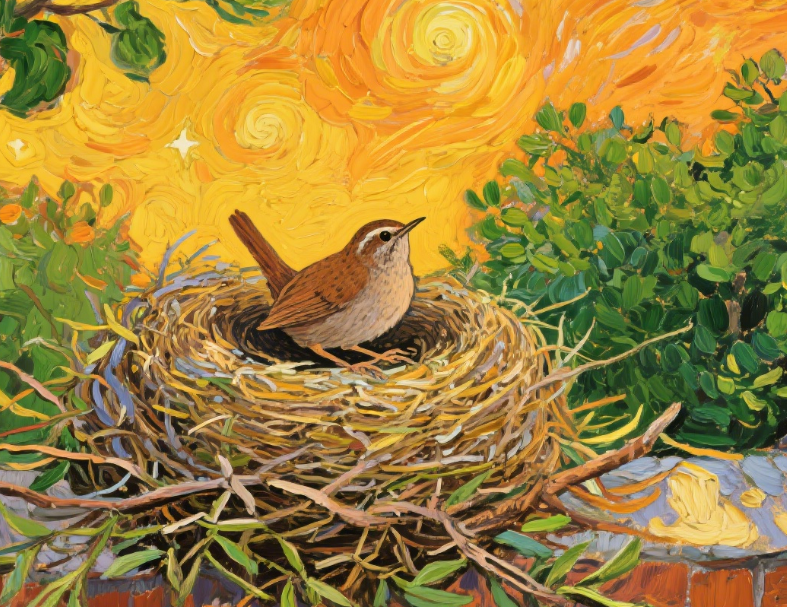
In the gardens of the Americas, a diverse array of bird species thrives. When faced with time-consuming and patience-demanding “slow tasks” such as nest-building, raising chicks, and foraging for food reserves, these birds demonstrate unique and efficient strategies. These survival wisdom, refined through natural selection over time, offer valuable insights for humans navigating the complex and time-consuming challenges of modern, fast-paced societies.
I. Typical Approaches of American Garden Birds to Slow-Paced Tasks
(1) Patient Nesting: Detailed Planning and Continuous Investment
Many American backyard birds demonstrate remarkable patience and planning ability in the “slow process” of nest-building. Take the Carolina Wren as an example: they spend weeks searching for suitable nesting sites, typically choosing shrubs, vines, or human-made birdhouses in backyards. Once a location is selected, the male bird constructs multiple “candidate nests,” each meticulously woven from materials like twigs, leaves, and feathers, with constant adjustments to the arrangement and density of the materials. The female bird then selects the most suitable nest based on safety and comfort standards, further refining it by adding soft down to enhance insulation. The entire nest-building process is carried out with no sense of urgency, with each step carefully considered to ensure the nest can withstand wind and rain and provide a stable environment for hatching chicks.
Another common backyard bird, the North American redbird, primarily has the female bird responsible for nest-building, while the male bird provides nesting materials. The female bird spends several hours each day carefully assembling materials such as twigs, bark fibers, and weeds. The nest's outer diameter typically measures around 10–12 centimeters, with an inner diameter of approximately 6–7 centimeters. The depth is appropriately designed to ensure the chicks have sufficient space to move while preventing them from falling out. During construction, if the female bird encounters unsuitable materials or unstable structures, she will not hesitate to dismantle and rebuild until the nest reaches an ideal state. This strict quality control over the “slow process” is crucial for ensuring the survival of their offspring.
(2) Careful chick-rearing: gradual progression and constant protection
Chick-rearing is another time-consuming and labor-intensive “slow process” in the life cycle of birds. American backyard birds demonstrate gradual wisdom and a sense of responsibility for constant protection throughout this process. Take the house swallow as an example: after the chicks hatch, the parents adjust the feeding frequency and food types according to the chicks' growth stages. Initially, the chicks cannot digest hard food, so the parents chew the insects they catch into small pieces before feeding them to the chicks, with feeding occurring dozens of times a day; As the chicks grow, the parents gradually reduce the feeding frequency while increasing the hardness of the food, helping the chicks adapt to independent digestion. By the time the chicks are ready to leave the nest, the parents guide them in practicing flight near the nest and teaching them to catch food. This process is gradual, ensuring the chicks gradually master survival skills and are fully prepared for independent life.
Blue jays exhibit a strong protective instinct during the rearing process. The parents take turns guarding the nest to prevent attacks from predators. When they detect predators such as snakes or squirrels approaching the nest, the parents emit sharp warning calls while repeatedly diving and pecking at the predators to drive them away. Even when foraging outside, the parents constantly monitor the surroundings of the nest. Upon detecting danger, they immediately return to the nest to guard it. This continuous protective behavior, though time-consuming and energy-intensive, significantly increases the survival rate of the chicks.
(3) Seasonal Storage: Preparing for the Future and Scientific Storage
For many American garden birds living in temperate regions, the scarcity of food in winter is a severe challenge. Therefore, they store food during the abundant season to prepare for winter survival, demonstrating the wisdom of preparing for the future and the ability to store food scientifically. Take the starling as an example. They primarily feed on pine seeds. During the autumn season when pine seeds mature, starlings collect large quantities of seeds and store them in underground burrows. The memory of jays is truly remarkable; they can accurately recall the locations of their stored seeds and retrieve them effortlessly even after several months. To prevent the seeds from molding or rotting during storage, jays select dry, well-ventilated areas to dig their burrows and arrange the seeds in layers, separating each layer with fine soil. This scientific storage method significantly enhances the survival rate of the seeds.
Squirrels (though rodents, they are commonly found in American gardens and exhibit food-hoarding behaviors similar to birds, serving as a reference) also engage in food storage during autumn. They stuff nuts, seeds, and other foods into their cheek pouches and transport them back to their burrows for storage. Squirrel burrows have a complex structure, divided into storage rooms, sleeping areas, and other zones. Storage rooms are further categorized by food type, such as nuts in one area and seeds in another. This分类 storage method not only allows squirrels to quickly locate needed food in winter but also prevents cross-contamination between different foods, ensuring food quality.
II. Lessons Humans Can Learn from Birds' Approach to Slow-Moving Matters
(1) Facing Complex Tasks: Detailed Planning, Avoid Impatience
In human work and life, we often encounter complex and time-consuming tasks, such as project development, academic research, and home renovation. Many people, when faced with such tasks, often rush to complete them without proper planning and preparation, leading to various issues during execution and ultimately delaying the completion of the task. From the nesting behaviors of the Carolina Wren and the Northern Cardinal, we can learn the importance of detailed planning. Before starting a complex task, we should, like birds searching for nesting sites and selecting nesting materials, thoroughly research, analyze the task’s objectives, requirements, and challenges, and establish a detailed work plan and steps, clearly defining the tasks and timelines for each phase. Additionally, during task execution, we should adjust plans in a timely manner based on actual circumstances, just as birds adjust their nest structures, to ensure the task progresses as intended and avoid compromising work quality or task failure due to impatience.
(2) Cultivating Growing Entities: Progress Gradually and Exercise Patience
Whether nurturing children, mentoring newcomers, learning a new skill, or launching a new business, a gradual process is required—instant success is unrealistic. The way house swallows adjust their feeding methods and guidance behaviors according to the growth stages of their chicks, as well as the sense of responsibility blue jays demonstrate in protecting their chicks throughout their development, provide excellent examples for us to learn from. In nurturing growing things, we should follow the example of house swallows, setting up training plans and goals in a step-by-step manner, adjusting methods and pacing according to the actual circumstances of the objects being nurtured, and giving them sufficient time and space to grow and improve. At the same time, we should maintain the patience and sense of responsibility of blue jays in protecting their chicks, providing timely support and assistance when the objects being nurtured encounter difficulties or setbacks, rather than simply criticizing or abandoning them.
(3) Addressing future risks: Preparing in advance with scientific foresight
In today's uncertain social environment, the future may present various risks and challenges, such as economic crises, natural disasters, and disease outbreaks. The behavior of jackdaws and chipmunks in storing food during abundant seasons reminds us to cultivate a mindset of preparing for the future and taking proactive measures to address potential risks. In personal life, we can ensure preparedness for unforeseen circumstances through savings and insurance; in business operations, companies can reduce market risks through diversification and technological innovation; and in societal development, governments can enhance their ability to respond to natural disasters and public health emergencies by improving emergency management systems and strengthening infrastructure. Additionally, during the preparation process, we should adopt scientific methods and strategies, similar to how starlings and squirrels store food, to enhance the effectiveness and targeting of our preparations and avoid wasting resources through blind preparation.
The patience, wisdom, and sense of responsibility demonstrated by American garden birds in addressing “slow issues” are crucial to their survival and reproduction in nature. For humans, these insights from nature can help us maintain calmness and rationality in a fast-paced society, better address various challenges in work and life, and achieve sustainable development for individuals, businesses, and society.
What can humans learn from the way birds in the Americas deal with slow-moving matters?
Aug 20, 2025 Bird knowledge presenters