The Art of Birdwatching: The Humble Way of Coexisting with Birds in American Gardens
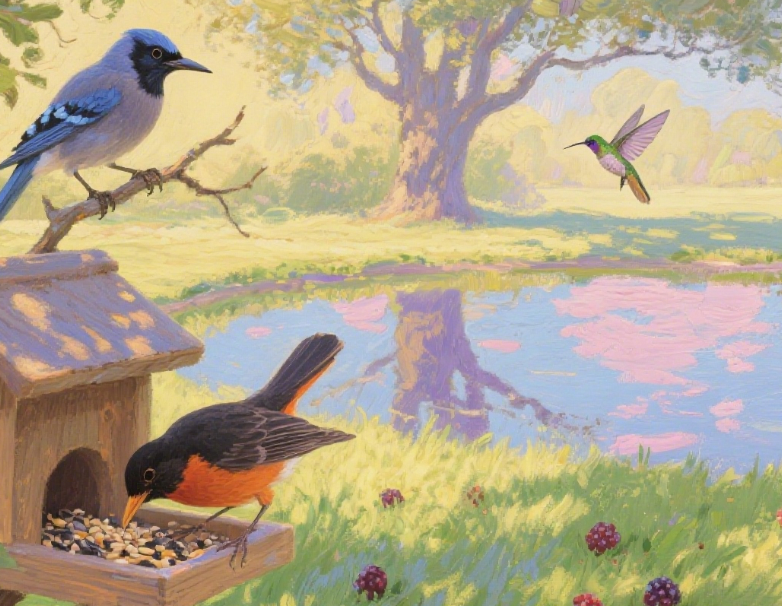
As the morning light filters through the oak groves of American gardens, the flapping wings of red-breasted robins feeding on berries intertwine with the humming of hummingbirds hovering to collect nectar, creating a natural morning symphony. At this moment, humans should assume the role of humble observers rather than arrogant rulers. Observing birds' feeding and behavior is, at its core, a cross-species dialogue that requires reverence as its foundation and restraint as its measure, allowing one to discern the rhythm of the natural world in silence.
Maintaining a sense of reverence through physical distance is the primary principle. When American robins scratch the ground for food on a lawn, standing three meters away allows them to feel at ease as they instinctively use their beaks to flip through fallen leaves. When redpolls pick seeds from a feeder, if a human figure suddenly moves, the instant they raise their crests is a sign of alertness. This sense of distance is not about being distant, but about respecting the territorial awareness of wild animals—their feeding behavior is about survival instincts, and humans getting too close can mess up the balance of energy intake and even cause stress reactions. Setting up hidden bird-watching spots in the yard and using binoculars to observe without disturbing the ecology around the feeder is all about making “not disturbing” the premise of watching.
Adopting an open-minded attitude of perception rather than interpretation allows observation to approach the essence of life. When a blue jay uses its beak to pick up a nut and repeatedly strike the ground, there is no need to hastily judge it using human standards of “clever” or “clumsy.” Instead, one should observe the dynamic balance between the force of its beak and the hardness of the nut; When North American redpolls take turns feeding their chicks, the rhythm of their wing movements and the subtle changes in feeding frequency are more concrete expressions of life than the concept of “tenderness.” There is no superior or inferior behavior among birds; every peck, swallow, and food storage is the crystallization of millions of years of evolution. If observers set aside their preconceived value judgments, they may discover the precision with which the North American goldfinch hovers over thistle flowers, or the perfect arc traced by the wing tips of swallows as they skim the water's surface to catch food—these moments are not about meaning, but about the miracles of life itself.
Transforming observation into symbiotic action is a deeper form of observational ethics. After noticing that the Eurasian tree sparrow frequently feeds on berries in the courtyard, one might preserve some wild plants instead of pruning them all; upon discovering that hummingbirds prefer flowers of a specific color, one might plant native nectar-producing plants along the courtyard edge; the seed husks left behind at the feeder in winter are clues to changes in bird diets, prompting adjustments to the types of food provided to meet their nutritional needs. This shift from “observing” to “participating” is not about imposing human will on nature, but about humbly aligning with the rhythms of bird life, making the garden a medium for mutual understanding between species.
As twilight falls, the last sparrow disappears into the shrubs with a full crop, leaving behind not just scattered grains but a metaphor for human-nature coexistence — true observation is allowing birds to thrive according to their own behavioral logic, while we remain as witnesses who know to maintain distance and hold reverence.
Translated with DeepL.com (free version)