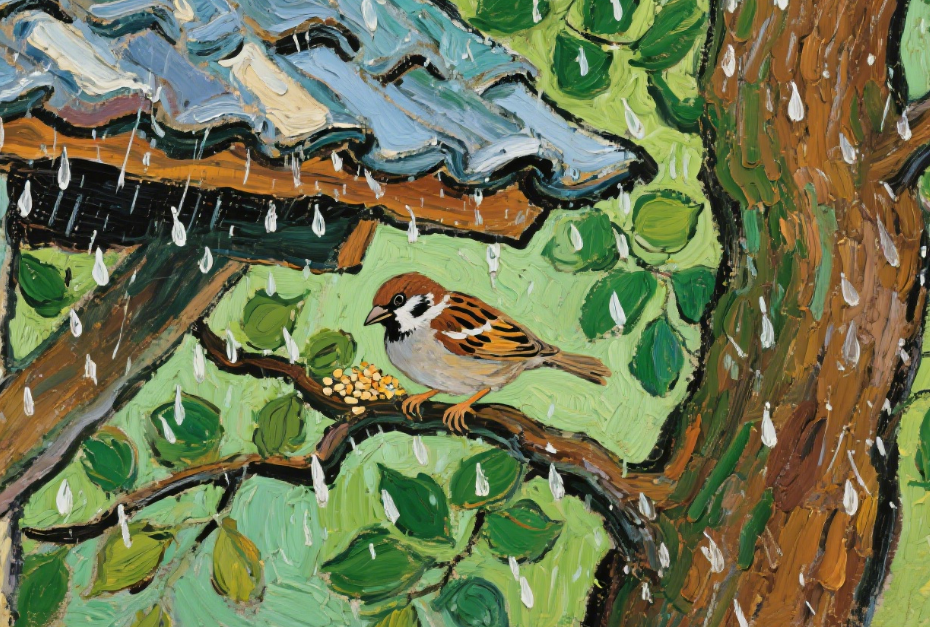
The birds in the American courtyard show a series of amazing survival wisdom in the face of severe weather such as wind, rainstorm and cold. There are many aspects of their life behaviors that are worth learning from for humanity, providing valuable insights for us to cope with various difficulties and challenges.
Early warning and preparedness awareness
Many courtyard birds in the Americas become sensitive before severe weather arrives
Sharp perception ability and awareness of advance preparation. For example, when a storm is approaching, mockingbirds will search for a more sturdy habitat in advance. They will carefully inspect the caves of trees, gaps under eaves, etc., to ensure a safe hiding place. At the same time, they will also accelerate their foraging pace and store as much food as possible to cope with food shortages during weather periods.
This kind of early warning and preparation behavior has important reference significance for humanity. When facing potential risks such as natural disasters and economic crises, humans should also cultivate keen insight and prepare in advance. For example, in areas prone to natural disasters, people can develop emergency plans in advance and reserve necessary materials; In an unstable economic environment, individuals and businesses can make good financial planning and accumulate a certain amount of reserve funds to cope with possible difficulties.
The spirit of group collaboration and mutual assistance
In adverse weather conditions, birds in American courtyards often exhibit a strong spirit of teamwork and mutual assistance. When a cold wave strikes, blue ravens will gather together, snuggle up to each other for warmth, and resist the cold through the power of the group. They will also jointly search for food resources, and upon discovering food, they will notify their companions through specific vocalizations to achieve resource sharing.
This kind of group collaboration and mutual assistance behavior reminds humanity that the power of unity and cooperation is enormous when facing difficulties. In social life, whether it is responding to public health emergencies or carrying out major construction projects, people need to cooperate and help each other. For example, during the epidemic, medical staff, volunteers, ordinary people and other forces united as one to fight against the epidemic, demonstrating strong cohesion; In team work, division of labor, cooperation, and mutual support among members can improve work efficiency and better complete tasks.
Flexible adaptation and adjustment strategies
Adverse weather often changes the living environment of birds, and birds in American courtyards can adapt flexibly to environmental changes and adjust their behavioral strategies in a timely manner. For example, in the continuous rainstorm weather, the sparrows that used to feed on the ground will change their feeding locations and turn to the relatively dry places under the eaves, among the branches and so on to look for food.
This inspires humans to have the ability to adapt flexibly and adjust their plans and strategies in a timely manner when facing changes and uncertainties. In the workplace, the market environment and job demands may change, and people need to adjust their work methods and goals according to the actual situation; In life, there may also be various unexpected situations that require flexible responses to better adapt to changes.
Cherish resources and have an awareness of energy conservation
In adverse weather conditions, food and energy resources are relatively scarce, and birds in American courtyards exhibit a strong sense of cherishing resources and energy conservation. For example, in cold weather, birds will reduce unnecessary activities, lower energy consumption, and only go out to forage when necessary.
This act of cherishing resources and conserving energy has important reference significance for humanity. In today's society, resource scarcity and environmental issues are becoming increasingly prominent. Humans should cherish various resources, establish energy-saving awareness, reduce resource waste and environmental damage. For example, in daily life, saving water and electricity, reducing the use of disposable items, etc. are all concrete manifestations of cherishing resources and energy conservation.
In short, the living behavior of courtyard birds in the Americas under adverse weather conditions contains rich wisdom, which provides useful reference for humans to cope with various challenges and difficulties. Human beings can learn from the experience of early preparation, unity and cooperation, flexible adaptation, and cherishing resources to better survive and develop.
What are the behaviors of birds in American courtyards during harsh weather conditions worth learning from for humans
Aug 14, 2025 Bird knowledge presenters