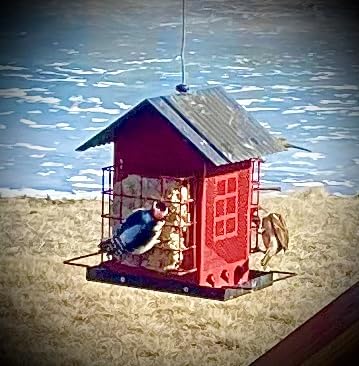
Recently, under the influence of the splitting of the Arctic vortex and the attack of bomb cyclones, the Americas has experienced rare extreme changeable weather - from the near zero cold wave in Florida, the 46 cm snowstorm, to the rainstorm and mountain torrents in some areas, where cold and warm alternate violently, and extreme weather occurs frequently, bringing severe challenges to the birds living in the courtyard. These birds, relying on their evolved physiological mechanisms and flexible behavioral strategies, cleverly respond to weather changes and ensure their own survival. The specific ways can be divided into the following categories.
1、 Physiological adaptation: Comes with "cold resistant and waterproof equipment" to lock in survival energy
Faced with the recent extreme cold, rainy and snowy weather in many parts of the Americas, courtyard birds primarily rely on their own physiological structures to resist harsh environments, with the core being to reduce heat loss and keep their bodies dry.
Most courtyard birds, such as the main Cardinals and Karoo Reed wrens, have a sophisticated 'counter current heat exchange system', which is the key secret to their bare leg cold resistance. Arterial blood and venous blood flow side by side in opposite directions in the legs. Arterial blood transfers heat to the cooled venous blood, which not only pre cools the blood flowing to the feet to reduce heat loss, but also heats up the returning venous blood to maintain stable core body temperature. Even if the foot temperature is close to freezing point, it will not suffer from frostbite - because bird feet are mainly composed of bones and tendons, with very little muscle and water, sparse nerve endings, and strong frost resistance. In addition, some birds (such as snow sparrows) have fewer pain receptors in their feet, and they hardly feel the pain caused by cold.
Feathers are the "multifunctional protective clothing" of birds. Recently, with frequent rain and snow, birds will comb their feathers and apply waterproof substances secreted by their tail oil glands to the surface of the feathers, forming a waterproof layer to prevent the feathers from losing their insulation function due to being soaked in rainwater. It should be noted that bird body temperature needs to be maintained at around 38.5 ℃. Once the feathers are soaked, they may die from hypothermia within a few minutes. At the same time, they will fluffy their feathers, forming countless air pockets between them to lock in body heat to the maximum extent. This is also the reason why the main Cardinals and Cardinals in the courtyard often fluffy into "small balls" when a cold wave arrives. In addition, some resident birds will grow thicker feathers before the arrival of winter to increase insulation and cope with sudden temperature drops.
2、 Behavioral strategy: Proactively avoid risks and efficiently conserve energy
Faced with the ever-changing extreme weather, courtyard birds in the Americas will flexibly adjust their behavior by avoiding, gathering, hiding, and other methods to reduce the damage caused by severe weather and reduce energy consumption.
One is to actively seek shelter from wind and rain. When a blizzard, rainstorm or strong wind strikes, birds will give up the open branches and hide under the dense bushes and evergreen leaves in the courtyard, or use tree holes, eaves gaps, artificial nest boxes and other hidden places to reduce wind and shelter rain and snow with the help of terrain and structure. For example, small songbirds (such as sparrows and wrens) will burrow into tree crevices or dense shrubs, while large birds (such as pigeons and eagles) will choose thick tree trunks in the leeward direction, quietly waiting for the weather to improve and avoiding flying in strong winds that consume energy. For the chicks in the nest, the parent birds will take turns spreading their wings to protect them like a "moving umbrella", using their own body temperature to keep them warm and prevent them from being frostbitten by rain, snow, and ice.
The second is group habitat, sharing heat. In recent extremely cold weather, small birds in the courtyard (such as sparrows and bluebirds) will adopt a group habitat, squeezing into tree holes, nest boxes, or dense branches and leaves, reducing individual heat loss and lowering the risk of being preyed upon by natural enemies through the superposition of their body temperatures. Research has found that birds living in groups have significantly reduced individual energy consumption compared to those living alone, making them better able to cope with prolonged cold waves.
Thirdly, adjust body posture to reduce heat loss. When a cold wave arrives, birds will adopt a one legged standing posture, hide one foot in a feather to keep warm, and alternate their feet at regular intervals to avoid excessive heat loss from their feet; At the same time, it will lower the body and cover the feet with abdominal feathers, further reducing the contact area with cold air and maximizing the preservation of physical strength. In strong wind weather, birds will also use their strong claws to tightly grasp tree branches, lower their bodies to lower their center of gravity, and avoid being blown down by the wind. Some ground dwelling birds will directly lie on the ground, reducing the area exposed to the wind.
3、 Foraging Adjustment: Accurately Reserve Energy to Address Food Shortages
The recent extreme weather has led to a shortage of natural food (seeds, berries, insects) in the courtyard, and rain and snow covering the ground and obstructing vegetation have increased the difficulty of foraging. American courtyard birds ensure energy supply and cope with weather fluctuations by "pre stocking, optimizing foraging, and leveraging human resources".
Pre storing food is a core strategy for many backyard birds. For example, the Karo tit, the five headed tit, etc., will frequently travel to the feeders and hidden places in the courtyard on clear days, hiding seeds, nuts, and other food in the gaps of tree bark, fallen leaves, or soil in flower pots. A single Karo tit can store up to 80000 seeds and can accurately remember the storage location. In weather conditions such as blizzards and cold waves where they cannot go out to forage, they rely on stored food to survive.
Optimize foraging time and range to improve foraging efficiency. Birds will avoid the peak period of heavy snow, rainstorm and strong wind, choose the interval when the weather turns better for a short time to go out for food, and give priority to the foraging point close to the habitat to reduce flight distance and energy consumption. At the same time, they will adjust their foraging preferences: during cold waves, they prioritize high calorie foods (such as sunflower seeds, nuts, animal fats) to quickly replenish energy. Some small birds may have a body fat content exceeding 10% of their body weight in winter, providing energy reserves to resist the severe cold; After the rainstorm, they will focus on feeding insects and berries on the ground or vegetation to make up for the energy gap in bad weather.
Utilize human activities to obtain food. With the adaptation of courtyard birds in the Americas to human environments, many birds actively take advantage of the convenience provided by humans - during extreme weather periods, they frequently visit the bird feeders in the courtyard to obtain seeds, grains, suets (animal fat blocks) and other food thrown by humans. This "reliance on human supply" has become an important aid for many resident birds to cope with the recent unpredictable weather, especially for small birds. The high-energy food released by humans can effectively help them avoid consuming their own fat reserves and increase their survival probability.
4、 Special Response: Migration Adjustment and Emergency Evacuation
In addition to the conventional methods mentioned above, some courtyard birds also adjust their migration rhythm according to weather changes to cope with extreme weather conditions. The recent abnormal cooling caused by the southward movement of the Arctic vortex has prompted some bird species (such as some warblers and swallows) that were originally planned to migrate southward to depart earlier or change their migration routes to avoid extremely cold areas; And some resident birds that did not originally migrate, if the courtyard environment cannot meet their survival needs (such as running out of food or burying their habitat in snow), will temporarily move to warm low latitude areas or urban heat island areas, and return to the courtyard after the weather improves.
For sudden extreme weather events (such as blizzards and severe thunderstorms caused by bomb cyclones), birds will take emergency measures to avoid danger: stop flying and make an emergency landing in a safe hiding place; If feathers are wet due to rainstorm, they will be combed and dried in time to quickly restore the thermal insulation function; Some small birds will enter a short-term sleep state, reduce metabolic rate, decrease energy consumption, and wait for the weather to improve.
In summary, the core logic for American courtyard birds to cope with recent unpredictable weather is to "reduce consumption, store energy, and avoid risks" - relying on the advantages of physiological evolution to resist severe cold and rain and snow, reducing damage through flexible behavioral strategies, ensuring energy supply through precise foraging adjustments, and even adjusting migration rhythms according to weather changes. These adaptation methods are the result of their long-term evolution and game with the natural environment, allowing them to continue reproducing and inhabiting in the courtyard in extremely variable weather. At the same time, humans have preserved dense vegetation in the courtyard, set up nest boxes and feeders, which have also provided important assistance for these birds to cope with changing weather conditions.
We recommend our Flowafoli bird feeder!