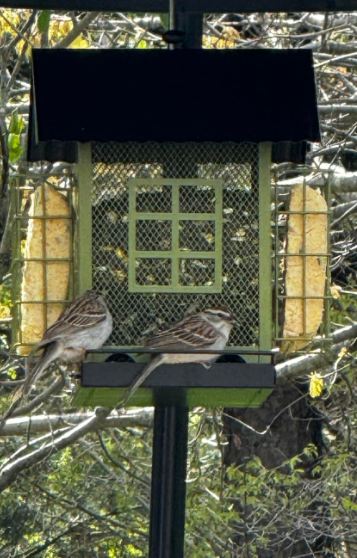
The bird feeders in American courtyards are not simply "food delivery points", but an important link that adapts to the survival needs of native American birds and connects nature with the living environment. For birds that come to forage, its significance runs through multiple core levels such as survival guarantee, energy supply, risk avoidance, and population continuation. It not only conforms to the physiological and behavioral characteristics of birds in different seasons, but also forms a virtuous balance between human intervention and natural laws.
1、 Core survival guarantee: solving the dilemma of extreme environment and food shortage
The American continent has distinct four seasons, with extreme weather conditions such as low temperatures in winter, snowfall, and drought in summer, often leading to a sharp decline in natural food resources for birds. This is the most critical value of bird feeders. In winter, insects hibernate, their seeds are covered in snow, and the duration of sunlight is shortened. Birds have significantly less time to forage, but they need to consume more energy to maintain their body temperature - the black crowned sparrow needs to eat food equivalent to one-third of its body weight every day in winter, and the blue crowned raven also needs to consume 10% of its body weight to survive. At this time, the stable food source provided by the courtyard bird feeder can directly improve the overwintering survival rate of birds. Studies have shown that in areas with bird feeders, the winter survival rate of black crowned tits increases from 37% to 69%.
Except for winter, birds during the spring and autumn migration seasons also rely on bird feeders to replenish energy. Many bird species in the Americas, such as the mourning dove and the diphtheria sparrow, can migrate over a one-way distance of more than 1000 miles, requiring frequent supplies during long-distance flights. The yard bird feeder serves as a "stopover station", providing them with critical energy support and increasing their migration success rate. In the process of urbanization, the natural foraging habitats of birds are occupied by buildings and roads, and bird feeders effectively fill this resource gap, becoming an important food supply station for urban and suburban birds.
2、 Adapt to species habits: meet the foraging needs of different birds
The design and food distribution of bird feeders in American courtyards often conform to the foraging habits of local birds, and can adapt to the needs of various bird species, improving food acquisition efficiency. There are significant differences in foraging methods and food preferences among different bird species: Northern Cardinals and American Goldfinches prefer sunflower seeds and safflower seeds, while Red bellied Woodpeckers prefer to eat beef fat and peanuts. Hummingbirds rely on nectar (nectar) food, while ground foraging mourning doves and black eyed Vermilion (snow birds) are suitable for millet and crushed corn in tray feeders.
Reasonably arranged bird feeders (such as weight sensitive, cage type, tube type, etc.) can also provide a safe foraging space for small birds (such as tits and goldfinches), avoiding food being seized by squirrels and large birds. This targeted food supply not only eliminates the need for birds to spend a lot of energy searching for food, but also reduces foraging competition between different species, allowing more birds (from small sparrows to medium-sized woodpeckers and jays) to efficiently obtain food.
We recommend our Flowafoli bird feeder!