The bird communities in American gardens are filled with complex and vibrant interactions. Different species have developed unique “social rules” based on their habits, where competition and cooperation coexist, forming a intricate ecological network.
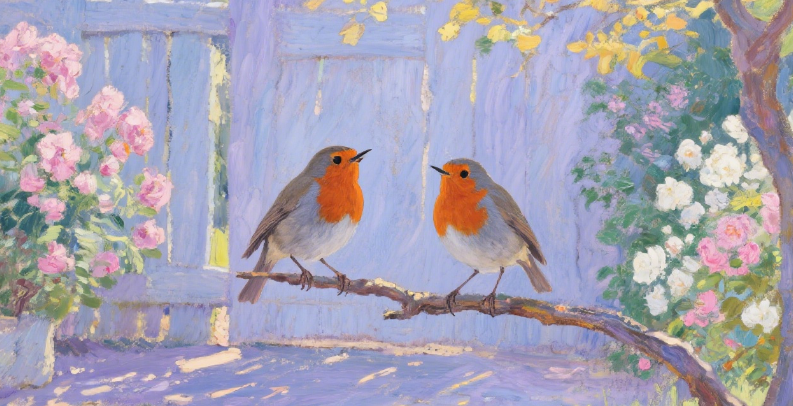
Take the North American robin as an example; they are typical “territorial guardians” in gardens. During the breeding season, male and female robins jointly establish their territory. The male asserts its dominance through crisp calls, and if another robin encroaches, it will engage in a brief yet intense expulsion—they do not actually harm each other but use wing flapping and posturing to intimidate the intruder into leaving. In this “territorial society,” pair bonds are stable, with both sexes sharing the responsibility of raising chicks. The female incubates the eggs, while the male forages for food, occasionally taking turns guarding the nest, demonstrating clear division of labor.
Blue jays are the “social butterflies” of the backyard, with their groups exhibiting a certain hierarchical structure. Within a group of blue jays, dominant individuals (typically larger male birds) prioritize access to food resources, while subordinate individuals demonstrate submission through behaviors such as bowing their heads or gently pecking at wings. Even more interestingly, they form a “mutual aid network”: when a blue jay spots a predator like a raptor, it emits a sharp alarm call, prompting other individuals to quickly hide; in return, individuals that discover food sources will call out to summon companions to share, enhancing the group's overall survival rate.
House sparrows, on the other hand, form a more “loose-knit community.” They do not fixate on specific territories but gather around food sources. Near bird feeders in courtyards, one can often see dozens of sparrows crowded together, appearing chaotic yet following unspoken rules—adult male sparrows occupy the prime central position at the feeder, while females and juveniles stay on the periphery. They are relatively tolerant of “outsiders,” allowing other small birds (such as goldfinches) to feed alongside them as long as they do not compete for core resources. However, when encountering larger pigeons, they will collectively take flight to create noise and drive them away, demonstrating a “united front against outsiders” characteristic.
Hummingbird societies, however, exhibit a strong “solitary tendency,” especially in red-throated hummingbirds, which spend most of their time alone. Male hummingbirds may even drive away other males and females approaching the nest. However, during the non-breeding season, multiple hummingbirds form “temporary social circles” near high-quality nectar sources (such as trumpet vine flower clusters in gardens). While competition still exists—males occupy the highest points of the flower clusters and dive to drive away conspecifics attempting to feed—their ‘conflicts’ are more like ritualized displays, rarely causing actual harm, and more akin to establishing a “feeding order.”
Additionally, “cross-species interactions” occur between different species. For example, North American redbirds and house sparrows often share feeders, with redbirds using their size advantage to feed first, while sparrows nimbly search for leftover seeds in crevices, creating “asymmetric competition”; Crows, as the “intelligent guardians” of the garden, even observe human activities and mimic the actions of opening feeders. Their groups also “hold grudges”—if someone has ever driven them away, the entire group may remain vigilant toward that garden for a long time. This “collective memory” adds complexity to their social behavior.
These birds' social behaviors are fundamentally about the allocation and competition for resources (food, territory, breeding opportunities), yet they unconsciously maintain the ecological balance of the courtyard, allowing each bird to find its place within its “social circle,” and enabling humans to glimpse the most vibrant “social landscape” of nature through the windowsill.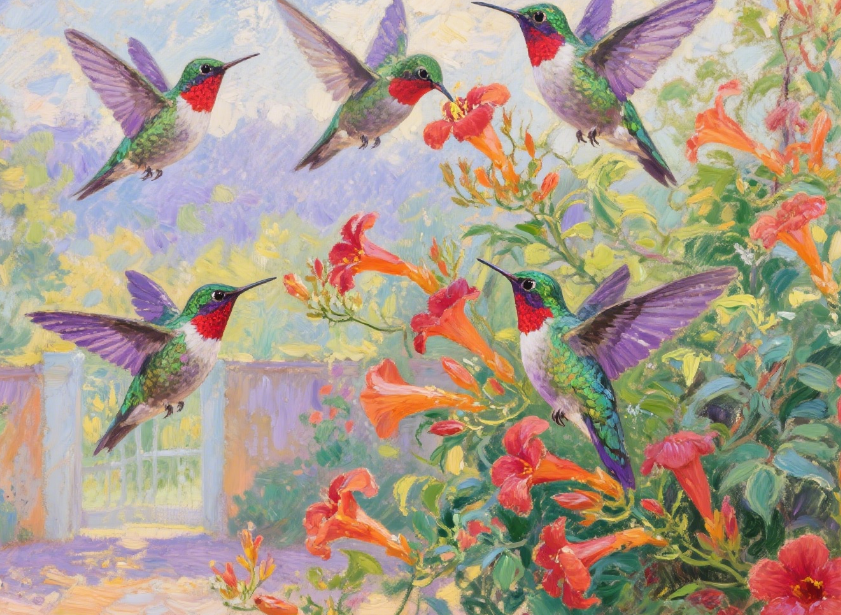
Introduction to the social ecological network of birds in the American courtyard
Jul 29, 2025 Bird knowledge presenters