Across the vast expanse of the Americas, from the temperate forests of North America to the tropical rainforests of South America, gardens are always teeming with the lively presence of various bird species. These agile creatures not only bring vitality and energy to gardens but also offer fascinating insights into their unique behaviors and mysterious ways.
Common Birds in North American Gardens
Red Cardinal
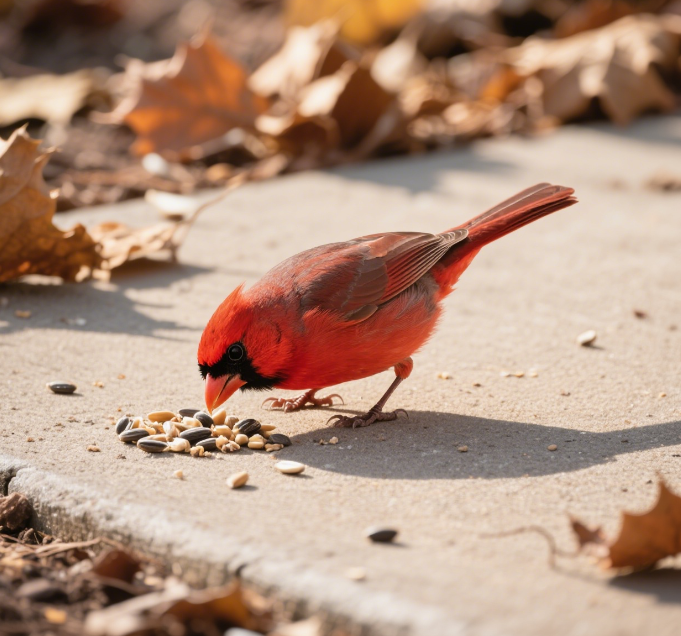
The cardinal is one of the most easily recognizable birds in North American gardens, with the male cardinal's vibrant red plumage standing out prominently. They are omnivorous birds with a wide range of food preferences. During spring and summer, when insect populations are abundant, cardinals feed on protein-rich insects such as beetles, caterpillars, and spiders, which are crucial for their own growth and for raising their young. In autumn and winter, when insects become scarce, red cardinals shift their diet to plant seeds and berries, with sunflower seeds and thistle seeds being among their favorite foods.
The breeding season for red cardinals typically occurs between March and August each year. In terms of nest-building, the female takes the lead, using materials such as small branches, grass stems, and moss to construct a cup-shaped nest in shrubs or low-lying trees. The female lays 2–5 eggs, which she incubates for approximately 11–13 days. After hatching, both parents take turns feeding the chicks with insects and other prey. The chicks typically fledge after about 9–11 days.
Redbirds are resident birds and generally do not migrate over long distances. They have strong adaptability to their environment and can survive even in cold winters by relying on stored food in gardens and surrounding areas.
North American Redbird
The North American redbird is a common visitor to gardens in North America. The male bird’s bright red feathers contrast sharply with its black mask, making it highly distinctive. They primarily feed on seeds, particularly grass seeds and grains. While foraging, North American Redpolls often hop on the ground to search for food and peck at fruits and seeds in shrubs. They also do not shy away from insects, which are a nutrient-rich food source. During the breeding season, insects become the primary food source for feeding chicks.
During the breeding season, male birds attract females through singing and display the food they have found. Nest-building is led by the female, with nests typically constructed in shrubs or small trees 1–3 meters above the ground, made from twigs, grass leaves, and bark. Females lay 2–5 eggs per clutch, with an incubation period of approximately 12–13 days. After the chicks hatch, the parents take turns feeding them, and the chicks can leave the nest and begin to move around after about 10–12 days.
Like the redbird, the North American redbird is primarily a resident bird, but during winter when food is scarce, they may undertake short-distance movements to seek areas with more abundant food supplies.
Common birds in Central American gardens
Green woodpecker
The Green-backed Woodpecker is often referred to as the “beauty icon” of Central America. Male Green-backed Woodpeckers have long tail feathers, with plumage displaying stunning metallic green and blue hues. They primarily inhabit cloud forests and are not commonly seen in ordinary gardens, though they may occasionally be spotted in gardens near forests. Green-backed woodpeckers primarily feed on fruits, particularly those of avocado plants, and also consume insects, frogs, and small reptiles.
The breeding behavior of green-backed woodpeckers is highly distinctive. They do not build their own nests but instead seek out natural tree cavities or abandoned woodpecker nests as breeding sites. The breeding season typically occurs between March and June each year. The female lays 1–2 eggs per clutch, and both parents take turns incubating them. The incubation period lasts approximately 18–19 days. After hatching, the parents carefully nurture the chicks, feeding them a variety of foods. Green woodpeckers have extremely high environmental requirements, and their survival is threatened by factors such as deforestation.
Green Woodpeckers do not exhibit obvious migratory behavior and are highly dependent on their habitats, typically remaining within fixed areas.
Golden-collared Tanager
The Golden-collared Tanager is a common, vibrantly colored bird found in Central American gardens. Its plumage is primarily yellow, with a striking black collar around the neck of the male. The Golden-collared Tanager is a typical omnivorous bird, feeding on nectar from flowers, catching insects among the flowers, and consuming fruits and seeds from plants. While foraging, they often dart and weave between branches with remarkable agility.
The breeding season typically occurs between April and July each year. The female builds a cup-shaped nest on branches using materials such as grass stems, small branches, and plant fibers. She lays 2–4 eggs per clutch, with an incubation period of approximately 12–14 days. After the chicks hatch, both parents feed them. As the chicks grow, the parents teach them how to forage and avoid predators. Golden-collared Donovan's finches typically do not migrate in large numbers but may move within a certain range depending on seasonal changes and food availability.
Common South American Garden Birds
Sun Conure
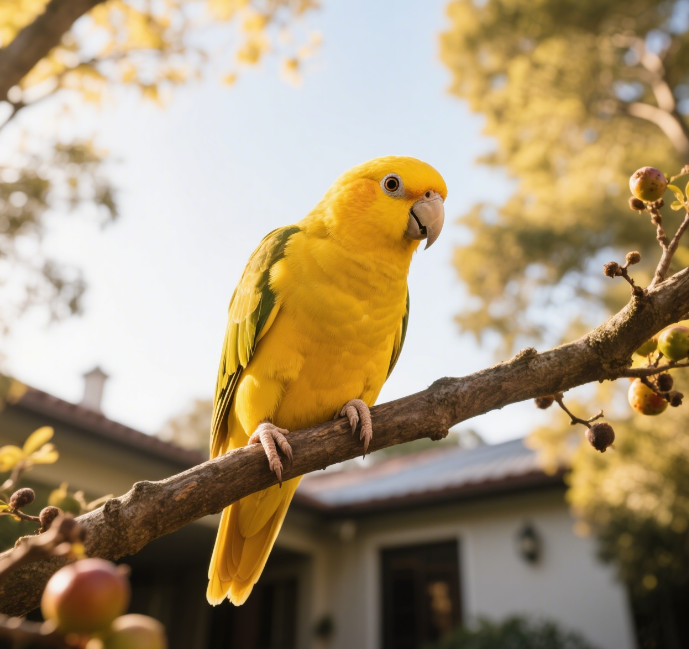
The Sun Conure is a very popular garden bird in South America. Its feathers are mostly golden yellow, shimmering brilliantly in the sunlight. This parrot is an omnivorous bird, primarily feeding on plant seeds, fruits, berries, and nuts, and occasionally consuming insects and their larvae. It has a powerful beak capable of easily cracking open hard nut shells. When foraging, Sun Conures often move in flocks, searching for food in trees or on the ground, and sometimes mix with other parrot species.
The breeding season typically runs from November to April, during which they seek out natural tree cavities or artificial nest boxes to build their nests. The female lays 3–5 eggs per clutch, which she incubates alone. The incubation period lasts approximately 23–26 days. After hatching, the male takes responsibility for providing food for the female and chicks. The chicks require approximately 50–60 days to fully feather and leave the nest. Sun Conures may undertake localized migrations during the non-breeding season to seek more suitable environments and food resources.
Andean Crested Umbrellas
Andean Crested Umbrellas are primarily distributed in the Andes Mountains region of South America. Male birds have distinctive fan-shaped crests on their heads, making them highly ornamental. They primarily feed on fruits and berries, particularly in the canopy layers of tall trees in forests. They also consume insects and small invertebrates.
In terms of reproduction, the Andean Crested Umbrella Bird exhibits unique courtship behavior. During the breeding season, male birds gather at specific courtship sites, displaying their vibrant plumage, unique dances, and calls to attract females. Females select their mates by choosing the most desirable partner. Females lay eggs in steep rock walls or tree cavities, typically producing 1–2 eggs per clutch, and subsequently undertake the incubation and rearing of the young alone. Andean crested toucans do not exhibit obvious seasonal migratory behavior, and their activity range is relatively fixed.
The above provides an overview of the behavioral habits of common birds found in gardens across different regions of the Americas. If you are particularly interested in any of these birds or wish to learn more about other bird species in the Americas, please feel free to let me know.