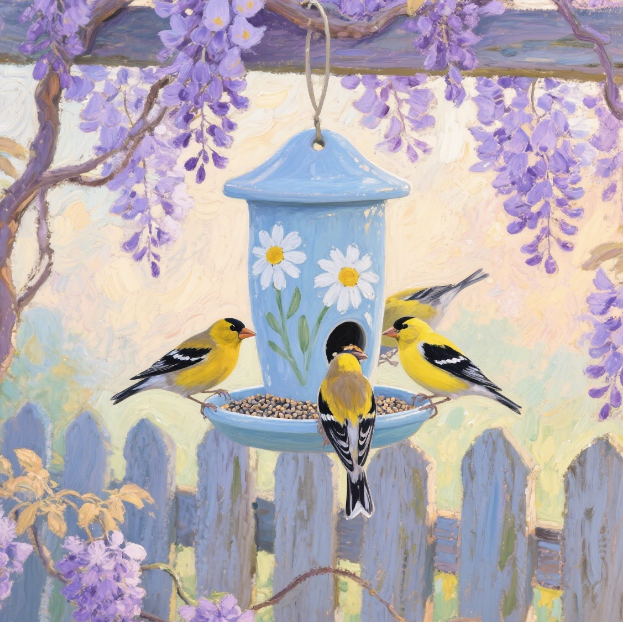
In American gardens, the following types of bird feeders are commonly used:
Ground feeders: These are usually trays with mesh bottoms, raised a few inches off the ground or platform. Some have covers to protect against snow, and others are equipped with metal mesh to deter large birds such as squirrels and crows. When using them, place them in an open area at least 10 feet away from the nearest trees or shrubs to allow birds to avoid predators while feeding. They are suitable for attracting pigeons, sparrows, finches, goldfinches, and red-breasted birds.
Sunflower Seed Tube Feeder: This is a more versatile bird feeder. When selecting one, choose a model with metal ports around the seed dispenser to prevent squirrels and house sparrows from chewing on it. Hang it at least 5 feet above the ground and as close to a window as possible for bird watching. This feeder attracts birds such as chickadees, nuthatches, woodpeckers, American goldfinches, pine siskins, and purple finches.
Suet feeder: Suet is highly favored by nuthatches, chickadees, woodpeckers, and woodpeckers, and occasionally by wrens, siskins, and warblers. You can hang suet blocks in mesh bags, purchase cage-style feeders, or make your own suet “pudding” by grinding suet and mixing it with seeds, then filling the gaps in large pinecones to create feeders. Suet feeders can be hung on trees, poles near other feeders, or wires between trees. However, avoid using them when temperatures exceed 80°F (approximately 26.7°C) to prevent the suet from spoiling.
Funnel-shaped feeders: These can hold several pounds of mixed seeds and keep them dry. When birds land on the feeder, it triggers the release of seeds. When using it, install it on a pole about 5 feet above the ground. It attracts all the birds that a tube feeder can attract, as well as larger birds like blue jays, mockingbirds, red-winged blackbirds, and red-breasted nuthatches.
Nyjer seed feeder: Specifically designed for distributing nyjer seeds, it has small holes that only small-billed birds like American goldfinches, redpolls, and pine siskins can access. It can be hung on a tree or placed on a pole 5 feet off the ground, and using it with a squirrel-proof device enhances its effectiveness.
When using bird feeders, please also note the following precautions:
Regular cleaning: Clean the feeder every two weeks with a solution of 1 part bleach to 9 parts water, rinse thoroughly with hot water, and let it dry completely before refilling with seeds to prevent mold and disease transmission.
Avoid collisions: Place the feeder at least 3 feet away from windows or more than 30 feet away, or use window decals to reduce the risk of birds colliding with windows and dying.
Avoid attracting predators: Do not place the bird feeder in areas where predators like cats can easily hide, such as within 10 to 12 feet of low shrubs or piles of wood.
Choose seeds wisely: Use seed mixtures suitable for the feeder and target bird species. Avoid mixtures containing filler seeds and grains (such as millet, sorghum, and foxtail millet), as these are typically unpopular with birds and can accumulate on the ground, leading to mold growth.
Control feeding quantities: Feed in moderation, setting up a small number of feeders per acre to prevent birds from becoming overly reliant on artificial feeding, while also avoiding seed waste and ground contamination.