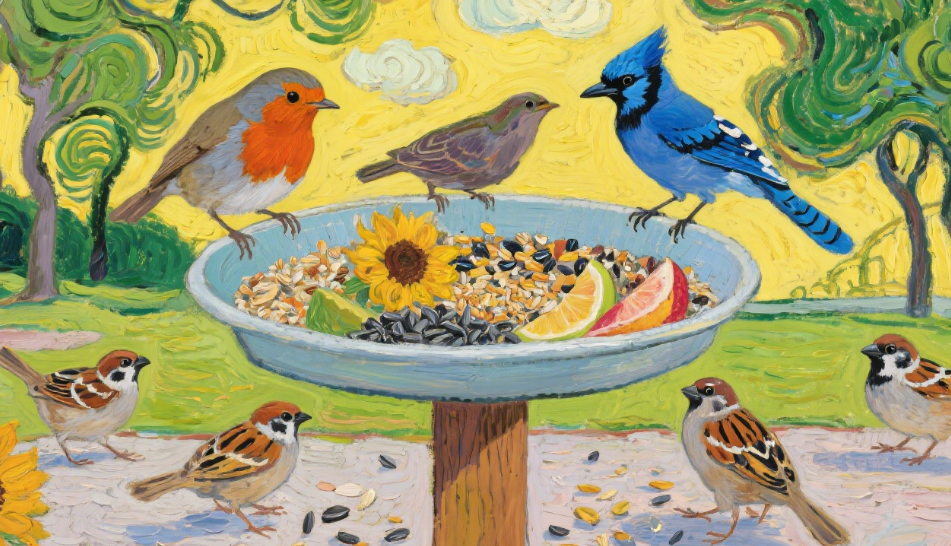
In the ecological environment of the American garden, birds' preference for bird feeders is not random but closely related to factors such as their feeding habits, dietary preferences, need for security, and the convenience of food provided by the feeders. The following is a ranking of preference levels and detailed explanations based on observations of common bird behavior and ornithological research.
1. Preference Ranking (from highest to lowest)
Platform Feeders
Tube Feeders
Suction Cup Window Feeders
Hanging Fruit Feeders
Hummingbird Nectar Feeders
Ground Feeding Areas (non-traditional feeders but commonly used)
Caged Squirrel-Proof Feeders
II. Detailed Explanations of Each Feeder
(1) Platform Bird Feeders (Most Popular)
Platform bird feeders are typically open, shallow dish-shaped structures that can be placed on stands, hung, or secured to elevated ground positions. They can accommodate various types of bird food, such as mixed grains, sunflower seeds, crushed nuts, and fruit slices.
Reasons for popularity:
Highly versatile, it can meet the feeding needs of most common bird species in American gardens. Whether seed-eating birds (such as sparrows, juncos, and grass sparrows), insect-eating birds (which occasionally consume seeds for energy, such as warblers), or omnivorous birds (such as robins and blue jays), all can feed here.
The open design allows birds to enter and exit freely without needing to adapt to complex entrance structures, making it particularly friendly for elderly birds or chicks.
The open view allows birds to observe their surroundings for predators (such as eagles or cats) while feeding, providing a high sense of security.
Common birds attracted: American Robin, Blue Jay, House Sparrow, Dark-eyed Junco, Mourning Dove, etc.
(2) Tube-style bird feeder
Tube-style bird feeders are made of transparent or semi-transparent plastic or glass tubes, with multiple small holes on the tube body serving as feeding ports. The interior typically holds small-particle feed such as sunflower seeds or Nyjer seeds (suitable for goldfinches), and can be hung on branches or stands.
Reasons for popularity:
They have a large feed storage capacity and good sealing performance, effectively preventing moisture and mold growth, thereby reducing feed waste.
The feeding port design is reasonable, suitable for small seed-eating birds to stand and feed, while also preventing larger birds (such as crows) and squirrels from stealing food to some extent.
The transparent tube allows birds to clearly see the amount of feed inside, attracting them to come and feed.
Common birds attracted: American Goldfinch, European Starling (note that they may gather in large numbers), wrens (such as the Carolina Wren), White-throated Sparrow, etc.
(3) Suction cup window feeder
This type of feeder is secured to the window glass with a strong suction cup. It is typically small and disc-shaped or box-shaped and can hold sunflower seeds, bread crumbs, small pieces of fruit, and other feed, allowing people to observe birds up close.
Reasons for popularity:
Their unique location near human-inhabited windows attracts birds with higher adaptability to human activity (such as sparrows and chickadees), as they perceive feeding near humans as relatively safe (predators are less likely to approach human-inhabited areas).
The close-up observation experience encourages humans to replenish feed more frequently, ensuring a steady supply and further attracting birds.
Compact size, suitable for use in courtyards with limited space, without occupying too much outdoor space.
Common birds attracted: house sparrows, great tits, silver-throated long-tailed tits, Eurasian nuthatches, etc.
(4) Hanging fruit tray bird feeder
Hanging fruit tray bird feeders are typically made of metal or plastic in the shape of a disk, with the interior designed to hold fruit-based foods such as apple slices, orange chunks, raisins, and berries. They are usually suspended from tree branches or eaves.
Reasons for popularity:
The fruit-based foods provided are a favorite among many omnivorous bird species, especially during the fruit-ripening season, satisfying birds' needs for sugar and vitamins.
The hanging design prevents ground moisture from causing the fruit to spoil and reduces contamination by insects such as ants and cockroaches.
The fruit tray has a simple structure, allowing birds to stand on the edge of the tray to feed, making it easy to use.
Common birds attracted: Baltimore Oriole, Cedar Waxwing, North American Robin, Blue Jay, Turkey Vulture (occasionally feeds on larger fruit scraps), etc.
(5) Hummingbird-specific nectar feeder
Hummingbird-specific feeders are typically red (hummingbirds are sensitive to red) plastic or glass containers with a narrow, tube-shaped feeding opening. They are filled with a sugar water solution (simulating nectar) mixed in the correct proportions and should be hung in a sunny location with an open view.
Reasons for popularity:
Specifically designed for hummingbirds, it precisely meets their high-energy nectar requirements, making it an important food source for hummingbirds in gardens.
The red color and narrow feeding opening quickly attract hummingbirds' attention, allowing them to locate food quickly.
Easy to clean and disinfect, ensuring the hygiene of the sugar water and reducing the risk of disease transmission to hummingbirds.
Common birds attracted: Ruby-throated Hummingbird, Black-chinned Hummingbird, Anna's Hummingbird, and various other North American hummingbird species.
(6) Ground Feeding Area
Although the ground feeding area is not a traditional “bird feeder,” in American gardens, many birds are accustomed to feeding on the ground, and people often attract birds by scattering feed on the ground, so it is included in the ranking. Typically, mixed grains, millet, and crushed corn are scattered as feed.
Reasons for popularity:
It aligns with the natural feeding habits of certain bird species, such as ground-dwelling birds like quails and pheasants, as well as some ground-feeding songbirds (e.g., sparrows and finches), which prefer to search for food on the ground.
Simple to operate, no equipment installation required—simply spread the feed evenly on open ground or lawns in the courtyard.
Attracts birds that are not adept at feeding from hanging or tube feeders.
Common birds attracted: quail, ring-necked pheasants, dark-eyed juncos, house sparrows, mourning doves, etc. However, note that ground feeding may attract rodents and squirrels, and feed may spoil if exposed to rain. Control the amount of feed scattered and promptly remove any leftover debris.
(7) Cage-type squirrel-proof bird feeder (lower preference)
Cage-type squirrel-proof bird feeders are based on traditional tube-type or platform-type feeders but include an additional metal cage-like outer shell. The cage's mesh size allows only birds to enter while blocking squirrels and larger birds. The interior typically holds sunflower seeds, mixed grains, and other feed.
Reasons for lower preference:
While the metal cage-like shell prevents squirrel intrusion, it also somewhat inconveniences birds when entering and exiting, especially larger birds (such as blue jays) that struggle to access the interior for feeding.
The cage's obstruction limits birds' visibility, preventing them from observing their surroundings while feeding, thereby reducing their sense of security. As a result, many birds prefer unobstructed feeders.
Cleaning is more difficult, as the gaps in the cage's mesh can trap feed residue, requiring more time and effort to clean.
Common birds attracted: Only small seed-eating birds, such as American goldfinches, chickadees, and white-throated sparrows, and the number is typically lower than other types of feeders.
In the American courtyard, the ranking of birds' preferences for various types of bird feeders and related explanations.
Aug 20, 2025 Bird knowledge presenters