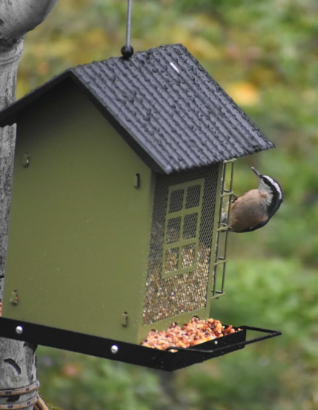
In the courtyard ecosystems of the Americas, bird feeders serve as an important medium for interaction between humans and birds, forming a unique "observation response" dynamic relationship around them. Birds of different families and genera exhibit diverse responses from adaptation to vigilance when faced with human observation behavior through bird feeders. These responses are influenced by species nature and closely related to human activity frequency and observation methods, ultimately forming differentiated behavioral strategies.
The response of common birds in American courtyards to bird feeders can be divided into three core gradients, each corresponding to different behavioral characteristics and species tendencies.
(1) Adaptive response: integration of normalized eating and environment
Resident birds, represented by the North American Cardinalis cardinalis and the House Vermilion, develop a high degree of adaptation to human observation in courtyards with long-term bird feeders. This type of bird can usually engage in normal feeding behavior when humans are 1.5-3 meters away from the bird feeder and remain stationary for observation: after pecking at the seeds with their beaks, they will briefly look up and scan the environment, but stay for no more than 2 seconds; During meal intervals, they will comb their feathers or rest on the branches around the bird feeder, and have no significant response to slight human movements such as adjusting observation angles or taking notes. This adaptation stems from long-term "safety memory" - when human observation behavior is consistently unrelated to threats (such as capture, noise), birds will identify the feeder area as a "low-risk foraging point" and even actively gather during fixed observation periods.
(2) Alert response: intermittent eating and distance maintenance
Medium sized songbirds such as Cyanochita cristata and Baeolophus bicolor exhibit typical vigilance responses. When they observe humans, they first stay on tall trees near the bird feeder for 3-5 seconds, and collect environmental information by rotating their heads and raising their crests; After confirming that there is no direct threat, they will feed in a "short distance sprint fast pecking immediate evacuation" mode, with a single stay on the bird feeder usually not exceeding 10 seconds. If humans experience significant body movements during observation (such as standing up or waving), these birds will quickly fly to the top of trees over 10 meters high, stay and observe for 2-3 minutes before attempting to return. Some individuals may even choose to abandon the bird feeder and turn to other foraging points.
(3) Stress response: Avoidance behavior and group linkage
Small social birds such as Junco hyemalis and Passer montanus are more sensitive to human observation through feeding devices and often exhibit stress avoidance. When humans observe at a distance of 5 meters from the bird feeder, they gather on the ground or in low shrubs, emitting high-frequency warning calls. The group members respond to each other and always maintain a safe distance of 3-4 meters from the bird feeder, with no individual actively approaching; If humans continue to observe for more than 5 minutes, the group may shift as a whole to the edge of the courtyard or adjacent areas, and gradually return 10-15 minutes after humans leave. In addition, this type of bird also exhibits the phenomenon of "group linkage stress" - if one bird is startled by human actions and takes off, the entire group will synchronously evacuate within 1-2 seconds, forming a "momentary blank field" behavioral landscape. This response is a typical defense strategy for small birds to deal with potential threats.
We recommend our Flowafoli bird feeder!