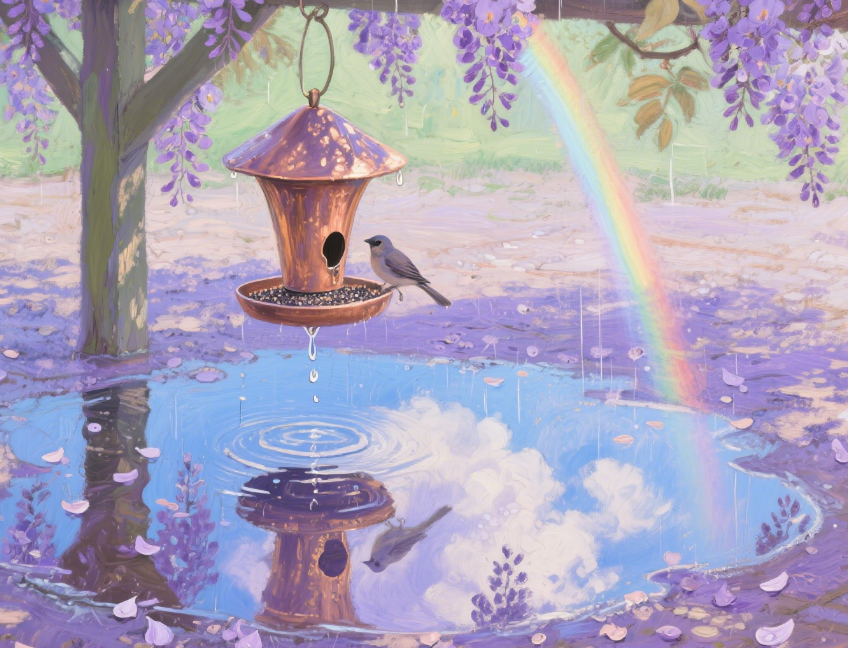
When placing bird feeders in an American-style garden, it is essential to consider the local bird species' habits and the garden's environmental characteristics, ensuring bird safety, ease of feeding, and the human observation experience. The following are specific location recommendations:
First, it is essential to provide birds with a safe feeding environment. Common predators of birds in American gardens include domestic cats and eagles. Therefore, bird feeders should be placed at least 1.5 meters away from branches, fences, or buildings that cats can easily jump onto. Additionally, they should avoid being completely exposed in open areas — — They can be hung 1–3 meters away from shrubs or medium-sized trees, allowing birds to quickly hide in vegetation for safety while preventing predators from using dense vegetation as cover for ambushes. If the yard has tall trees, the feeder can be hung at the fork of the trunk or on low-hanging branches, with a height of 1.2–2 meters being ideal. This makes it convenient for medium-sized birds (such as the American redstart and blue jay) to land while reducing the threat from ground predators.
Secondly, consider the birds' ease of access to food and food preservation. The area around the feeder should have sufficient open space (diameter of 1.5 meters or more) to avoid dense foliage obstructing the birds' landing, especially for small birds like goldfinches and chickadees, which require clear flight paths. Additionally, direct sunlight and strong winds should be avoided: prolonged exposure to sunlight can accelerate the spoilage of seed-based foods and may cause syrup-based foods to ferment. The feeder can be placed in partially shaded areas such as the edge of tree shade or under eaves. If the yard is prone to strong winds, walls, fences, or dense shrubbery can be used to block the wind, preventing food from being blown away or the feeder from shaking excessively. Furthermore, avoid low-lying areas prone to water accumulation to prevent rainwater from entering the feeder and causing food to mold.
Additionally, consider human observation and maintenance needs. The feeder can be placed 3–5 meters from a window, a distance that allows clear observation of bird activity while reducing the likelihood of birds colliding with the glass due to startle (if the window is highly reflective, anti-collision stickers can be applied for assistance). Additionally, the location should be convenient for regular refilling and cleaning, such as near the house entrance or a pathway, to avoid neglecting maintenance due to an inconvenient location. The ground should be grass, soil, or gravel to facilitate cleaning up food debris and bird droppings, maintaining a clean environment.
Furthermore, coordination with other elements in the garden should be considered. If there is an area designated for feeding squirrels, the bird feeder should be kept at a distance to prevent squirrels from stealing bird food. If a birdbath is installed, the two should be spaced 5–10 meters apart to meet birds' sequential needs for “feeding–drinking” while avoiding contamination of food by water due to proximity. For different types of bird feeders, hanging feeders are suitable for hanging on tree branches or dedicated stands, while ground-mounted feeders should be placed in slightly elevated, well-drained lawn areas with no dense weeds nearby (to prevent snakes from hiding).
Finally, adjust the position slightly according to the season. In summer, shade should be enhanced to prevent food from spoiling due to high temperatures; in winter, feeders can be placed closer to buildings or dense vegetation to provide birds with a warmer feeding environment. If a particular location remains unvisited by birds for an extended period, try adjusting the distance by 1–2 meters or altering the degree of vegetation coverage around the feeder, as different bird species have varying preferences for “concealment” and “openness.” 
How to place bird feeders in the right locations in American gardens
Jul 21, 2025 Bird knowledge presenters