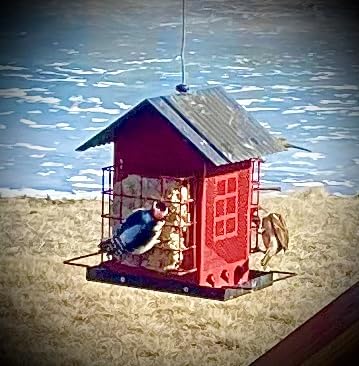
In the ecological environment of the American courtyard, birds' selection of iron bird feeders is not a random behavior, but a comprehensive judgment based on their own sensory abilities, survival needs, safety demands, and behavioral habits. Compared to wooden, plastic, and other materials, iron bird feeders have characteristics such as durability, resistance to biting, and ease of cleaning. However, birds do not directly "recognize" the material, but indirectly select iron utensils that meet their own needs through the appearance, structure, function, and other external manifestations of the bird feeders. The following breaks down the selection logic of birds from multiple key dimensions: First, visual recognition: preliminary screening of color and contour
Birds have an extremely sharp visual system, particularly sensitive to high-contrast colors and clear contours, which is their first step in selecting a bird feeder. For metal bird feeders, their color coating and design directly affect the attention of birds:
1. Color preference adaptation: Common backyard birds in the Americas (such as cardinal, blue jay, goldfinch, etc.) have a natural preference for bright colors like red and yellow, which can simulate the visual signals of ripe fruits and nectar, attracting birds to approach actively. Therefore, iron bird feeders painted with bright coatings are more likely to be selected by birds than those with pure or dark colors. In addition, some birds are more sensitive to bird feeders that form a high contrast with the surrounding environment. For example, beside green lawns or brown bushes, light-colored iron bird feeders such as silver and white have clearer contours, making it easier for birds to quickly locate them.
2. Simplicity of contour: Birds are wary of complex and strange contours and tend to prefer bird feeders with simple and regular shapes. Iron bird feeders often adopt basic shapes such as round and square, with smooth edges and no sharp protrusions (high-quality iron bird feeders undergo polishing). This simple contour allows birds to quickly judge that it is "non-threatening" and thus approach it actively. Conversely, if the design of the iron bird feeder is too complex or has unnecessary decorative protrusions, it may be mistaken by birds as a potential danger (such as the limbs of a predator) and thus be rejected.
II. Touch and Load-bearing: Core Judgment of Footing Stability
When birds land on bird feeders to feed, the stability of their footing directly affects their feeding efficiency and safety. The structural strength and footing design of metal bird feeders are key factors for birds to judge stability:
1. Indirect perception of load-bearing capacity: The density of iron material is much higher than that of plastic or wood. Therefore, bird feeders made of iron with the same volume have stronger load-bearing capacity and will not sway significantly due to birds landing or competing for food. When birds first approach the bird feeder, they will test its stability by lightly landing on it - if the bird feeder is stable and does not sway, the birds will perceive it as a "safe feeding platform"; if there is swaying or tilting, even if it is made of iron, it may be abandoned. In addition, the brackets and hooks of iron bird feeders are usually made of metal, which provides a stronger connection and prevents the bird feeder from falling off due to wind or other external forces. This is also an indirect "safety signal" recognized by birds.
2. Comfort of the perch: High-quality iron bird feeders are often paired with wooden or rubber-covered perches (to prevent metal from freezing and injuring birds' feet) or metal perches with a suitable width and rough surface (to increase friction). Birds judge the suitability of a perch based on the feel of their feet - if the perch is too narrow, too slippery, or if the metal surface is too hot/cold (iron conducts heat quickly, rising in temperature after exposure to the sun in summer and becoming cold in winter), it will reduce the birds' willingness to choose; conversely, a well-designed perch will make birds feel more at ease when feeding, thus giving preference to such iron bird feeders.
3. Feeding Efficiency: Key Selection of Opening Design and Food Accessibility
The core need of birds is to efficiently obtain food. Therefore, the opening size, location, and quantity of iron bird feeders, as well as the visibility and accessibility of food, are the core factors determining whether birds will "choose" them:
1. Adaptability of the opening to the beak: The shapes and lengths of beaks among different bird species vary significantly, leading to distinct requirements for the openings of bird feeders. For instance, the beak of the cardinal is sturdy and suitable for pecking at larger seeds, thus it tends to prefer metal bird feeders with larger openings (1-2 cm in diameter); whereas the beak of the goldfinch is slender and better suited for consuming tiny seeds, making it more inclined to select metal bird feeders featuring grid-like openings or small-mouth designs. The openings of metal bird feeders are typically metal-stamped, with smooth edges that won't scratch the birds' beaks. This is also an advantage over wooden bird feeders (which are prone to wear and have rough edges), allowing birds to feed with greater peace of mind.
2. Visibility and accessibility of food: Birds need to visually confirm the presence of food in the bird feeder before they will proactively approach it. Iron bird feeders with transparent or translucent side panels (such as metal frames paired with acrylic side panels) allow birds to clearly see the seeds, nectar, and other food inside, making them more attractive. At the same time, if the opening position of the iron bird feeder is designed reasonably (such as being close to the perch and unobstructed), it allows birds to easily reach the food after landing, improving feeding efficiency; if the opening position is too high, too deep, or obstructed by metal parts, even if there is food inside, birds may give up.
We recommend our Flowafoli bird feeder!