1. Rhythm Core: Anchoring the Time Coordinate with “Survival Needs”
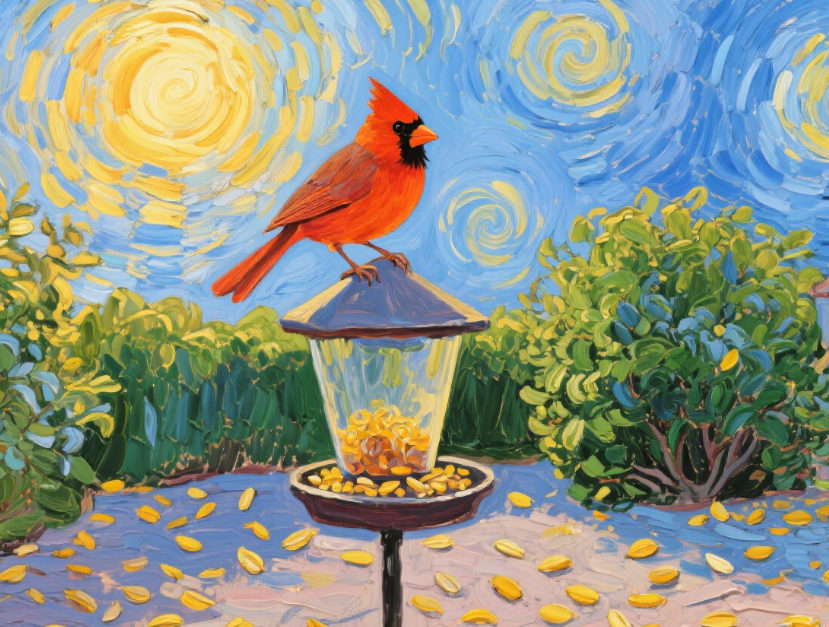
Despite being immersed in the fast-paced whirlwind of human activity (such as the roar of vehicles, the hustle and bustle of pedestrians, and gardening work), the birds in the American courtyard remain grounded in their physiological rhythms and seasonal cycles, breaking down complex tasks into executable “natural to-do lists.” This rhythm is not random but a “survival algorithm” shaped by millions of years of evolution—for example, the dawn calls of the Northern Cardinal, Carolina Wren efficiently complete the critical steps of “territory declaration” and “mate communication” during the soft light and reduced predator activity of dawn. The entire process is precisely controlled within 30–45 minutes, after which they transition to foraging mode to avoid excessive energy expenditure during the midday heat.
II. Task Management: Prioritized “Modular Operations”
Foraging: Efficient Utilization of Fragmented Time
In response to the dynamic changes in food resources (such as feeders, scattered seeds, and insects) in human gardens, birds have developed a “short, frequent, and fast” foraging strategy. North American redbirds engage in 6–8 short foraging trips daily, each lasting 5–10 minutes, prioritizing areas close to the nest with low predator risks (such as the edges of shrubs or under balcony flower racks). Hummingbirds take this to the extreme: to maintain their high metabolism, they must feed on nectar every 10–15 minutes. They also remember the “sugar recovery time” of each flower in the yard, avoiding repeated visits to unripe flowers to minimize time wasted.
Reproduction: A phased “precise progression”
Reproduction is the “key project” in birds' annual activities, but they never rush it. Instead, they proceed in stages: “nest building - egg laying - incubation - chick rearing.” For example, when House Finches build their nests, the male bird is responsible for gathering materials like dry branches and grass leaves, carrying only 1-2 items at a time, and making over 100 trips to complete the basic framework. The female bird then spends the next 2-3 days using soft feathers and cotton to refine the interior, ensuring a stable incubation temperature for the eggs. During the incubation period, the parents strictly divide their roles: the female bird handles 90% of the incubation tasks, while the male bird feeds the eggs every 1-2 hours, ensuring both the safety of the eggs and preventing the parents from becoming overly fatigued. This rhythm aligns perfectly with the patterns of human activity in a garden, such as avoiding disturbances during morning gardening peak hours or evening walking times.
Risk avoidance: balancing immediate response and long-term adaptation
Threats in the garden (such as pet cats, cars, and children chasing) are sudden, and birds' risk avoidance patterns exhibit a “immediate response + post-adjustment” characteristic. When danger arises, they take flight or hide in shrubs at millisecond speeds. For example, when the Dark-eyed Junco detects a cat's movement, it freezes for 1–2 seconds to assess the direction before taking off vertically to a higher vantage point, avoiding blindly fleeing and wasting energy. In the long term, they adjust their activities based on the high-risk periods for threats in the yard. For example, during the afternoon when children are playing, they move their primary activity area to the deep parts of the yard among trees, then return to the ground to forage after the crowd disperses in the evening.
III. The Essence of Rhythm: “Flexible Adaptation” in Symbiosis with the Environment
The “self-paced rhythm” of American courtyard birds is not a stubborn “do-as-I-please” attitude, but rather a flexible adaptive strategy. They fine-tune their behavior to align with human activity rhythms without violating physiological norms—for example, in courtyards where humans frequently feed birds, American Goldfinches synchronize their peak foraging times with human feeding schedules (such as 7 a.m. and 6 p.m.) to reduce unnecessary energy expenditure; in unmanaged natural gardens, they revert to more primitive dawn-dusk foraging patterns. This “self-centered yet moderately accommodating” rhythm is precisely the key to their survival in human-dominated environments: they neither allow their survival rhythms to be disrupted by the fast pace of human life nor fail to cleverly utilize the resources provided by gardens, finding a balance between nature and human culture.