In the backyard ecosystems of the Americas, bird feeders serve not only as a bridge between humans and nature but also as an excellent window into the diverse behaviors of birds. Different bird species, with their unique physiological structures and behavioral habits, have evolved diverse ways of using bird feeders, and their feeding behaviors reflect sophisticated adaptive strategies and ecological logic. The following analysis will examine bird usage and feeding patterns in American backyard bird feeders from five dimensions: habitat selection, feeding actions, group interactions, temporal patterns, and environmental adaptation.
I. Habitat and Perching: Feeder Adaptation Strategies Based on Body Structure
Birds' initial selection of feeders often depends on their body size, foot structure, and balance abilities. Different types of feeders attract distinctly different bird species, creating a clear “habitat stratification” phenomenon.
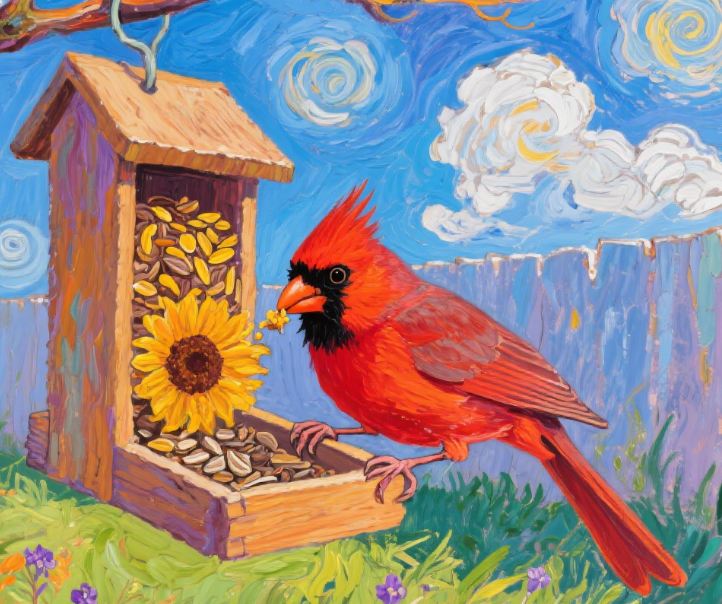
The “flexible perching type” of small songbirds: Small birds such as the Northern Cardinal and Carolina Wren prefer hanging or tube-shaped bird feeders. Their robust hind toes enable them to grip firmly, allowing them to easily grasp the metal hooks or mesh edges of the feeder. They can even press their bodies against the feeder walls, balancing on one foot while extending the other to reach the food tray. When feeding, the Northern Cardinal first stabilizes its body on the side of the feeder, tilts its head slightly, and uses its sharp beak to peck at sunflower seeds in the mixed grain. If it encounters seeds with hard shells, it will carry them to a perch, hold them down with its feet, and repeatedly peck at them until the shells crack.
Medium-sized birds' “stable standing type”: Medium-sized birds like blue jays and mourning doves prefer platform-style feeders with wide perches. Blue Jays have well-developed leg muscles, allowing them to stand steadily on perches. When feeding, they use their beaks to quickly sift through grain piles, selecting preferred peanuts or cornflakes, and may even carry multiple seeds at once to store in their crops before flying to nearby branches to enjoy them slowly; Mourning Doves, due to their stockier build and slower movements, typically stroll slowly on the platform, lowering their heads to peck at scattered millet or sorghum. During feeding, they frequently look up to observe their surroundings, vigilant for potential predators.
The “inverted feeding type” of climbing birds: species such as the Downy Woodpecker and Hairy Woodpecker demonstrate a unique “inverted” feeding method. Their toes are opposable (two toes forward, two toes backward), allowing them to firmly grip the bottom or side panels of the feeder. They hang upside down beneath the feeder, extending their heads upward and using their slender beaks to probe into the feeding trough to peck at insect larvae or nut fragments. This behavior is not only an adaptation to the structure of the feeder but also an extension of their natural behavior of climbing tree trunks and pecking insects from within the bark.
II. Feeding Actions: Specialized Beak Functions and Feeding Techniques
The shape of a bird's beak is highly adapted to its diet. At feeders, birds with different beak types exhibit specialized feeding actions to efficiently obtain food resources.
The “beak processing technique” of seed-eating birds: Birds such as the American Goldfinch and House Finch, which primarily feed on seeds, have conical beaks and are skilled at “cracking seeds.” When feeding on Nyjer seeds (small black seeds), the American Goldfinch aligns the tip of its beak with the seed, gently bites it with the edge of its beak, and then rapidly shakes its head from side to side to crack open the seed shell. After spitting out the shell, it swallows the seed kernel. House finches, on the other hand, prefer sunflower seeds. They pick up the seeds with their beaks, secure them at the front of their beaks, and then repeatedly tap the seed shells with the sides of their beaks until cracks appear. They then use their tongues to lick out the kernels, completing the entire process in just 2-3 seconds with smooth and efficient movements.
The “precise capture method” of insect-eating birds: Insect-eating birds such as warblers (e.g., the yellow-throated warbler) and flycatchers (e.g., the eastern flycatcher) primarily consume dried insects or minced meat from mixed feed in bird feeders. The Yellow-throated Warbler has a slender, pointed beak resembling a probe, enabling it to precisely probe into the gaps of the feeder and extract small dried insects; The Eastern Phoebe's beak is flat and wide, with serrated edges. When feeding, it quickly pecks at the meat paste while using the serrations on its beak to firmly grip the food, preventing it from slipping out. Its feeding actions are swift and aggressive, resembling the “ambush” behavior it exhibits when capturing flying insects in its natural habitat.
The “multi-functional feeding strategy” of omnivorous birds: Omnivorous birds such as the Blue Jay and Northern Mockingbird possess beaks with high adaptability, enabling them to flexibly handle various food types. At bird feeders, mockingbirds use their beaks to peck at berries (such as raisins), pick up corn kernels from mixed grains, and even attempt to catch small insects flying around the feeder. When encountering larger food items (such as whole peanuts), the Northern Mockingbird will pick up the food with its beak, fly to a nearby ground or branch, hold the food down with its feet, and repeatedly peck at it with its beak to break it into smaller pieces before eating, demonstrating “tool-assisted” foraging intelligence.
III. Group Interaction: Hierarchical Order and Cooperative Feeding Behavior
Around bird feeders where resources are relatively concentrated, birds form temporary groups. Interactions within these groups reflect both intraspecific hierarchical order and cooperative feeding behavior.
Intraspecific hierarchical “feeding priority”: Birds of the same species exhibit clear hierarchical differences at bird feeders, with larger individuals and those with more vibrant plumage typically having higher feeding priority. For example, in a flock of redpolls, male redpolls (with red feathers) will prioritize occupying the best feeding positions at the feeder (such as directly in front of the feeder tray), while female redpolls (with brownish-red feathers) and juveniles can only wait at the edges or on nearby branches, only approaching to feed after the male individuals have departed. If a young male cardinal attempts to challenge a dominant individual, the dominant bird will intimidate the challenger by spreading its wings, calling, or pecking, until the challenger retreats.
Interspecific coexistence through “ecological niche differentiation”: Different bird species adjust their behavior around feeders to coexist and avoid excessive competition. For example, on platform-style feeders, blue jays occupy the central area to feed on larger peanuts and corn; house sparrows gather in groups at the edges to peck at scattered small seeds; while common woodpeckers move along the sides or bottom of the feeder to feed on insects near the bark. This “spatial stratification” feeding pattern is an ecological niche differentiation formed through long-term adaptation by different bird species, maximizing the utilization of food resources in the feeder and reducing interspecific conflicts.
Cooperative feeding and “information sharing”: Some bird species exhibit cooperative feeding behavior, especially when discovering new feeders or food sources. For example, American goldfinches typically forage in groups. When one goldfinch locates a feeder and confirms it is safe, it communicates this information to the group through specific calls (short, crisp “cheep” sounds), attracting other goldfinches to feed. During group feeding, some individuals take on sentry duties (standing on nearby high ground to observe the surroundings). Upon detecting predators (such as hawks or cats), they immediately issue an alarm call, prompting the entire group to swiftly fly away. This “division of labor” behavior enhances the group's survival probability and feeding efficiency.
4. Time patterns: Feeding choices based on circadian rhythms and environmental safety
Bird feeding behavior at feeders is not random but follows strict circadian rhythms and is influenced by environmental safety factors, forming specific “feeding peaks.”
Morning-Afternoon Double Peak Circadian Rhythm: Most American backyard birds exhibit a “morning-afternoon double peak” feeding pattern. The first peak occurs in the morning (1–2 hours after sunrise), when birds need to quickly replenish food and restore energy after a night of energy expenditure. For example, mourning doves gather at feeders in the early morning to consume large amounts of millet and grains, storing energy for daytime activities; from 10 a.m. to 2 p.m., as temperatures rise and predators become more active, bird feeding activity decreases, with only a few small bird species (such as the Carolina wren) occasionally visiting feeders; From 3 to 5 p.m. (2 to 3 hours before sunset), there is a second feeding peak, with birds again consuming large amounts of food before nightfall to store energy for nocturnal hibernation. At this time, species like the Northern Cardinal and House Finch are most active, and bird feeders often attract large numbers of individuals.
Seasonal adjustments to feeding times: As seasons change, birds' feeding times also adjust accordingly. In winter (December–February), due to shorter daylight hours and lower temperatures, birds require more energy to maintain body temperature, resulting in earlier feeding peaks that last longer. For example, American goldfinches will immediately visit feeders after sunrise in winter and frequently shuttle between feeders and their habitats throughout the morning; In summer (June–August), with longer daylight hours and abundant food resources (such as increased insects and berries in natural environments), birds become less dependent on feeders, resulting in a delayed peak feeding time and reduced feeding frequency, with more time spent foraging in natural environments.
Environmental safety-oriented timing: The activity patterns of predators and the intensity of human activity also influence birds' feeding times. If there are raptors like eagles or owls near the yard, birds will avoid the active periods of these predators (e.g., between 10 a.m. and 1 p.m.), choosing instead to visit feeders during the predator's resting periods in the early morning or evening. If human activity is frequent in the yard (e.g., children playing or vehicles moving in and out during the day), birds may adjust their feeding times to “low-activity periods at dawn and dusk,” i.e., before humans wake up in the morning and after human activity decreases in the evening, to minimize contact with humans and reduce the risk of disturbance.
5. Environmental adaptation: The impact of feeder location and food type on feeding behavior
Environmental factors such as feeder location and food type directly influence birds' willingness to use the feeder and their feeding behavior. Birds adapt to different environmental conditions through behavioral adjustments.
“Safety Preference” for Feeder Location: Birds have a clear safety preference for feeder locations, typically choosing spots near cover (such as trees or shrubs). If a feeder is installed in the open center of a yard without cover protection, only a few highly vigilant bird species (such as blue jays) will briefly stop to feed, and they will frequently look up while feeding; If the feeder is installed 3–5 meters away from trees, bird activity becomes more active, as trees provide both shelter from predators and prevent predators (such as snakes or squirrels) from easily approaching the feeder due to the distance. For example, the common woodpecker prefers feeders installed near tree trunks, allowing it to quickly fly to the trunk to avoid danger during feeding breaks.
“Selective feeding” based on food type: The type of food placed in the feeder directly determines the species composition and feeding behavior of birds. If Nyjer seeds are provided, they primarily attract small songbirds like American goldfinches and redpolls, which use precise beak movements to eat the tiny seeds; if sunflower seeds are provided, birds like redpolls, house finches, and blue jays become the primary users, exhibiting actions like cracking seeds and picking them up; If mixed feed (containing seeds, dried insects, and dried berries) is provided, it will attract a variety of omnivorous birds, forming a rich bird community. Additionally, birds have high requirements for the freshness of food. If the food becomes damp or moldy, birds will refuse to eat it and may even avoid the entire feeder until the food is replaced.
Behavioral adjustments under extreme weather conditions: Under extreme weather conditions, birds will adjust their use of the feeder. During heavy rain, birds will reduce their outdoor activities and only quickly fly to the feeder to feed when the rain is lighter, with shorter feeding times and more rapid movements; During windy weather, suspended feeders sway in the wind. Small birds (such as American goldfinches) maintain balance by adjusting their body posture (lowering their center of gravity and tucking their wings), while medium-sized birds (such as mourning doves) avoid feeders that sway violently and instead choose stable platform-style feeders; In hot weather, birds will linger in the shade near the feeder until their body temperature drops before heading to feed, and they will prioritize foods containing moisture (such as soaked raisins) to replenish water and energy.