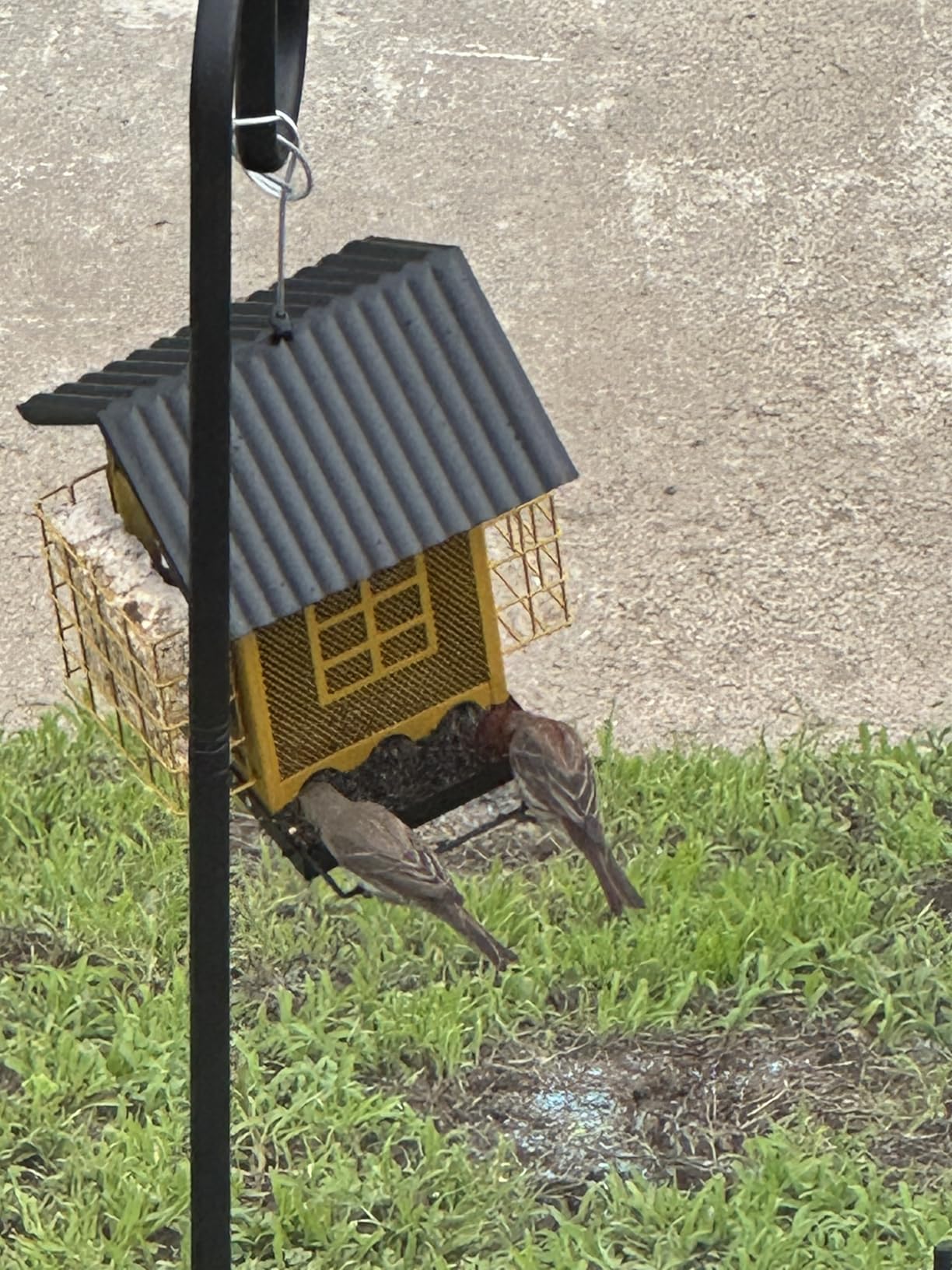
The American courtyard, as a space where artificiality and naturalness blend, attracts a variety of birds such as sparrows, cardinal birds, goldfinches, woodpeckers, and hummingbirds to roost. As artificial food supply points, bird feeders have become important places for these birds to forage daily. The foraging behavior of birds towards bird feeders is a typical behavior of perceiving the environment and adapting to artificial facilities. Due to differences in body size, beak structure, and behavioral habits, different birds exhibit unique operational methods at various stages.
1. Positioning and identification - precisely pinpointing the source of food
Birds first locate the bird feeder through dual perception of vision and hearing.
Common diurnal birds in American courtyards, such as cardinal and goldfinch, are sensitive to colors and are particularly attracted to bird feeders in bright colors like red and yellow (which is why many bird feeders are designed in bright colors). They will hover over the courtyard or perch on nearby branches or fences, observing the shape of the bird feeder (such as hanging, platform, or tube type) and whether their peers are feeding, to determine whether it is a place where they can find food.
For small birds like hummingbirds that rely on nectar, in addition to visual positioning, they can also perceive the scent of nectar in the bird feeder through their sense of smell. Furthermore, the collective behavior of birds also aids in positioning - when a bird discovers a bird feeder and successfully feeds, the gathering behavior of its conspecifics forms a "foraging signal" that attracts more birds to come. During the recognition phase, birds will also make a preliminary judgment on the safety of the bird feeder, observing whether there are predators such as cats and dogs around, as well as the frequency of human activity. Only after confirming the safety of the environment will they proceed to the next step of approaching behavior.
2. Approach and Exploration - "Cautious Exploration" in Adaptation to Artificial Facilities
There are significant differences in the way birds of different body types approach bird feeders. Small birds such as sparrows and goldfinches are agile and usually fly a short distance directly to the vicinity of the bird feeder. They first perch on the edge of the bird feeder, the hook, or the attached perch, and make a brief pause to test the situation. They gently peck at the shell, food opening, and other parts of the bird feeder to perceive its stability (such as whether it is shaking or making any abnormal noise) and confirm whether the food is accessible.
Medium-sized birds, such as cardinal and blue jay, are slightly larger in size and have a more stable flight trajectory. They will land directly on the supporting structure of the bird feeder (such as the platform of a platform-style bird feeder or the perch bar of a tube-style bird feeder). When landing, they adjust the amplitude of their wing flapping to control the force, avoiding violent shaking of the bird feeder due to their excessive weight. For birds that are good at climbing, such as woodpeckers, if they encounter a hanging or tree-attached bird feeder, they will use their sharp claws to grasp the outer shell of the bird feeder or the nearby tree trunk, and observe the feeding position from the side.
The key to the probing stage is "safety confirmation". Birds will repeatedly adjust their resting positions, and even briefly fly away and return again, until they fully adapt to the presence of the bird feeder and the stability of the surrounding environment. For bird feeders with anti-squirrel designs such as protective nets and baffles, birds will also test whether these structures will hinder feeding, gradually finding the path to enter the feeding area.
We recommend our bird feeder!