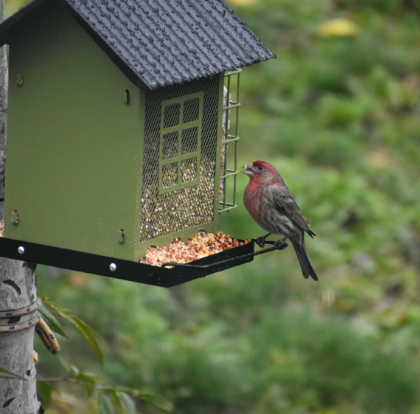
Due to the integration of human activities and natural environment, American courtyards have become the "urban habitat" for numerous birds. There are abundant food sources and hidden places here, as well as multiple challenges such as foraging competition, nest shortage, and threats from natural enemies. Faced with these problems, the birds in the courtyard have evolved a set of precise and efficient coping strategies, each behavior demonstrating the survival wisdom bestowed by natural selection.
Food is the core need for bird survival, and in American gardens, different birds often compete due to overlapping food sources, while also facing the "technical challenges" brought by human feeding methods. Their solutions are both flexible and specific, adept at avoiding conflicts and breaking through obstacles.
1. Ecological niche differentiation: avoiding competitive "division of labor and cooperation"
The most common main Cardinals, Blue Jays, and Home Sparrows in the courtyard, although all rely on seeds fed by humans, resolve competition through differentiation of time and food preferences. The main Cardinals prefer sunflower seeds and are more active in the early morning and evening, when foraging pressure is relatively low; Blue ravens, on the other hand, prefer crushed peanuts and often choose to eat during the noon period, using their strong aggressiveness to seize temporary food sources; Smaller house sparrows mainly target millet and barnyard grass, foraging in gaps through their numerical advantage during group activities to avoid direct conflict with large birds. This "staggered foraging+food segmentation" strategy allows three bird species to coexist at the same feeding point without interfering with each other.
2. Tool usage: "Technological innovation" to overcome obstacles
Faced with enclosed bird feeders or hard food shells, some birds exhibit astonishing "tool thinking". The Karoo reed wren will use its beak to pick up twigs, insert them into the gaps of bird feeders, and pull out the seeds stuck inside; A more representative example is the blue raven. When they encounter a nut with a shell, they will first carry the nut to a hard ground or roof and repeatedly strike it with their beak. If they cannot break the shell once, they will lift the nut and fly high into the sky, release their beak to let it fall and hit the ground, and use gravity to break through the shell. This' physical obstacle breaking 'behavior is a typical manifestation of their adaptation to the courtyard environment.
We recommend our Flowafoli bird feeder!