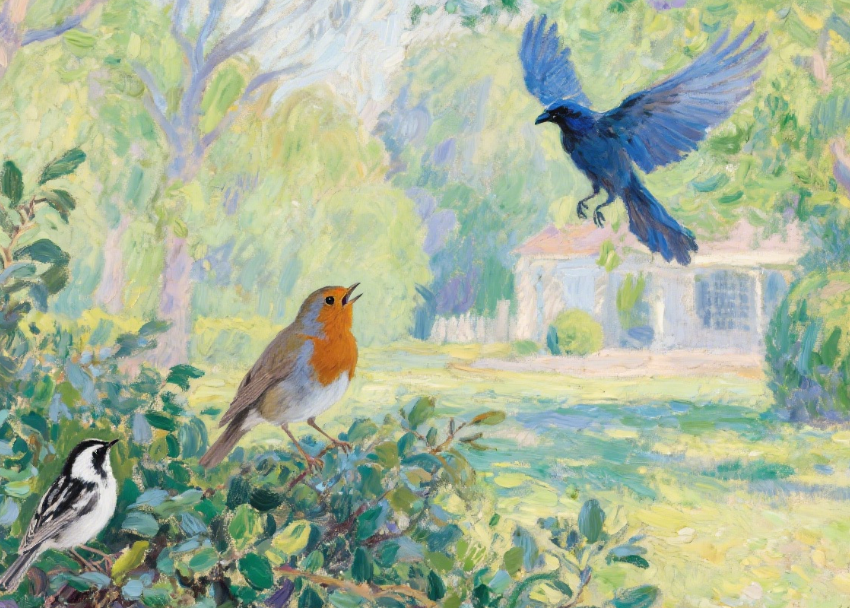
In the gardens of the Americas, various bird species form a sophisticated ecological collaboration network. Through diverse signal transmission, they achieve division of labor and collaboration ranging from simple coordination to complex processes. These signals act as an invisible language, playing a crucial role in scenarios such as foraging, nesting, and vigilance, enabling the group to operate efficiently.
Visual Signals: Direct Action Commands
Feather color and posture are the most direct visual signals in birds. For example, the male Northern Cardinal's vibrant red feathers stand out vividly against the green foliage of gardens. When it spots a berry bush, it communicates the message “food is here” to other group members by spreading its tail feathers and moving its head up and down. Such signals are typically used for close-range, immediate collaboration, suitable for feeding scenarios with clear division of labor. Upon receiving the signal, female birds and chicks quickly gather and divide tasks based on size: smaller individuals peck at lower-lying fruits, while male birds monitor the surrounding environment.
Another visual signal is the formation changes during group flight. In the forests surrounding courtyards, flocks of purple-backed swallows adjust their flight formations to convey turning instructions while hunting flying insects. When the lead individual suddenly ascends in altitude and flaps its wings slightly, subsequent members instinctively turn left. This signaling system enables the entire group to efficiently encircle moving insect swarms, with each individual assuming specific roles in pursuit or blockage along designated flight paths, thereby avoiding redundant labor.
Auditory Signals: Long-Distance Information Transmission
Calls and vocalizations are the core signals for cross-distance collaboration among birds. The songs of North American robins carry rich meanings; their morning calls are typically “territorial declarations,” but when they detect a predator approaching, they emit sharp, brief “chirps.” This alarm signal can spread rapidly within a 30-meter radius. Birds receiving the signal respond according to their own habits: ground-dwelling white-throated sparrows immediately hide in bushes, while tree-dwelling blue jays fly to higher ground to observe the raptor's movements and update location information through louder calls, forming a three-dimensional warning network.
During the nesting phase, the birds' vocalizations become even more specialized. When building mud nests, male swallows are responsible for foraging for mud, while females remain at the nest site to organize materials. When the male returns with a mud ball, it emits a low “gurgling” sound, while the female responds with a high-pitched ‘chirping’ sound. This signal not only confirms the “delivery of materials” but also allows the female to adjust her body posture in advance to efficiently receive the mud ball and continue building the nest.
Behavioral Signals: Collaborative Guidance for Complex Processes
When cooperating to hunt larger prey, birds use a series of behavioral signals to assign roles. For example, when several blue tits surround an earthworm, the first individual to discover the prey does not attack directly but instead jumps in place and repeatedly pecks at the ground, signaling to its companions the “location and size of the prey.” Subsequently, the largest individual in the group approaches to secure the earthworm's head with its beak, medium-sized individuals pull from the sides, and the smallest individuals observe from the rear and prevent the earthworm from escaping. The entire process requires no vocal communication; division of labor is achieved solely through the sequence and intensity of movements, ensuring a high success rate in hunting.
Behavioral signals during the chick-rearing period demonstrate even more refined collaboration. When feeding chicks, North American wren parents convey information about the chicks' growth status through feeding frequency and food type. As chicks prepare to leave the nest, parents intentionally reduce feeding frequency and bring more hard insect exoskeletons. This signal encourages chicks to actively spread their wings and practice flying, while also prompting other parents to adjust their roles—some remain near the nest to monitor, while others guide chicks in learning foraging skills to prepare for independent life after fledging.
The development of these signaling systems is the result of long-term adaptation to the environment by American backyard birds. Through multi-dimensional signaling via vision, hearing, and behavior, they integrate individual capabilities into group collaboration, enhancing survival efficiency while ensuring population continuity, thereby infusing vibrant vitality into the balance of backyard ecosystems. 
How do birds in the American courtyard collaborate through the emission of various signals to achieve different levels and processes of division of labor?
Aug 4, 2025 Bird knowledge presenters