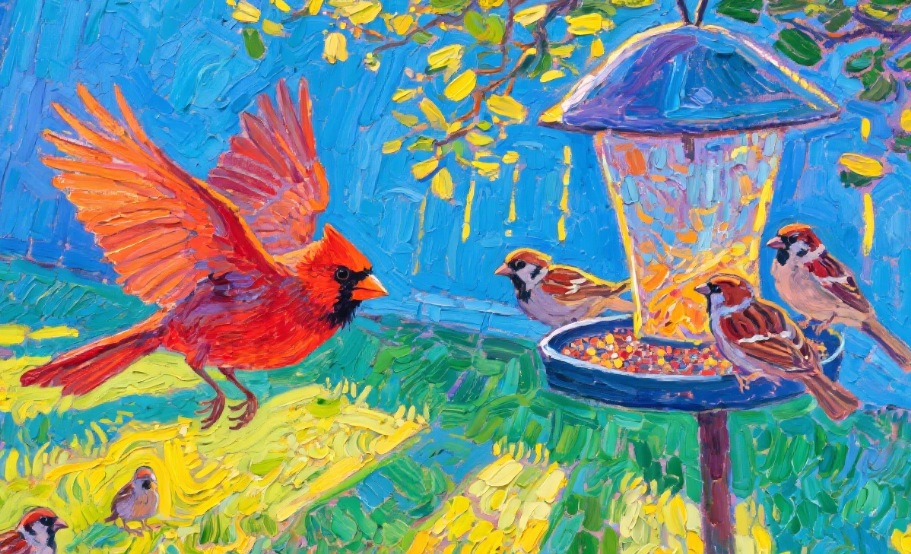
In the courtyards of homes across the Americas, the daily foraging activities of birds such as sparrows, cardinals, and goldfinches brim with vitality. Yet, the “disturbances” lurking among the branches and leaves never cease—whether it be the sudden appearance of stray cats, territorial disputes among peers, or an unexpected downpour interrupting their meals. These disturbances not only temporarily interrupt their foraging behavior but also trigger brief stress responses. However, these small creatures have evolved an efficient “mental adjustment mechanism” that allows them to regain composure within minutes to several tens of minutes and resume their search for seeds, berries, or insects.
Step One: The “Safety Confirmation Ritual” After Stress
When danger signals (such as the sound of a cat's claws rustling through the grass or the aggressive calls of unfamiliar birds) appear, the birds' first reaction is to halt foraging and enter “alert mode” — wings slightly spread, heads moving rapidly, scanning the surroundings through vision and hearing. Once they have moved out of the danger zone (typically by flying to a higher branch or the edge of a roof), they initiate a “safety confirmation ritual”: the red cardinal repeatedly preens its tail feathers, while the goldfinch emits a soft ‘chirping’ sound. This behavior not only alleviates the physiological tension caused by surging adrenaline but also communicates the message that “the danger has passed” through both physical movements and sounds. Research has found that this “ritualized behavior” can restore the birds' heart rates to normal levels within 5-8 minutes, preparing them physiologically to resume foraging.
Step Two: “Memory Screening” and Adjusting Foraging Strategies
After experiencing disturbance, birds do not blindly return to their original foraging sites but instead undergo rapid “memory screening.” For example, if they previously encountered competition from conspecifics at the feeder on the left side of the courtyard, sparrows will prioritize the ground feeding area on the right side; if they notice cats lurking near bushes, redpolls will abandon low berry bushes and instead fly to higher elm tree fruits. This adjustment is not a random choice but based on short-term memory of “dangerous scenarios” — despite its small size, the hippocampus in birds' brains can temporarily store critical environmental information and guide subsequent behavior. Additionally, they reduce risk through “group observation”: when a goldfinch cautiously approaches the feeder, other companions watch from nearby branches. If the former safely feeds for over 30 seconds, the group gradually joins in. This “peer validation” mechanism further alleviates anxiety.
Step Three: Behavior Reactivation Driven by “Energy Compensation”
Stress responses consume significant energy in birds, and the instinct to “replenish energy” becomes the core motivation driving them to resume foraging. A stable food source in the yard (such as human-provided mixed seeds or ripe hawthorn fruits) forms a strong “foraging memory.” Even if temporarily disrupted, this memory prompts them to return swiftly once safety is confirmed. For example, after being disturbed, North American redpolls typically pause on tree branches for 2–3 minutes to observe their surroundings before flying directly to their usual feeders—this behavior reflects a rapid balancing of “energy needs” and “environmental safety.” Additionally, birds' “time perception” plays a role: dawn and dusk are prime foraging periods, so to obtain sufficient energy within a limited timeframe, they recover more quickly from stress states to avoid missing feeding windows due to excessive vigilance.
The survival wisdom behind the behavior
The “mental adjustment” of American backyard birds is essentially a survival strategy adapted over the long term to human-impacted environments. Compared to the wild, disturbances in backyards (such as human activity and pet presence) are more frequent but less dangerous, leading birds to evolve a “rapid stress response - rapid recovery” behavioral pattern — neither overly relaxing to risk predation nor overly anxious to waste energy. This balancing ability enables them to thrive in environments coexisting with humans: they can utilize food resources in gardens while coping with various “minor annoyances” that come with it. From the subtle actions of preening feathers to collaborative foraging methods within groups, every behavioral detail reflects precise calculations for survival, offering us a glimpse into the ordinary yet exquisite wisdom of life in nature.
How do birds in the American courtyard adjust their mindset and resume foraging behaviors after dealing with something that causes them some distress?
Aug 19, 2025 Bird knowledge presenters