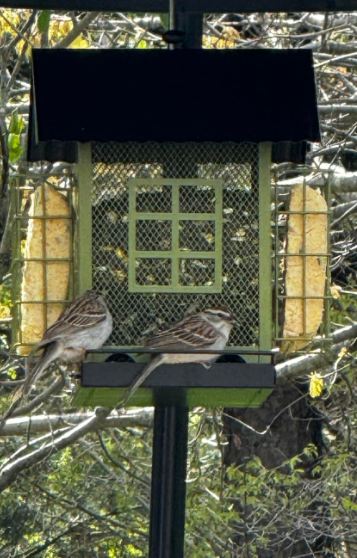
In residential gardens across the Americas, bird feeders have long served as vital bridges connecting humans and wild birds. When humans observe birds feeding at close range through these devices, these feathered creatures exhibit rich and varied behavioral responses.
I. Typical Reactions of American Garden Birds to Close Human Observation
Common backyard birds in the Americas, such as the Northern Cardinal, House Finch, Dark-eyed Junco, and Blue Jay, exhibit three typical responses when confronted with close human observation. These responses vary based on species habits, individual experience, distance, and human behavior patterns, each reflecting the birds' balancing act between “potential threat” and “food benefit.”
(1) Vigilant Avoidance: Direct Manifestation of Survival Instinct
This is the primary response for most birds during initial close encounters with humans, particularly common among species sensitive to human presence. Take the Dark-eyed Bunting as an example. These small, ground-foraging birds will first perch on nearby shrubs or branches when humans remain motionless within 5 meters of a feeder. Their bodies tense, heads darting frequently as they assess potential threats through sight and sound. If humans make subtle movements (such as raising a hand or bending over), they immediately take flight to a safe zone 10-15 meters away. Only after humans remain motionless for 3-5 minutes will they tentatively return near the feeder, though they consistently maintain a greater distance from humans. Despite their larger size and relatively active nature, Eurasian jays also exhibit vigilant avoidance when humans approach within close range (under 3 meters). They pause feeding, emit short “caw” calls, and if the human does not retreat, swiftly take a seed and fly away, avoiding prolonged stays near the feeder. This reaction stems from an evolutionary survival instinct where birds perceive humans as potential predators (like large mammals). They balance feeding needs and safety risks through a “observe-withdraw-test” process.
(2) Adaptive Tolerance: Behavioral Adjustment Through Experience
Individual birds or populations long exposed to human activity zones gradually develop “adaptive tolerance.” They permit observation at relatively close distances (2-3 meters), retreating only when humans make sudden movements (e.g., rapid approach, arm waving). The Northern Cardinal exemplifies this response. In gardens with regular feeders, male cardinals remain calmly perched on feeders eating sunflower seeds even when humans sit on balconies (about 2 meters away). They may occasionally glance up at people but do not interrupt feeding. This adaptive behavior develops through prolonged “positive interactions”: humans consistently maintain quiet, slow movements without actively disturbing the birds, allowing them to gradually associate “human proximity” with signals of “no threat” and “available food.” Research indicates that birds exhibiting this adaptive tolerance have significantly lower cortisol (a stress hormone) levels compared to wary, avoidant individuals. This suggests they have reduced their stress response to humans through accumulated experience, developing a behavioral pattern of coexistence.
(3) Selective Interaction: Proactive Approach Behavior
A small number of highly curious birds or those dependent on human-provided food exhibit “selective interaction”—actively approaching humans and even lingering nearby to obtain additional food. The Eurasian Bullfinch is one of the species most prone to this behavior. During winter food shortages, if humans consistently replenish feeders at fixed times, bullfinches will fly within a 1-2 meter radius around humans approaching the feeder. They may even land near human feet to peck at spilled seeds. Additionally, some birds that have been consistently fed by humans (such as hand-fed birds), like the North American goldfinch, may actively fly onto a person's shoulder or arm. This interaction is not driven by “affection,” but rather by the bird's recognition that “human = food source.” It is important to note that selective interaction exhibits significant individual variation. It typically occurs only in birds that interact with humans extremely frequently and have never experienced harm from humans. It is not a universal behavior across the species.
We recommend our Flowafoli bird feeder!