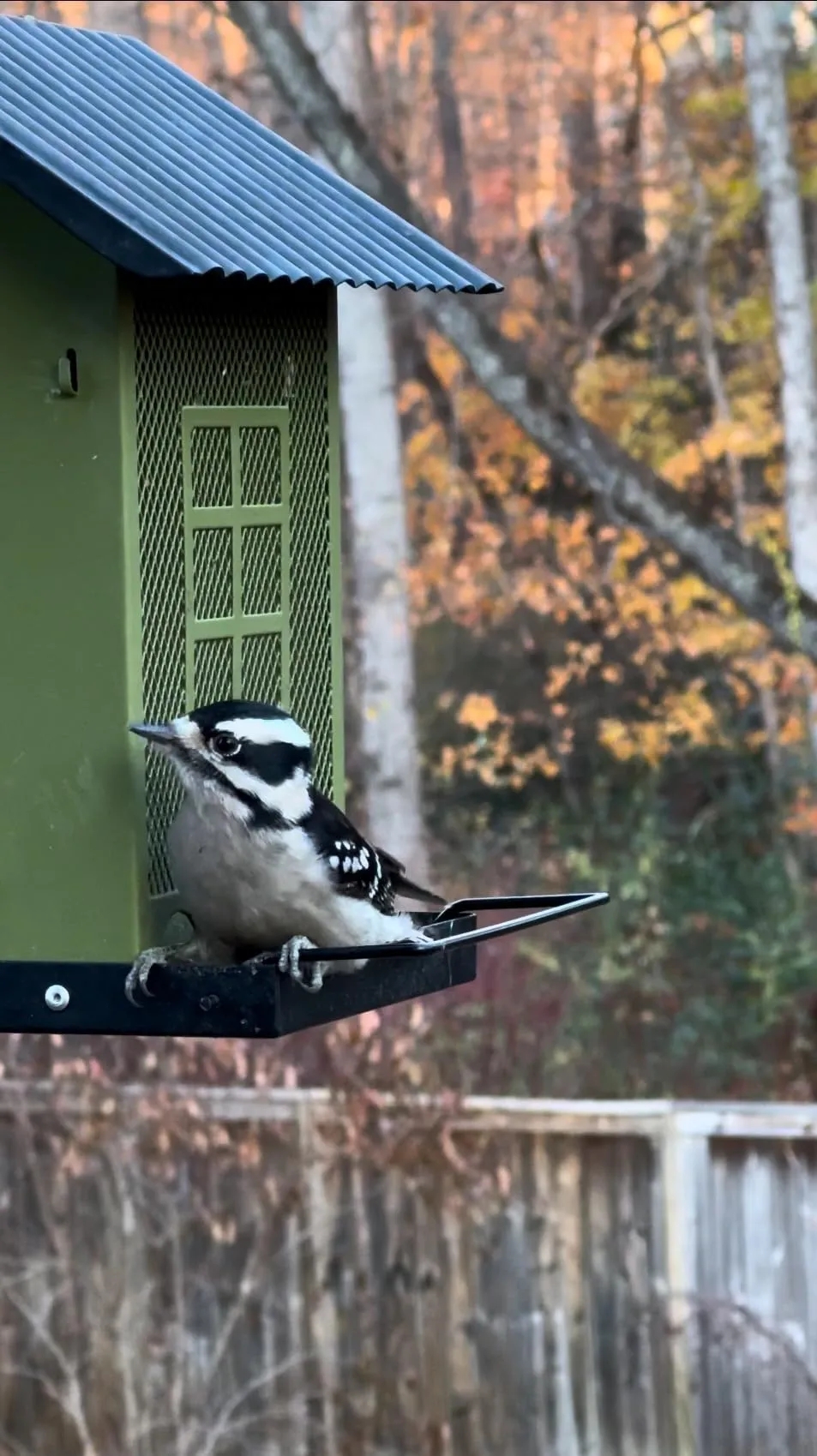
In the treetops, shrubs, and lawns of American courtyards, birds such as sparrows, cardinals, blue jays, hummingbirds, and others frequently intertwine with human life trajectories. As a "food supply station" actively built by humans, bird feeders have long been integrated into their survival rhythm. From the perspective of birds, this "gift" provided by humans is not simply a "goodwill reception", but a complex cognition formed based on instinct, perception, and experience - it involves dependence on survival convenience, vigilance against unknown risks, and tacit understanding accumulated through long-term interaction. Each view is in line with their survival logic and natural nature.
1.A Buffer for Survival Crisis, a Weigher of Risk and Benefit
For birds in American courtyards, foraging has always been a core survival proposition. Especially during the critical period of food scarcity in winter (fruit withering, insect hibernation) and the dramatic increase in energy consumption during the breeding season (chick rearing requires a large amount of food), stable seeds, nectar, or broken food in bird feeders are undoubtedly important "life-saving food". In their perception, the bird feeder is not a "miracle" that appears out of thin air, but a "food source" strongly bound to the "human activity area" - they can accurately locate this supply point through vision (the color and shape of the bird feeder), hearing (the sound of human footsteps, door and window switches), and even smell (the smell of food).
But the instinct of birds never gives up vigilance. Birds on the American continent have evolved to be wary of "large mammals", and humans, as beings much larger than them, cannot completely eliminate their instinctive defenses even if they actively provide food. Observations have shown that when birds approach the bird feeder, they often first stop on nearby branches, look left and right, listen attentively, and confirm that there is no threat from humans (such as being stationary or far away) before quickly diving to the feeder to feed; If humans suddenly move and make loud noises, they will immediately scatter and flee, even if their food has not been eaten, they will prioritize their own safety. This behavior of "being vigilant first, then feeding" is essentially a balance between "benefits (food)" and "risks (potential threats)" - when hunger exceeds their vigilance, they will actively take advantage of the convenience provided by humans, but always remain prepared to evacuate at any time.
2.The Anchor Point of Environmental Memory, Habitual Trust Accumulation
Birds have strong environmental memory abilities, especially for long-term stable food sources, which can form fixed activity trajectories and cognition. For birds that are active in the same courtyard all year round, if the bird feeder can continuously provide food and humans have never caused harm to them (such as capturing, driving away, or feeding harmful food), they will gradually lower their vigilance, bind the bird feeder to the dual signal of "safety+food", and even form a "limited trust" in humans.
The expression of this trust is very delicate: the main sparrow may still calmly feed on the bird feeder when humans approach the window; Hummingbirds will briefly stay on nearby flower branches when humans change nectar, waiting for humans to leave and continue foraging; Blue ravens even remember humans who are regularly fed and actively chirp when they appear, as if "reminding" them to replenish their food. This kind of interaction is not an abstract emotion of gratitude in birds, but a conditioned reflex that has been habitual for a long time. By repeatedly observing and confirming that human existence is related to "food supply" and poses no threat, they will include humans in the category of "safe environment". Although this trust is fragile (once a threat appears, it will completely collapse), it is also the most direct response of birds to human goodwill.
3. The "gathering place" of group interaction, the social scene indirectly shaped by humans
The bird feeder is not only a food supply station, but also a "social center" for courtyard birds. Different types of birds will form a fixed interaction pattern here: smaller sparrows and goldfinches will gather in groups on bird feeders, competing for food; Larger blue jays and woodpeckers will occupy the dominant position of bird feeders to drive away small birds; Hummingbirds will guard the nectar feeder and resist the invasion of their own kind. As the "providers" of bird feeders, humans, although not directly involved in these interactions, indirectly shape this scene - birds associate "human existence" with "group foraging scenes", believing that in human activity courtyards, there is stable food and relatively safe social space (compared to the wild, there are fewer threats from natural enemies in the courtyard).
This kind of cognition will continue through intergenerational transmission. When young birds follow their parent birds to learn how to forage, they will imitate their behavior of approaching the bird feeder and being alert to humans; If the parent bird trusts humans enough, the young birds will also adapt to human presence faster and will still use the bird feeder in the courtyard as their main foraging point when they grow up. Over time, the entire bird community in the courtyard will form a fixed understanding of "human+bird feeder", and human goodwill will be integrated into the group survival mode of birds in this way.
We recommend our Flowafoli bird feeder!