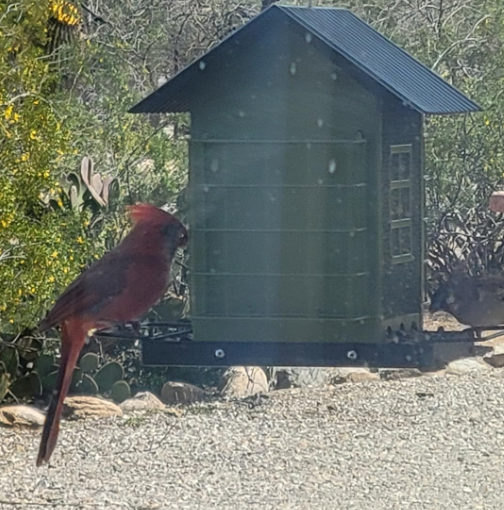
The use of bird feeders by birds in American courtyards is essentially a manifestation of their adaptation to artificially assisted foraging environments. Different species of birds will form a relatively fixed usage pattern based on their own morphological characteristics and foraging habits, and will also be influenced by factors such as the type, placement, and food types of bird feeders, exhibiting diverse behavioral behaviors. The following provides a detailed analysis of its usage from four dimensions: exploration before use, core behaviors during use, differentiated use of different birds, and influencing factors.
1、 Trial and adaptation before use: prioritizing risk avoidance
Before birds come into contact with bird feeders, their primary task is to assess the safety of the environment, and their behavior during this stage shows obvious vigilance. Most birds will first stop at high points such as branches and fences near the bird feeder (such as sparrows and tits), observe the surrounding movements, listen to sounds, and confirm that there are no natural enemies (such as eagles and cats) or human interference before gradually approaching.
During the approach, birds usually adopt a "short distance jump+pause observation" approach, gradually approaching from a distance of several meters from the bird feeder. Some timid species (such as the dark eyed bunting) may repeatedly test and even evacuate halfway until safety is fully confirmed. For newly placed bird feeders, this adaptation cycle may last for 1-3 days, during which birds will only wander around without direct contact.
2、 Core behavior in use: Balancing foraging and avoidance
After birds confirm the safety of the environment, they will enter the core stage of using bird feeders. During this process, foraging efficiency and immediate avoidance needs are always in a balanced state, mainly manifested as the following typical behaviors:
(1) Stopping and standing: adapted to bird feeder structure
Different types of bird feeders (such as suspended, platform, tube, cage) have significant differences in the way birds park. For suspended tubular bird feeders, smaller birds (such as tits and goldfinches) will use their claws to grasp the hooks, side brackets, or feeding edges of the feeder, and their bodies will be suspended or semi suspended for foraging. The grip strength of their claws can help stabilize their bodies; Platform style bird feeders are more suitable for slightly larger birds (such as mockingbirds and blue jays), who will stand directly on the platform, peck at food with their heads lowered, and some birds will briefly comb their feathers on the platform.
In the use of cage feeders (mainly used to prevent squirrel interference), birds will enter the interior through the gaps in the grid of the cage or stop at the edge of the grid, and insert their beaks into their feeding mouths to feed. Smaller birds (such as stevia) may directly pass through the grid and freely forage inside.
(2) Feeding and Storage: Adjusting Behavioral Strategies on Demand
The core of feeding behavior is "efficient food acquisition", and the feeding methods of different birds vary depending on the shape of their beaks: short and thick beaks (such as sparrows and pigeons) are suitable for pecking at granular food (such as millet and sunflower seeds), and they will repeatedly peck and bite the food before swallowing it; Long and pointed beaks (such as hummingbirds and flycatchers) are suitable for feeding on liquid foods (such as sugar water and nectar). Hummingbirds hover in front of the feeding mouth of the bird feeder, continuously feeding with their beaks, while flycatchers will stop and quickly peck for liquids.
Some birds also exhibit "food storage behavior", which is particularly evident in winter or seasons of food scarcity. For example, blue ravens, star ravens, etc. will pick up excess food (such as nuts, seeds) with their beaks after feeding, bury them in the soil, fallen leaves, or tree holes in the courtyard for future consumption. This type of bird has a faster feeding rhythm before feeding the bird feeder, usually quickly feeding 2-3 pieces of food and immediately withdrawing, repeating multiple times.
We recommend our Flowafoli bird feeder!