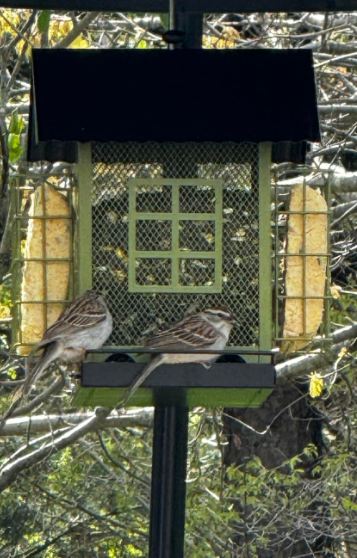
1、 The core connotation of the "check-in behavior" of birds in American courtyards
In the courtyard ecology of the Americas, the "check-in" of birds is not a human registration behavior, but a key activity closely related to survival needs, mainly including three core scenarios:
Territory check-in: Declaring the boundaries of a territory through vocalizations, fecal markers, feather remnants, and other means, commonly seen in species with strong territorial awareness such as the main Cardinals and Blue Jays;
Community check-in: Cluster birds (such as sparrows and starlings) identify their peers through specific calls and body movements (such as flapping frequency) to maintain group cohesion;
Resource check-in: In fixed areas such as feeders and water sources, the location of resources is memorized and information is transmitted to peers through odor markers (such as hummingbird saliva residue) or visual signals (such as mockingbird tail feathers flapping).
These "check-in methods" are essentially survival strategies for birds to adapt to their environment. When environmental changes (such as human activity interference, resource relocation, and the emergence of natural enemies) cause the original check-in methods to fail, they will activate multiple adjustment mechanisms.
2、 Four core strategies for responding to changes in check-in methods
(1) Behavioral flexibility: Quickly switch check-in carriers
When the original check-in carrier cannot be used, birds will prioritize adjusting their behavior carrier to ensure uninterrupted information transmission. For example:
Replacement of sound carriers: If tall trees in the courtyard are cut down (the original call "check-in point" disappears), the main Cardinals will change the check-in carrier from "high canopy call" to "fence post short call", and increase the call frequency (from once every 5 minutes to once every 2 minutes) to compensate for the lack of propagation range by increasing signal density;
Visual carrier upgrade: When the artificial feeder changes from red to green (the original visual sign in signal disappears), the Vermilion Bird will adjust its recognition focus within 3-5 days, shifting from "color sign in" to "shape+position sign in" - even if the feeder color changes, as long as the hanging height (about 2 meters) and hanging method (hook type) remain unchanged, it can still quickly locate;
Chemical carrier supplement: If the hardening of the courtyard floor leads to the failure of fecal labeling (chemical sign in), mourning doves will transfer the sign in carrier to the edge of the roof drainage ditch and maintain the effectiveness of the chemical signal through centralized excretion.
(2) Sensory Collaboration: Strengthening Cross Sensory Check in Verification
Faced with the failure of a single check-in method, birds will activate a "multi sensory collaboration" strategy to ensure check-in accuracy through cross validation of visual, auditory, and olfactory senses. Typical cases include:
Blue winged warbler's "audio-visual double sign": When the density of shrubs in the courtyard increases (visual sign in obstructed), the blue winged warbler will chirp (auditory sign in) while spreading its tail feathers and rapidly shaking (visual signal). Even if its own species is obstructed by shrubs, it can complete community sign in through "sound localization+visual confirmation";
The "olfactory visual complementarity" of thrushes: During the rainy season, the odor signal of ground feces is diluted by rainwater (olfactory check-in is ineffective), and thrushes leave feathers (visual markers) around the original check-in point. At the same time, by pecking at specific rhythms on the ground (auditory assistance), they guide their peers to complete resource check-in through "visual feather finding+auditory location recognition";
Hummingbird's "touch visual linkage": When the color mark of the feeder is covered with dust (visual check-in is blurred), the hummingbird will touch a specific protrusion of the feeder through its beak (tactile check-in), while combining the feeder's position in memory (spatial visual memory) to ensure accurate "check-in" for each feeding.
(3) Community learning: Passing on new check-in methods through group communication
For social birds, "community learning" is an efficient strategy to cope with changes in check-in methods. The experience of elderly individuals will be transmitted to younger individuals through group interaction, accelerating the adaptation process of the entire population. Specifically manifested as:
Demonstration learning of sparrows: When an automatic feeding device is added to the courtyard (which requires touching the switch to feed, i.e. the new check-in method), adult sparrows who have mastered the switch skills will repeatedly demonstrate next to the feeding device. Young sparrows can learn the new check-in method within one day by observing their beak movements and body posture;
The "cluster adaptation" of starlings: When the trees that inhabit at night are removed (the original community check-in point disappears), starlings will search for new habitats through group circling flight ("trial and error check-in"). Once some individuals find suitable roofs or utility poles, they will attract other individuals to gather through high-frequency chirping, and new community check-in points can be formed within 2-3 days;
The "intergenerational transmission" of goldfinches: If a new type of insecticide is introduced in the courtyard, it will cause changes in the odor sign in signals of existing plants. Adult goldfinches will lead their young birds to repeatedly peck at the leaves of different plants ("odor test"), and distinguish between "safe plants" (which can be used as new sign in points) and "dangerous plants" based on their call intensity. This preference for selection will be transmitted to the next generation through foraging interaction between parents and children.
(4) Environmental utilization: Innovating check-in methods with the help of artificial facilities
As an "artificial natural mixed ecology", the American courtyard actively utilizes facilities created by human activities and innovates check-in methods to adapt to environmental changes. Common "manually assisted sign ins" include:
Using architectural structure: Swallows will build their mud nests under courtyard lamp posts, and the light and shadow changes of the lamp posts (daytime shadow length, nighttime light range) become new visual check-in signals. Even if the flight trajectory of the same species deviates, the position of the nest can be located through the light and shadow of the lamp posts;
With the help of human objects: Mockingbirds will carry discarded colored plastic sheets, metal wires, and other items to the boundary of their territory as visual check-in markers (replacing the original tree branch markers). The high recognition of these artificial items can effectively reduce territorial conflicts;
Adapting to technological equipment: Some birds in the courtyard, such as the main Cardinals and Karoo Reed wrens, will adapt to the presence of surveillance cameras and use the area around the camera as a "safety check-in point" - due to frequent human activities in the camera area and low probability of natural enemies appearing, birds will sing and stay next to the camera to transmit a "safety signal" to their peers.
3、 The core drivers of adaptability: survival needs and ecological memory
The reason why American courtyard birds can quickly respond to changes in check-in methods is essentially the result of the combined effects of "survival needs driven" and "ecological memory accumulation":
The urgency of survival needs: Check in behavior is directly related to territorial defense, food acquisition, and community safety. Once the original methods fail, birds will activate a "trial and error adjustment" mechanism in a short period of time to avoid survival crises caused by interrupted information transmission;
The heritability of ecological memory: Some sign in adaptation strategies (such as using artificial facilities and multi sensory collaboration) will accumulate "ecological memory" through gene transmission and behavioral learning. For example, birds that live in human courtyards for a long time will have significantly higher acceptance and utilization ability of artificial items in their offspring than in wild populations;
Adaptability of environmental resilience: The ecological environment of American courtyards (with both natural vegetation and artificial facilities) itself has high resilience, providing birds with diverse check-in carrier choices (such as trees, lamp posts, feeders). This environmental diversity provides a foundation for flexible adjustment of check-in methods.
We recommend our Flowafoli bird feeder!