1、 Core survival strategies for courtyard birds in the Americas
As an ecological space interwoven with artificial and natural elements, the American courtyard presents multiple challenges for birds, including food acquisition, breeding and brooding, avoidance of natural enemies, and adaptation to extreme environments, resulting in targeted behavioral patterns
(1) Access and distribution of food resources
Dietary differentiation and niche adaptation: Different birds in the courtyard divide their ecological niches based on food types to reduce competition. For example, the Northern Cardinals feed on berries and seeds and often inhabit courtyard shrubs; Barn Swallow focuses on catching insects in the air and flies low along the eaves; American Robin often searches for earthworms on lawns, forming a three-dimensional feeding network of "ground shrub air".
Seasonal food reserves: Some bird species exhibit reserve behavior to cope with food shortages. The Black crowned Chickadee collects seeds and nuts in autumn, hiding them in bark crevices or fallen leaves, and accurately retrieves them through memory; And Blue Jay is better at "transporting and storing", containing more than ten acorns at a time, scattered and buried in the soil of the courtyard, becoming a natural "tree planter".
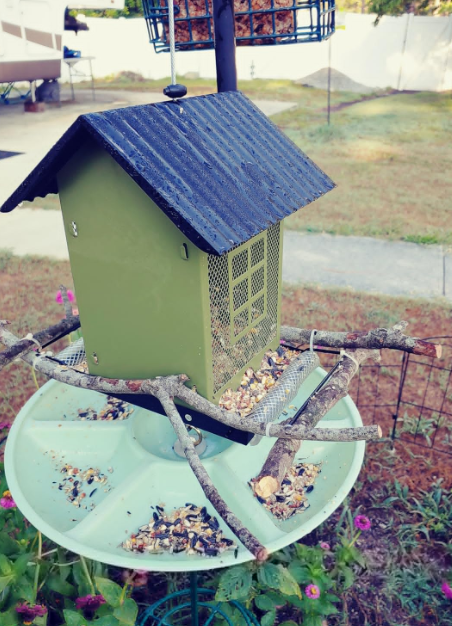
Adaptive adjustment of artificial feeding: Faced with feeders provided by humans, birds gradually form a fixed feeding rhythm. American Goldfinch prefers Nyjer seed feeders and will flock to visit regularly; Mourning Doves tend to prefer scattered grains on the ground and wait for birds around the feeder to leave before feeding, demonstrating behavioral adaptation to artificial environments.
(2) Accurate control of the reproductive cycle
Nest Site Selection and Nesting Strategy: Birds choose safe nest sites based on the courtyard microenvironment. House Sparrow prefers gaps under the eaves or artificial nest boxes, and quickly builds nests with hay and feathers; The American Robin builds its nest on the middle branches of courtyard trees, using soil mixed with grass roots to create a sturdy cup-shaped nest that can withstand wind and rain. Some birds also use human waste, such as reinforcing their nest structures with plastic fibers, to demonstrate their adaptation to urban environments.
Division of labor and efficiency optimization in brooding: Most courtyard birds adopt a "parental cooperation" brooding mode. The male bird is responsible for guarding and searching for distant food, while the female bird focuses on foraging near the nest and warming up the nest with chicks. For example, the parents of the Carolina Wren alternate between returning to their nest and feeding every 10-15 minutes, with hundreds of feedings per day, ensuring rapid growth of the chicks.
Breeding season natural enemy defense: Faced with natural enemies such as cats, snakes, and raptors, birds form a multi-layered defense system. Smaller warbler birds will drive away invaders through "crowing intimidation"; The Eastern Bluebird in North America will frequently patrol near its nest box, warning its companions with specific calls when it detects danger, and even actively diving to attack small predators.
(3) Adaptive response to extreme environments
Adaptation to high temperature and drought: During high temperatures in summer, courtyard birds regulate their temperature through behavior. They will inhabit the dense branches and leaves under the shade of trees, or take a bath in the shallow waters of the courtyard; Hummingbirds reduce their activity frequency, lower energy consumption, and rely on human set sugar water feeders to replenish water and energy. During drought periods, birds tend to gather at artificial water sources such as courtyard fountains and water basins, forming brief "gathering points".
Coping with Cold and Wind and Snow: Before winter arrives, birds will thicken their feather layer and store fat. Birds such as Dark eyed Junco gather in groups under leeward eaves or shrubs to reduce heat loss through group aggregation; Woodpeckers, on the other hand, will peck at insect larvae deep in the bark of trees, even when covered in heavy snow, to obtain food.
2、 Statistical organization and data processing methods of courtyard birds in the Americas
The statistics of courtyard birds need to be combined with manual observation and technical means, and precise analysis and application of data should be achieved through standardized processes
(1) Core statistical methods and implementation points
Fixed-point and timed observation method: Set up 1-2 fixed observation points (such as window edges and terraces) in the courtyard, select peak bird activity periods (6-8 am, 17-19 pm) for observation, and record the species, quantity, and behavior of birds (feeding, nesting, chirping, etc.). The observation period is usually measured in weeks and lasts for at least 3 months to eliminate accidental interference.
Sample line survey method: For larger courtyards, slowly walk along a predetermined route (such as along the edge of the lawn or shrubbery) and record the birds that appear within a 10 meter range on both sides of the route. Conduct a comprehensive survey once every quarter, focusing on the appearance and disappearance time of migratory birds, to provide data for phenological analysis.
Technical Assistance Monitoring: Utilizing infrared cameras, bird acoustic recorders, and other equipment for all-weather monitoring. Infrared cameras can capture nocturnal birds (such as barn owls) or covert behaviors (such as building nests and raising chicks); Acoustic recorders can accurately identify bird species by recognizing the unique frequency of their calls, making them particularly suitable for areas with dense vegetation and difficult visual observation.
(2) Data organization and standardization process
Basic data classification and archiving: Classify observation records into four dimensions: "type time behavior environment". Species should be accurately named according to the North American Bird Field Handbook to avoid confusion with common names; Environmental data includes temperature, precipitation, vegetation coverage, artificial facilities (feeders, number of nest boxes), etc., providing a basis for subsequent correlation analysis.
Abnormal data screening and correction: Remove obvious error data, such as species misjudgment caused by distance, and migratory birds that fly by instantaneously (non courtyard resident species). For data with large fluctuations in quantity (such as clustered birds near feeders), the "average of multiple observations" is used for correction to ensure data stability.
(3) Data Processing and Application Direction
Population dynamics analysis: Draw population change curves using Excel or R language to analyze the richness of bird species and fluctuations in individual numbers in different seasons and years. For example, by comparing spring and autumn data, the proportion of resident and migratory birds in the courtyard can be clarified; Continuous years of data can reflect the long-term impact of urbanization on bird populations.
Behavioral correlation research: Using cross analysis method to explore the correlation between bird behavior and environmental factors. For example, analyzing the correspondence between "feeder seed type" and "bird visiting species" can optimize the manual feeding plan; Collecting data on "nest box location" and "reproductive success rate" can provide reference for courtyard ecological design.
Citizen Science Data Integration: Upload personal courtyard observation data to global bird observation platforms such as eBird, integrate it with data from other observers, and participate in the construction of regional bird distribution maps. This type of data can also provide basic information for bird conservation agencies and assist in habitat conservation planning for endangered species such as the brown croaker.
We recommend our bird feeder!