Interference avoidance: precise risk assessment and escape strategy
Frequent human activities in the courtyard are the most common "miscellaneous matters" faced by birds, and different species have formed differentiated avoidance systems. A study conducted by the School of Life Sciences at Hebei University on urban birds found that birds adapt to disturbances by adjusting their warning distance (AD) and flight start distance (FID), a pattern that also applies to courtyard birds in the Americas.
The larger Northern Cardinals exhibit a typical "early warning efficient evacuation" pattern. These birds with bright red feathers use the concealment of tall shrubs to establish observation points - they prefer to stay between the branches and leaves of holly or dogwood, using the leaves to cover their bodies while monitoring yard dynamics through keen visual perception. When humans approach to trim shrubs or clear fallen leaves, the FID of the main Cardinals is usually maintained at 8-10 meters. Once it exceeds the safety threshold, it will fly in a straight line towards the tallest tree in the courtyard. This choice is highly consistent with the Eastern Magpie's preference for tall trees as shelters, which ensures escape safety and reduces energy waste.
The compact Black crowned Chickadee, on the other hand, adopts a "flexible tolerance" strategy. As aerial acrobats in the courtyard, they shuttle flexibly around human activity areas, with a FID of only 3-5 meters, much lower than the main Cardinals. Research has shown that this low alert distance is due to their group collaboration - sparrows often move in small groups of 3-5 individuals, improving alert efficiency through the "multi eye hypothesis" effect. There are always individuals in the group responsible for alerting, while the rest of the members focus on foraging. Even if they encounter interference, they can fly short distances and hide in low shrubs, demonstrating the survival wisdom of "low energy consumption high flexibility".
Resource adaptation: dynamic adjustment of food and nest location
The transformation of courtyard vegetation, interruption of feeding and other "resource changes" will directly affect the foraging and breeding plans of birds, and the adaptability of American birds is particularly prominent in this regard. The American Robin, as a common ground forager in the courtyard, has a highly representative coping strategy. When the lawn in the courtyard is frequently trimmed and the exposure to food such as earthworms changes, the thrush will adjust its foraging rhythm - concentrate on foraging within 1-2 hours after human trimming, and use the short-term availability of food to efficiently hunt; During the peak pruning period, they turn to fruit based foods and consume the berries of crabapple or hawthorn trees. This dietary switching ability allows them to maintain stable energy intake in the face of fluctuations in food resources.
The 'alternative innovation' in nest site selection is a key means for birds to cope with building maintenance and nest material shortages. Similar to the behavior of tree sparrows using air conditioning and billboard gaps to build nests in cities, birds in American courtyards are also adept at discovering "natural nest sites" in artificial environments. The main sparrow will build its nest on a fence covered with vines, using the shading effect of vines to simulate a natural shrub environment; Black crowned tits use abandoned flower pots and hanging flower baskets from humans as nest bases, and even collect fine tree branches and dead grass trimmed by humans as nesting materials, transforming "yard clutter" into living resources.
When food supply is unstable, the "memory collaboration" mechanism of birds plays an important role. Research has found that courtyard birds transmit food location information through singing. In the crisp vocalizations of thrushes, specific frequency combinations of syllables represent "discovering areas with dense earthworms," while the whistle of the main sparrow indicates "safe feeding points. When humans change feeding locations or stop feeding, this information transmission can help birds reposition their food resources within 2-3 days, avoiding survival crises caused by interruptions in a single food source.
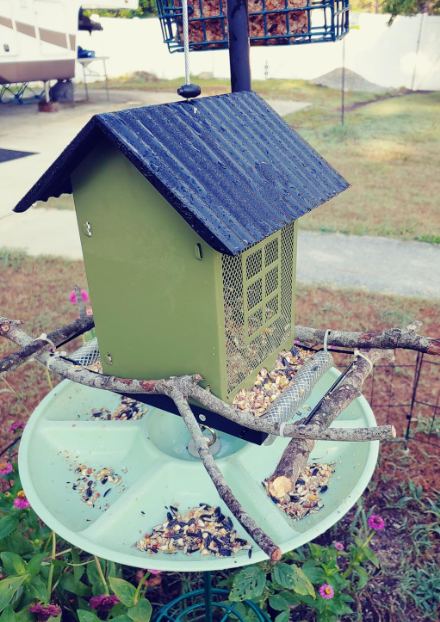
We recommend our Flowafoli bird feeder!