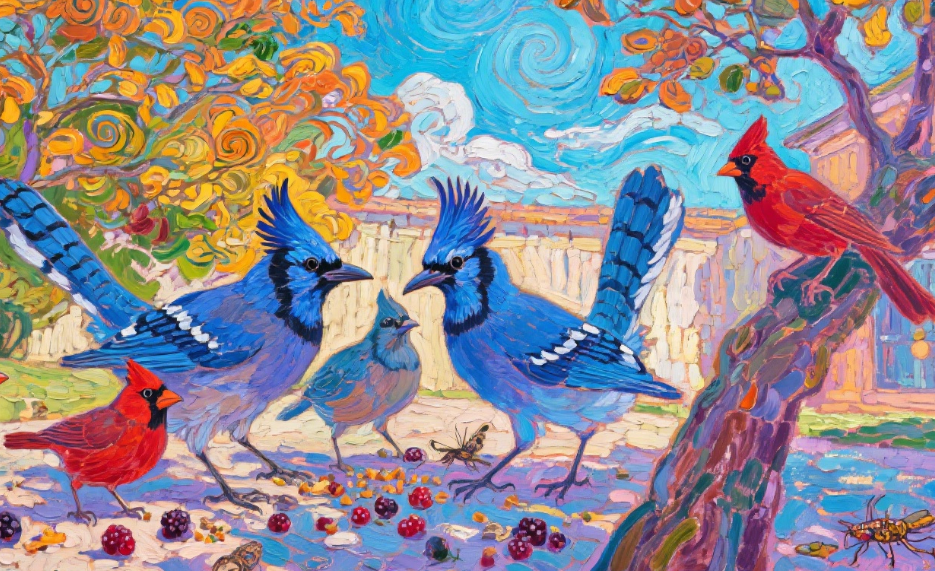
Information synchronization and division of labor mechanism of courtyard birds in the Americas and human reference
As a special ecological space where the city and nature intersect, the American courtyard is home to various bird species such as mockingbirds, hummingbirds, home sparrows, and blue jays. These birds need to efficiently complete multiple survival tasks such as reproduction, foraging, and defense in limited environments, and information synchronization is the core link for them to achieve complex division of labor. Thoroughly analyzing its mode of information transmission and division of labor cooperation can provide unique biological intelligence insights for organizational management, team collaboration, and other fields of human society.
1、 The information synchronization mechanism of courtyard birds in the Americas: a "signal bridge" for division of labor
The living environment of courtyard birds in the Americas is full of uncertainty - food resources (such as berries and insects) are scattered, natural enemies (such as eagles and cats) appear randomly, and the breeding season requires precise coordination, which requires them to establish an efficient information synchronization system. Its information transmission mainly relies on three carriers: visual signals, auditory signals, and behavioral coordination, and different signals correspond to different division of labor scenarios, forming precise matching of "signal task".
(1) Visual signals: real-time "division of labor instructions"
Visual signals are often used in specialized scenarios that require quick response due to their fast transmission speed and strong directionality. For example, when blue jays forage in the courtyard, they transmit the location and safety status of their food through changes in feather color and body movements. When they discover mature berry clusters, they raise their blue crests above their heads and quickly shake their tail feathers. This visual signal can accurately attract nearby companions to come and forage, avoiding repeated searches by their own kind; If an eagle predator is found in the sky, the blue raven will immediately lower its body, press its blue crest tightly against its head, and spread its wings in a "warning posture". When its companions see it, they will immediately stop moving, hide in bushes, or fly to a hidden place in tall trees, achieving the division of labor and synchronization of "discoverer vigilance evader".
During the breeding season, domestic sparrows coordinate the division of labor between hatching and foraging through visual signals. When male birds patrol near the nest and find that the female bird (hatching side) needs to be replaced, they will frequently jump on the branches next to the nest, while displaying bright red feathers on their chests - this "shift signal" can let the female bird know that her companions are ready to take over the hatching task, so that she can leave the nest to forage and avoid exposing the eggs to low temperatures or danger for a long time due to information misalignment.
(2) Auditory signals: widely covered 'task scheduling commands'
The advantage of auditory signals lies in their wide propagation range, unrestricted by visual obstruction, and suitability for environments with dense trees and scattered bird activities in courtyards. They are commonly used for large-scale division of labor scheduling, such as group foraging and collective defense. The American mockingbird is a typical "auditory signal expert" who can imitate the calls of various birds and even the sounds of human activities (such as phone ringtones), but in specialized scenarios, its calls have strict "semantics":
Foraging call sound: When the mockingbird discovers a large number of insects (such as beetle larvae in the lawn), it will emit a continuous and short "chirp chirp chirp" sound. This call frequency is stable and can cover a courtyard range of about 20 meters in diameter, attracting 5-8 birds of the same kind to come and "cooperate to hunt" - some birds are responsible for searching for larvae in the soil with their beaks, some are responsible for alerting surrounding movements, and some pass on the captured insects to nearby chicks, achieving the division of labor of "search alert chick rearing";
Enemy alarm sound: If a ground predator (such as a stray cat) is detected, the mockingbird will emit a sharp and piercing "hiss hiss" sound. This type of call has a high frequency and strong penetration, which can not only alert the same species in the courtyard, but also trigger "cross species cooperation" - nearby hummingbirds will stop feeding on nectar and fly above the cat to hover and interfere, while domestic sparrows will gather on tree branches to collectively chirp, using "multi species joint defense" to scare away predators. All of this division of labor is initiated by the synchronous auditory signals of the mockingbird.
In addition, the "wing vibration sound" of hummingbirds also has division of labor significance. Different types of hummingbirds (such as ruby throated hummingbirds and black jawed hummingbirds) have different wing vibration frequencies. When they compete for nectar resources in the courtyard, they will transmit the "territory ownership" signal by adjusting the vibration frequency: the faster frequency (about 80 times/second) of vibration sound indicates "this is my foraging area, please do not approach", while the slower frequency (about 50 times/second) of vibration sound indicates "sufficient resources, can be shared". This "sound code" can avoid ineffective competition among peers and achieve efficient allocation of nectar resources.
(3) Behavioral collaboration: a dynamic "division of labor calibrator"
When environmental changes (such as sudden reduction of food or sudden weather changes) cause the original division of labor to fail, birds will synchronize information and adjust their division of labor patterns through collective behavior coordination. For example, during the dry season, when the number of berries in the courtyard sharply decreases, the house sparrow will initiate a "collective reconnaissance" behavior: 10-15 sparrows form small groups and fly around the trees and flowers around the courtyard. Each bird is responsible for observing different areas. If a bird discovers a small amount of residual berries, it will immediately stop on a branch in that area and repeatedly peck at the bark (behavioral signal). Other birds will quickly gather upon seeing it and then automatically divide into a "pecking group" (responsible for obtaining berries) and a "warning group" (responsible for observing natural enemies); If extreme food scarcity is found in the courtyard after investigation, the group will synchronize information through a "unified takeoff direction" - all sparrows will fly in the same direction at the same time, indicating "migration to other foraging areas" to avoid group division caused by scattered individual decisions.
Blue Jay also synchronizes the "storage location" information through behavioral coordination when storing food (such as nuts). After burying nuts, they will use their beaks to peck out small pits of specific shapes on the ground (such as "cross shaped"), and at the same time use their claws to gather fallen leaves around the edges of the pits. This "marking behavior" is not only for their own future search, but also allows companions to identify the "stored food area", avoiding repeated burial or accidental digging, and achieving the division of labor and cooperation of "storage marking sharing".
2、 Multi item division of labor supported by information synchronization: the "maximization strategy" for survival efficiency
The division of labor among courtyard birds in the Americas is not fixed and unchanging, but is based on information synchronization as the core, dynamically adjusted according to "task priorities" (such as reproduction>foraging>territorial competition), forming an efficient model of "one information corresponds to multiple tasks, and multiple tasks share a set of information systems". The typical division of labor scenarios can be divided into three categories:
(1) Breeding period: precise division of labor through "male female collaboration+group assistance"
Breeding is the core task of bird survival, which requires precise coordination of multiple processes such as nest building, incubation, chick rearing, and vigilance. The accuracy of information synchronization directly determines the success rate of breeding. Taking the American Vermilion as an example, the division of labor during the breeding season relies entirely on the dual information synchronization of "visual+auditory":
Nesting stage: The female bird is responsible for searching for nesting materials (such as fine branches and feathers), while the male bird is responsible for guarding. When the female bird finds suitable materials, it will make a gentle "beep beep" sound, and the male bird will fly to a higher place near the female bird to observe if there are natural enemies (such as snakes and squirrels) approaching; If the female bird needs the assistance of the male bird in carrying thicker branches, she will jump 3-5 times next to the material (visual signal), and the male bird will immediately land and carry it together with the female bird to avoid material falling or being snatched by other birds;
Hatching and brooding stages: Male and female birds coordinate incubation time through a "switch signal" (male bird's red crest display+female bird's low cry) - usually after 3-4 hours of incubation during the day, the male bird will emit a "switch call" and bring insects as food for the female bird, while the female bird will take over the male bird's vigilance after feeding; When raising chicks, the parent bird synchronizes food demand information through the "chick begging sound": when the chick makes a high-frequency "chirp chirp chirp" sound, the parent bird will divide the work and go out to forage, one responsible for catching insects and the other responsible for collecting berries, ensuring that the chick receives balanced nutrition. This division of labor does not require additional signals and relies entirely on the intensity of the chick's begging sound (the louder the sound, the more frequent the division of labor).
In addition, other birds in the courtyard, such as mockingbirds, will form a "group assisted" division of labor during the breeding season. When a nest of a Vermilion Bird is threatened by a snake, nearby mockingbirds will issue a "collective alarm sound" and actively fly above the snake to peck its head. The Vermilion Bird will take the opportunity to transfer its chicks to a safe area - this "non peer collaboration" essentially achieves cross species division of labor through sharing "enemy information" and "vigilance interference transfer".
(2) Foraging period: closed-loop division of labor of "resource reconnaissance+efficient collection+risk avoidance"
The food resources in the courtyard, such as insects, berries, and nectar, are unevenly distributed and easily disturbed by human activities such as lawn mowing and pesticide spraying. Birds need to form a closed-loop division of labor from resource discovery to safe collection through information synchronization. Taking the "collaborative foraging" of blue ravens and hummingbirds as an example:
Resource reconnaissance division of labor: Blue jays are good at foraging on the ground (such as searching for fallen nuts and insects in the soil), while hummingbirds are good at foraging in the air (such as feeding on nectar from flowers). The two synchronize resource information through "sound signal sharing" - when blue jays discover ground food, they will make a "gurgling gurgling" sound. If hummingbirds hear it and find nearby flowers rich in nectar, they will respond with high-frequency wing vibration sound, forming a "ground air" resource information exchange;
Efficient collection and division of labor: Based on information synchronization, blue ravens will focus on digging for ground food, while hummingbirds will concentrate on feeding on nectar, avoiding competition between the two in the same area; If a certain area is densely populated with food (such as mature cherry trees), blue ravens will summon more companions through "crest shaking", while hummingbirds will reduce their activity in the area to avoid collisions, achieving complementary division of labor among "different species and ecological niches";
Risk avoidance division of labor: When foraging, there are always 1-2 birds serving as "sentinels" (usually vigilant blue jays or mockingbirds). The sentinels will continue to observe the surrounding environment, and once they detect humans approaching or natural enemies appearing, they will immediately issue a "warning signal" (visual or auditory). Other birds will quickly stop foraging and choose avoidance methods based on the type of signal (ground birds hide in bushes, airborne birds fly to high places), ensuring that division of labor is carried out within a safe range.
(3) Defense period: Collaborative division of labor of "natural enemy identification+group counterattack+regional protection"
There are various types of natural enemies in the courtyard (eagles in the air, cats on the ground, snakes on trees), and different natural enemies require different defense strategies. Birds achieve "accurate identification of natural enemies and rapid division of labor" through information synchronization. For example:
Defense against airborne predators (eagles): When sentinels detect eagles, they will emit a "sharp long cry" (auditory signal) and spread their wings in a "diving posture" (visual signal). Other birds will immediately stop flying and gather among dense tree branches to reduce their exposed area upon receiving the signal; Some larger blue jays will actively fly below the eagle and force the eagle to change its flight path through "interference flight" (rapid shuttle), achieving the division of labor of "gathering concealment+active interference";
Ground natural enemies (cats) defense: If a cat is found approaching its nest or foraging area, the sentry will emit a "short hiss" and quickly jump on the ground (visual signal) to guide the cat's attention; Other birds will be divided into two groups, one group pecking at the ground in front of the cat to create an "obstacle", and the other group chirping and disturbing behind the cat to force it to leave, forming a division of labor of "guidance interference expulsion";
Defense against natural enemies (snakes) on trees: When a snake is found crawling towards its nest, the birds will emit a "high-frequency chirping" and fly collectively to the branches where the snake is located, pecking at the snake's head and body with their beaks; Some birds will pick up small branches or leaves and throw them at the snake's eyes, interfering with its line of sight and achieving the division of labor of "collective attack+line of sight interference" to protect the safety of chicks.
3、 The reference and inspiration of human beings from bird information synchronization and division of labor
The information synchronization and division of labor of courtyard birds in the Americas are essentially "maximizing group benefits through efficient information transmission in limited resources and changing environments", which is highly compatible with scenarios such as team management, emergency response, and resource allocation in human society. Its core inspirations can be summarized into the following four points:
(1) Establish a communication system for "signal standardization" to reduce internal conflicts in division of labor
The key to the efficient information synchronization of birds lies in the strong binding between signals and tasks - specific signals correspond to specific tasks (such as the blue raven's erect crest=foraging call, sharp long cry=eagle warning), avoiding information ambiguity. The inspiration for human team management is the need to establish a "standardized communication language," especially in complex projects or urgent tasks. For example, in a software development team, a "requirement priority signal" can be established (such as "red label=urgent fix, blue label=functional optimization") to enable product, development, and testing personnel to quickly synchronize task priorities and avoid division of labor caused by communication ambiguity; In emergency rescue scenarios, the "disaster signal" can be unified (such as "three short whistles=need for supplies, one long whistle=discovery of trapped persons"), allowing different rescue teams (medical, search and rescue, logistics) to respond quickly and reduce decision-making time.
(2) Adopting a "dynamic division of labor" mode to adapt to environmental changes
Birds will adjust their division of labor through behavioral coordination based on environmental changes such as reduced food intake and the emergence of natural enemies, rather than sticking to fixed patterns. This suggests that human organizations need to abandon the "static division of labor" mindset and establish a "flexible division of labor system". For example, in the retail industry, employee division of labor can be dynamically adjusted based on customer flow: during peak hours (such as weekends), tally clerks can be temporarily deployed to the checkout counter to assist with checkout, while customer service personnel can assist in guiding customer flow, forming a "flexible replenishment" division of labor; In project management, roles can be adjusted according to task progress - if there is a delay in a certain stage, members who are proficient in that field can provide temporary support, while other members take over their original tasks to avoid overall project obstruction caused by a single stage stagnation.
(3) Unleash the collaborative value of 'niche signals' and activate cross role collaboration
The "niche signals" in birds, such as the wing vibration sound of hummingbirds and the changing feathers of domestic sparrows, although only used in specific scenarios, can achieve cross species and cross role collaboration. The inspiration for humanity is to value "specialized signals in specific fields" and promote cross departmental and cross domain collaboration. For example, in enterprises, the "code annotation specification" of the technology department, the "user demand label" of the marketing department, and the "cost accounting symbol" of the finance department are all "niche signals". If these signals can be understood by various departments through a shared platform, cross departmental communication costs can be reduced - the technology department can quickly understand market demand, the marketing department can clearly understand the difficulty of technical implementation, and the finance department can accurately calculate project costs, achieving seamless collaboration between "technology market finance".
(4) Building a "multi-level information synchronization" mechanism to ensure stable division of labor
The information synchronization of birds is not a single dimension, but a multi-level superposition of "visual+auditory+behavioral" (such as the signal of changing positions during the breeding season, which includes feather color display, low calls, and body movements). This "multidimensional verification" can avoid information omission or misjudgment. The inspiration for human organizations is to establish a "multi-level information synchronization" mechanism, especially in critical tasks. For example, in large-scale event planning, division of labor can be ensured through "three-level synchronization": first level synchronization (before the meeting) clarifies the responsibilities of each group through documents (such as venue group, guest group, publicity group); Secondary synchronization (during the meeting) updates task progress through real-time group chat (such as "50% completion of venue layout" and "guests have departed"); Three level synchronization (emergency situations) quickly transmits sudden information through phone or on-site gestures (such as "guests are late and need to delay the opening"), and multi-level information stacking can ensure that division of labor is not disconnected, making it easier to respond to emergencies.
Conclusion
The information synchronization and division of labor of courtyard birds in the Americas are the "survival wisdom" formed over millions of years of evolution - they do not have complex language, but can achieve precise cooperation through simple signals; There is no fixed organizational structure, but the division of labor can be dynamically adjusted according to the environment. For humans, this "information centric, collaboration oriented" model not only optimizes team management and improves work efficiency, but also inspires us to find a balance between individual value and group interests in the complex and ever-changing social environment. In the future, if we can further combine technological means such as the Internet of Things and artificial intelligence to simulate the information synchronization mechanism of birds, we may be able to create more efficient and flexible human collaboration models, allowing "biological intelligence" to truly serve the development of human society.
comments