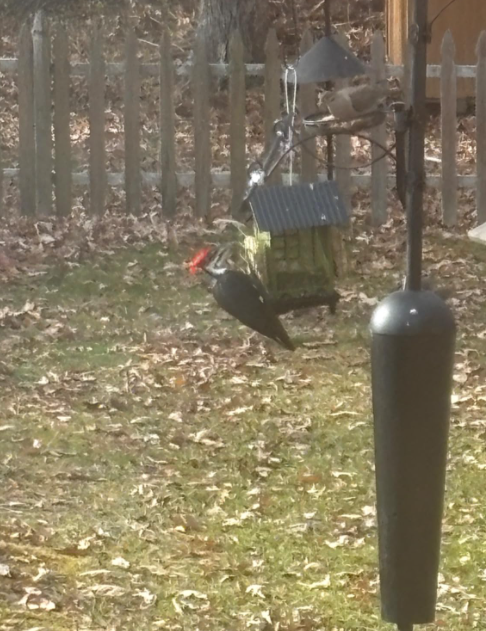
As a transitional space that combines artificial landscapes and natural ecology, the American courtyard presents birds with a "multi-item pre-update" that encompasses key survival issues such as overwintering resource reserves, breeding territory planning, predator risk warning, and migration timing coordination. These seemingly scattered items form an efficient processing flow through birds' unique group collaboration system, precise signal transmission mechanism, and flexible behavioral adjustment strategies. Essentially, it is the group adaptation wisdom shaped by natural selection.
1. Signal prepositioning: synchronous collection and transmission of multiple items of information
The core prerequisite for birds to handle multi-task pre-updating is the rapid sharing and precise decoding of information, which relies on the coordinated operation of multi-dimensional signals such as vision, hearing, and touch. In American courtyards, common birds such as cardinal, black-capped chickadee, and dark-eyed junco have established a "hierarchical signal transmission network" to ensure comprehensive coverage of relevant information for pre-updating tasks.
Auditory signals are the most core information carriers. The variation in the frequency and rhythm of the calls of the black-capped tit can accurately convey the priority of different pre-renewal items: the short, high-frequency "chirp-chirp" sound corresponds to urgent matters involving predator (such as eagles and cats) warnings, while the gentle, repeated calls are used to announce the storage of food resources (such as ripe sunflower seeds and berry yields). Research has shown that the transmission speed of such call signals can reach 20-30 meters per second, and a courtyard flock of 20 individuals can complete the synchronization of urgent matter information in just 0.5 seconds. For the timing coordination before winter migration, social birds such as jackdaws reach consensus through the accumulation of call intensity. When the call intensity reaches a critical value of -70dB/Hz, it triggers a collective signal for "migration preparation" to ensure that the group synchronizes into a pre-renewal state.
Visual signals serve as a supplement, adapting to information transmission in low-light or noisy environments. The cardinal changes the frequency of its wing flapping to indicate to its mate the progress of the territory boundary planning. The dark-eyed junco's jumping posture near the old nest can convey the pre-renewal need for "nest site renovation". The advantage of this visual signal lies in its precise positioning, allowing the receiver to quickly pinpoint the core area of the pre-renewal task and enhance subsequent processing efficiency. Furthermore, the state of a bird's feathers and body posture also convey health information, providing a basis for collaborative individuals in the group to select pre-renewal tasks - individuals with bright feathers and robust body posture are more likely to participate in high-intensity pre-renewal work such as resource storage and territory defense.
2. Coordination of Matters: Prioritization Based on Resources and Risks
Faced with multiple pre-update tasks, backyard birds in the Americas will form a "priority consensus" through group interaction, with the core sorting logic revolving around "survival urgency" and "resource availability". This coordination mechanism does not require individual leadership, but spontaneously emerges through decentralized interactive behaviors, reflecting the "scale-free correlation" characteristic of bird groups - each bird only needs to interact with about seven nearby individuals to enable consensus on priority sorting to cover the entire group.
The top priority is always "upgrading the predator risk warning". When signs of eagles or cat activity are detected in the courtyard, the birds that first notice the risk will immediately send out an emergency alert signal. The group will then suspend low-priority tasks such as food storage and nest site planning, and shift to a "risk update" state: through group gathering and alternating vigilance, they will confirm the scope of the risk, update the avoidance route, and record the new predator activity pattern as group memory to guide subsequent behavioral adjustments. This instantaneous switching of priorities can minimize survival risks and provide a foundation for advancing other pre-update tasks.
The second priority is "winter resource reserve" (before winter) or "breeding resource preparation" (before spring). In the courtyards of eastern North America, during autumn, the dark-eyed junco and cardinal form temporary foraging groups to coordinate and carry out pre-renewal work of seed collection and berry storage - they preferentially choose foods that are easy to preserve and have high energy density (such as sunflower seeds and hawthorn fruit), and enhance reserve efficiency through "division of labor and cooperation": some individuals are responsible for finding food sources, some for transportation, and some for guarding storage sites to prevent resources from being stolen by other animals. In spring, breeding-related pre-renewal matters will be upgraded to priority, and the group will determine breeding territories through competition and cooperation, simultaneously carrying out preparations for renovating old nests or building new nests. At this time, food reserves will be turned into "maintenance reserves" to ensure energy supply during the breeding period.
The third priority is "environmental adaptation and adjustment", encompassing the planning of the utilization of artificial facilities in the yard (such as bird feeders and flower pots) and preparations for extreme weather conditions (such as rainstorms and cold waves). Although these matters are not urgent, they can enhance long-term survival quality. Birds will gradually complete these tasks during the intervals of advancing high-priority matters. For instance, they will update their cognition of the newly placed bird feeders through tentative pecking and observation. Before the arrival of a cold wave, they will inspect sheltered areas such as dense shrubs and crevices in the eaves of the house to determine temporary resting spots and complete the preliminary update of their contingency plans.
We recommend our Flowafoli bird feeder!