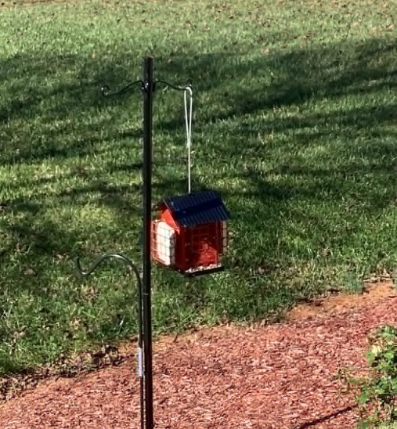
When the morning mist had not yet dissipated, a scattered bird song could already be heard in the courtyards of suburban America - this was not a casual singing, but a signal for the bird community to start a day of "business processing". From food collection to territorial protection, from nest repair to risk warning, resident species such as the American Crested Tit, Black crowned Crested Tit, and main Cardinals use a set of natural screening rules to arrange recent events in a reasonable and orderly manner, demonstrating the survival wisdom of tiny life forms.
Morning Meeting: Building an "Information Network" with Voices
In the dim light before dawn, the treetops of the courtyard first heard the crisp call of the American tit "Peter Peter". This repetitive and loud chirping is their unique "morning announcement" - both declaring to their peers that "this feeder and fruit tree are under our supervision", and confirming their location relationship with their spouses and neighbors. Soon, the echo of the black crowned tit came from the fence, their calls similar to those of close relatives but with subtle differences, accurately conveying the foraging information of "fresh berries in the shrubs on the east side".
This' Bird Singing Conference 'has strict order: the larger main Cardinals will control the rhythm with a metallic' cut cut 'sound to avoid interference between the calls of different birds; The agile yellow winged Australian honey bird will intersperse a few short high notes, playing the role of a "safety inspector". Once it detects the eagle shadow in the distance, it immediately switches to a sharp alarm sound, making the birds in the entire courtyard instantly put on alert. Scientists have discovered that these calls contain complex information codes that not only distinguish between "foraging signals" and "danger alerts," but also describe the predator's location and movement speed, like an efficient "transactional communication system.
Foraging division of labor: the "optimal strategy" for resource utilization
Recently, the acorns produced by oak trees in the courtyard have matured, and with the addition of seeds and nuts from feeders placed by humans, food resources have entered a "pulse period". However, birds have not fallen into chaos and competition, but have formed a clear division of labor system. The American Crested Tit demonstrates astonishing "decision-making wisdom" by prioritizing the largest and fullest nuts, pecking open hard shells with their beaks, and hiding leftover food in the crevices of tree bark to make a "food reserve". This screening of food quality is not only a skill for individual survival, but also avoids the waste of resources.
Different bird species divide their foraging areas based on ecological niche differences: the black crowned tit focuses on beetle and moth larvae in the shrub layer, and its flexible body can burrow into the gaps between branches and leaves to eliminate potential plant pests; The main sparrow stands firm on the ground, pecking at fallen seeds and berries, while being alert to threats such as raccoons from the ground; As a "bark expert", the five headed sparrow spirals up along the trunk, preying on beetle larvae deep in the bark and forming a "three-dimensional foraging network" with the mountain sparrow moving in the tree crown. When resources are abundant, the mountain sparrows, which were originally in a subordinate position, even actively defend against invading species to ensure the stability of their foraging areas. This behavioral adjustment enables the balanced utilization of food resources in the entire courtyard.
Nesting Collaboration: The 'Common Task' of Families and Communities
As the breeding season approaches, "building nests" has become the core task of courtyard birds, and this work is closely coordinated in the division of labor. The American Crested Tit is a typical "cave nester" who collectively surveys natural tree holes or nest boxes placed by humans in the courtyard. The male bird is responsible for cleaning up debris in the tree holes with its beak, while the female bird goes out to collect materials - soft animal hair is their "first choice for insulation", and sometimes even boldly flies to human balconies to pick up pets and comb up fallen hair.
The nesting behavior of the black crowned tit has a more "social attribute", and several subadult birds that have not participated in breeding will assist their parent birds in moving bark and hay, accelerating the nesting process. When choosing nest building trees, they will give priority to elm and oak trees, which have soft wood and are not easy to attract pests, reflecting considerations for "residential safety". At the boundary of the territory, the male and female green howling thrushes will declare their "nesting area sovereignty" with a tacit duet. The male bird first emits a sharp whistle, and the female bird responds loudly within 1 millisecond. This seamless call sends a signal to the outside world that "there is a stable family team here", effectively reducing territorial conflicts.
We recommend our Flowafoli bird feeder!