In the courtyard ecology of the American continent, behind the seemingly casual activities of birds, there is a time planning system that highly matches their survival needs. From dawn to late night, different species achieve population continuity in limited resource environments by accurately allocating time for foraging, reproduction, vigilance, and rest. This' time management ability 'is not acquired through postnatal learning, but an instinct that has been solidified through millions of years of evolution. The timing of each behavior is deeply bound to environmental rhythms, predator activities, and food availability.
1、 Dawn Time: The "Golden Hour" for Efficient Foraging and Territory Declaration
4:30 am to 5:30 am is the "morning peak" for courtyard birds in the Americas, and the core of time planning at this time revolves around "energy replenishment" and "resource ownership confirmation". Taking the Northern Cardinal as an example, male birds will sing 15 minutes before sunrise, marking the boundaries of their territory and attracting the attention of female birds through continuous singing for 20-30 minutes. This behavior is chosen to occur at dawn, as the environmental noise in the early morning is low (human activities have not yet begun, insect activities are weak), and the distance of singing propagation can reach more than 300 meters, while avoiding the consumption of vocal muscles by high temperatures during the day.
At the same time, carnivorous birds such as Carolina Wren take advantage of the low activity of insects at dawn and their tendency to stay on the surface of leaves to conduct a "carpet like search". Their foraging time is strictly controlled within 30 minutes, when the light gradually brightens but their predators (such as eagles) have not yet taken off. This allows them to locate prey visually and reduce the risk of being preyed upon. House Sparrow, which feeds on seeds, will delay their foraging for 10-15 minutes and wait for the dew on the ground to dry before pecking at scattered grains to avoid their beaks being stuck by moisture and affecting their feeding efficiency.
2、 Daytime period: Task allocation in different time periods, balancing efficiency and safety
With the increase of sunshine, bird time planning enters the stage of "multitasking scheduling", and different species form staggered behavior patterns based on ecological niche differences.
1. Fragmentation and specialization of foraging time
Hummingbird: adopts a "high-frequency short frequency" foraging strategy, flying towards flowers or feeders in the courtyard every 10-15 minutes, with a single stay of no more than 30 seconds. This schedule not only meets its high metabolic needs (requiring a daily intake of nectar equivalent to twice its body weight), but also reduces exposure time in open areas and avoids attacks from predators such as swallows and squirrels.
Blue Jay: Choose the "concentrated hoarding" mode, gather and forage for non perishable foods such as acorns and nuts from 9-11am every day, peck them with their beaks, and store them in the soil or tree holes in the courtyard. The storage time is about 5-8 seconds, and they can complete 20-30 hoarding times per hour. This time plan reserves resources for the winter food shortage period while avoiding the additional energy consumption caused by high temperatures at noon.
2. "Time priority adjustment" during the breeding season
During the breeding season from March to July, birds will reallocate their time resources and prioritize "raising chicks" as the highest priority. For example, the female of the American Robin only spends 2 hours a day foraging, and the rest of the time incubating eggs in the nest (incubation period is about 12-14 days), while the male is responsible for the "supply task", traveling back and forth to the nest area every 30 minutes to bring back earthworms, berries, and other food for the female. After the chicks hatch, the foraging frequency of the parent birds will increase to once every 15 minutes, and the cumulative flight distance in a single day can reach 10 kilometers. This high-intensity time investment continues until the chicks leave the nest (about 14-16 days).
3、 Dusk and Night: The 'Low profile Period' for Risk Avoidance and Energy Conservation
From 5pm to early the next morning, the focus of bird time planning shifts towards "safety" and "energy conservation". Most courtyard birds, such as sparrows and wrens, stop actively foraging one hour before sunset and choose dense shrubs or canopy habitats to reduce nighttime activity. This is not only due to the increased risk of predation caused by decreased visual ability (nocturnal raptors such as barn owls become active at this time), but also by reducing metabolic rate to preserve energy (nighttime body temperature can drop by 1-2 ℃, reducing energy consumption).
And a few nocturnal birds will activate their "working mode" at this time, such as Nightjar, which will start low altitude flight at dusk to hunt active flying insects. They will land and rest every 20-30 minutes, with a single hunting time of about 1-2 minutes. Their time planning is highly synchronized with the nocturnal rhythm of insects, utilizing their keen hearing and vision to fill the "foraging gap" in dark environments while avoiding daytime competition.
4、 Time elasticity adjustment in special environments
The artificial environment of American courtyards, such as human activities, feeder settings, and lighting, can affect birds' time planning and prompt them to make adaptive adjustments. For example:
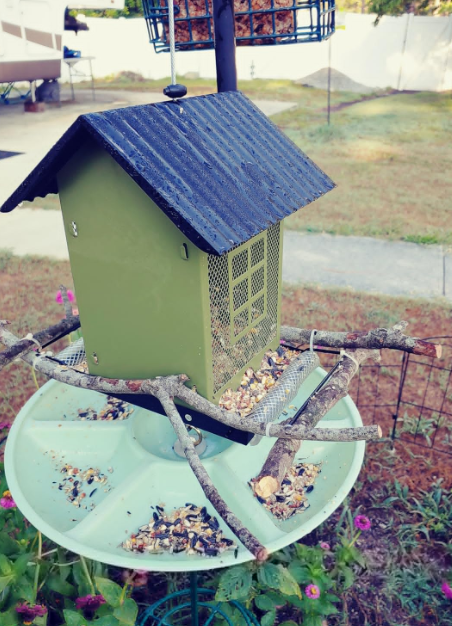
In courtyards with fixed feeders, the main cardinals and sparrows will concentrate their foraging time within 10-15 minutes after human feeding, forming a "timed gathering" behavior to reduce unnecessary energy consumption;
Birds in urban courtyards will delay their morning calls (about 30-60 minutes) to avoid the noise interference caused by humans waking up early, ensuring effective transmission of their songs;
In the low temperature environment of winter, birds will shorten their single foraging time (compressed from 30 minutes to 15 minutes), increase their foraging frequency (increased from once per hour to once every 30 minutes), and quickly obtain energy in the cold through a "short-term high-frequency" mode, while reducing outdoor activity time.
https://www.amazon.com/Outdoors-Capacity-Birdfeeders-Weatherproof-Attracting/dp/B0C9Q6VZ83?ref_=ast_sto_dp&th=1&psc=1
We recommend our Flowafoli bird feeder!