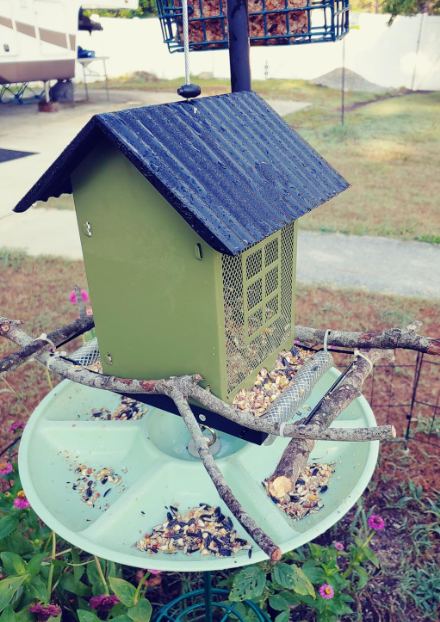
In urban courtyards, suburban gardens, and rural forest edges on the American continent, diverse bird communities form complex micro ecosystems. These courtyards are not only extension spaces for human activities, but also important habitats for birds to obtain food, build nests, and avoid natural enemies. However, limited resources (such as food and nesting sites) and the coexistence of diverse species require birds to develop unique adaptive strategies to cope with intra - and inter species competition, ensuring their survival and reproduction. From dietary differentiation to behavioral collaboration, from physiological adjustment to spatial utilization, the survival wisdom of courtyard birds in the Americas demonstrates the exquisite adaptability of organisms in resource limited environments.
Ecological niche differentiation is the core strategy for birds to cope with competition, by forming differences in dimensions such as food types, feeding time, and activity space, reducing direct resource competition between different species, and achieving a coexistence state of "each taking what they need". This differentiation is particularly evident in American courtyards, where different bird species occupy unique ecological roles in the same space through precise "resource positioning".
1. Specialization of dietary habits and feeding methods
In American courtyards, the dietary differentiation of birds directly determines their resource acquisition range. For example, the Northern Cardinals primarily feed on plant seeds and fruits, and their thick beaks are suitable for crushing hard seed shells. They often forage on the ground or in low shrubs; The American Goldfinch, on the other hand, prefers seeds from plants in the Asteraceae family. Its beak is slender and sharp, and it can accurately peck at small seeds in the flower disk. It also adjusts its feeding target according to seasonal migration (supplementing nutrition with insects in summer and focusing on seeds in winter). In addition, the Barn Swallow, as an aerial predator, feeds on flying insects. Its streamlined body and wide wings make it easy to quickly pursue prey, and there is almost no resource conflict with birds that feed on the ground; Woodpeckers, such as Downy Woodpecker, feed on insect larvae inside tree trunks by chiseling wood, utilizing their unique "trunk niche" to avoid competition with canopy or ground birds.
This dietary specialization is not only reflected in food types, but also in the adaptability of feeding tools - the shape, length, and strength of the beak directly correspond to the characteristics of the food, such as the pointed beak of insectivorous birds and the slender beak of honey eating birds (such as the Ruby throated Hummingbird), forming a precise match between "tool food" and eliminating some competition possibilities from a physiological structure perspective.
2. Misalignment of time and space utilization
In addition to their diet, birds also reduce competition by adjusting their activity time and space. In terms of time dimension, diurnal birds (such as sparrows and blue jays) form a clear time separation from twilight birds (such as nighthawks and barn owls). The former uses visual foraging during the day, while the latter relies on auditory capture of prey in the evening or night, avoiding competition for insect resources during the same time period. Even among diurnal birds, there are differences in the peak activity of different species: for example, early adult birds (such as pheasants) usually forage in the early morning and evening, while late adult birds (such as mockingbirds) concentrate their foraging peaks in the morning and afternoon, reducing resource competition pressure through "staggered travel".
In terms of spatial dimension, birds have a particularly significant vertical layered utilization of courtyards. The canopy of tall trees is the activity area of Blue Jay and Blue Grosbeak, who jump between branches to feed on fruits or insects; The shrub layer is the territory of Carolina Wren and Mockingbird, who are skilled at searching for hidden food in dense shrubs; The ground floor is occupied by House Sparrow and American Robin, who obtain resources by pecking at seeds or worms on the ground; The aerial layer belongs to hummingbirds and swallows, who hover over the courtyard, feeding on nectar and flying insects respectively. This "vertical layering" spatial utilization model is like dividing a courtyard into different "ecological floors", with each species occupying its own "activity area", greatly reducing the probability of interspecific competition.
We recommend our iron Flowafoli bird feeder!