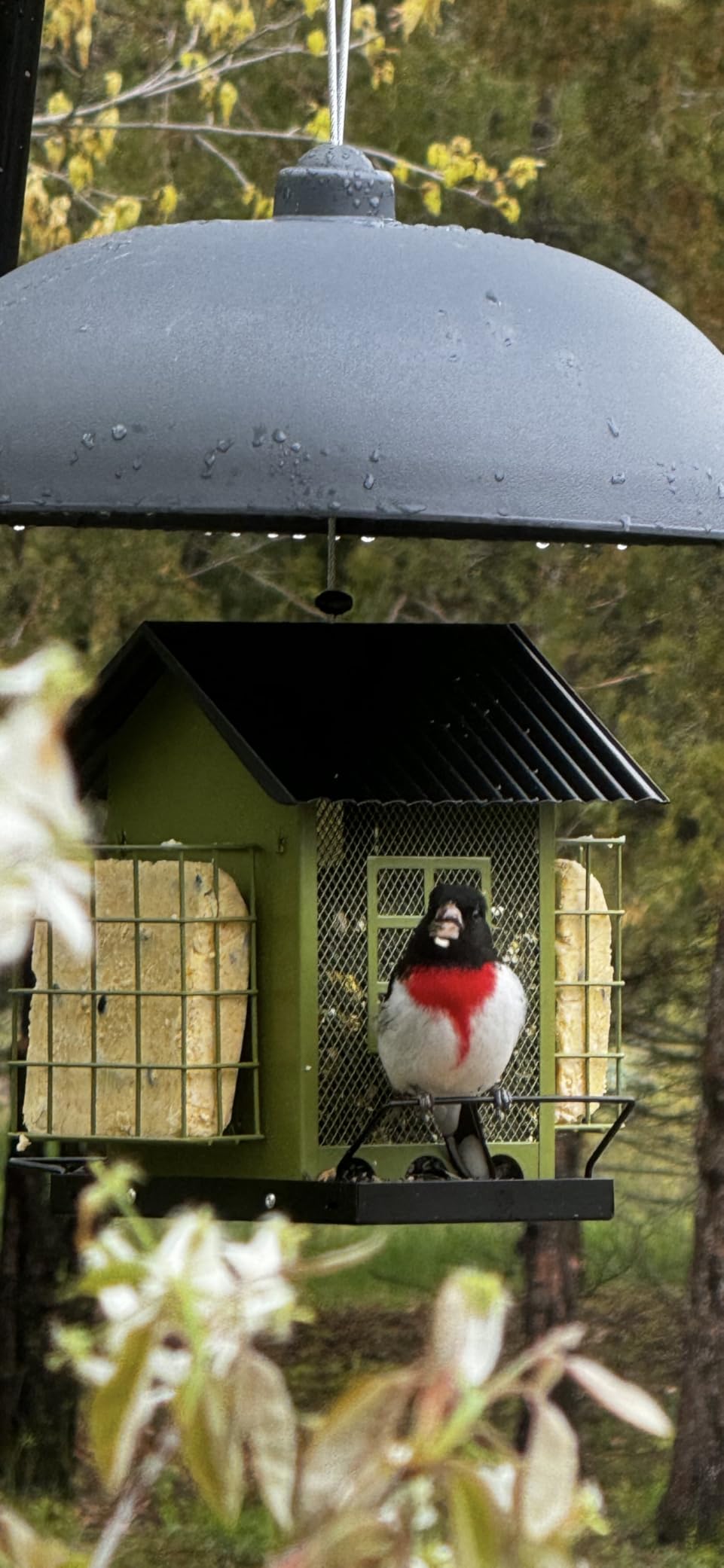
As the intersection of artificial environment and natural ecology, the "stock problem" faced by birds in American courtyards is essentially a dynamic challenge to the balance of resource supply and demand (food, nest, space). The 'stock' here is not a single dimensional quantity concept, but covers the reserve of living resources, the matching degree between population density and environmental carrying capacity, and the occupancy status of ecological niches. Through millions of years of evolution and environmental adaptation, American courtyard birds have developed a set of natural coping strategies centered on "resource regulation, behavioral coordination, and ecological adaptation", which not only ensure their own survival but also maintain the stability of courtyard ecology.
Food is the most essential survival resource for courtyard birds, and fluctuations in its stock directly affect population survival. American courtyard birds have developed differentiated processing strategies based on the characteristics of different food types, achieving a combination of "open source" and "throttling".
1. Seasonal hoarding: a "reserve mechanism" to cope with food shortages
In the courtyards of temperate regions of North America, birds such as black crowned tits and ravens are typical "reserve players". Every autumn, when berries, seeds, and other foods enter their peak season, they will initiate a large-scale "hoarding behavior" - black crowned tits will peck hard seeds such as sunflower seeds and pine nuts with their beaks, and then scatter them in hidden places such as bark crevices, fallen leaves, and pot soil in the courtyard, storing only 1-2 seeds each. At the same time, they can accurately record the storage location through visual markers and spatial memory, and their memory accuracy can be maintained for several months. The hoarding ability of star crows is even more astonishing. A single star crow can store tens of thousands of pine seeds in autumn, distributed over an area of tens of square kilometers. The courtyard, as its "core reserve area", has become their preferred storage location due to the stability of the artificial environment. This decentralized hoarding method not only reduces the risk of food being stolen by competitors such as the same species or squirrels, but also provides a stable supply for the sharp decline in winter food stocks.
2. Resource graded utilization: an efficient strategy to avoid food waste
The food sources in the courtyard are complex, including naturally grown fruits and insects, as well as artificially placed bird food such as grains and oil balls. Birds in the Americas will classify and utilize food based on its "stock value": for perishable foods such as ripe fruits and insect larvae, carnivorous birds such as mockingbirds and thrushes will prioritize feeding to avoid spoilage and waste; For seeds and nuts that are resistant to storage, they will be prioritized for inclusion in the hoarding plan. In addition, some birds also enhance their stock value by "processing food". For example, the main Cardinals use their beaks to peck the hard fruit kernels, and after feeding on the internal kernels, discard the shells at the edge of the yard, which not only improves feeding efficiency but also avoids untreated food occupying storage space.
3. Ecological niche differentiation: reducing the "spatial allocation" of food competition
When the food stock in the courtyard is limited, different birds achieve "stock sharing" by occupying different ecological niches. For example, on the same fruit tree, woodpeckers feed on borers in the trunk, while cedars feed on berries in the canopy; The ground foraging thrush focuses on earthworms in the fallen leaves, while the arboreal blue raven captures flying insects between branches. This vertical space and differentiation of feeding objects enable efficient utilization of limited food stocks, avoiding excessive consumption of certain resources by a single species and indirectly maintaining the long-term stability of food resources.
We recommend our Flowafoli bird feeder!