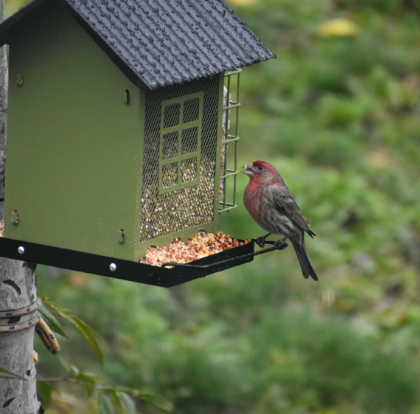
The foraging rhythm of birds is essentially a dynamic balance between the circadian rhythm system and environmental signals. For common courtyard birds such as North American goldfinches and house sparrows, their biological clocks exhibit a "dual zeitgeber" regulatory characteristic:
Basic Rhythm Anchor: Under normal circumstances, light is the core synchronous signal that drives birds to form a bimodal foraging pattern of "morning peak+dusk peak" - in the early morning (1-4 hours after sunrise), they need to replenish the energy consumed at night, and in the evening (2-3 hours before sunset), they need to store overnight fat. This pattern is particularly typical in species such as American mockingbirds and North American Cardinals.
The compensatory effect of food signals: When artificial feeding or natural food experiences time fluctuations, the food itself becomes a "secondary synchronous signal". The experiment of domestic sparrows shows that if the daily food availability time is shortened to 8 hours (normally 12-14 hours), their movement and feeding rhythm will be completely synchronized with the feeding period; But when the available time is extended to 20 hours, some individuals may actually deviate from the rhythm and enter a "free running" state, relying on immediate stimulation to eat. The essence of this difference lies in birds' judgment of food scarcity - a short time window implies "limited resources" and requires enhanced rhythm adaptation.
2、 Triple Adjustment of Behavioral Strategies: Balancing Adaptation and Avoidance
1. Elastic expansion during foraging period
Flexible transition of small insectivorous birds: insectivorous birds such as the yellow warbler are usually active in the morning and evening, but when insect activity is delayed due to abnormal weather conditions (such as sudden rain), they will shift their foraging peak to noon and use the brief warming window between leaves to hunt.
The staggered foraging of seed feeding birds: When the feeding system is interrupted, North American goldfinches will expand their foraging range to surrounding grasslands and no longer strictly follow the "morning strong and dusk weak" pattern. Instead, they will adopt a "seize the opportunity" feeding style - even during the traditional "midday lull period", they will gather to visit areas with scattered seeds.
2. Energy storage and metabolic regulation
Dynamic management of fat reserves: During winter, American goldfinches increase their body fat percentage from 10% to over 15% in anticipation of potential food interruptions, accumulating energy by extending their evening foraging time (30 minutes longer than normal). This strategy is also common in mourning doves, whose crop capacity can be temporarily doubled to store seeds.
Emergency mechanism of metabolic inhibition: When there is no food for more than 12 hours, species such as sparrows will activate a "low metabolism mode", reducing their basal metabolic rate by 18% while reducing unnecessary flying activities and only retaining short distance jumping for foraging.
We recommend our Flowafoli bird feeder!