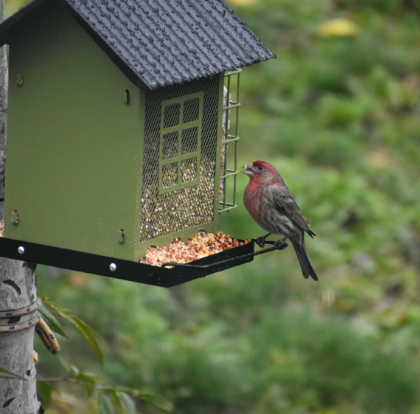
1、 Voice Communication: The Core Carrier of Information Transmission
Sound is the primary mode of communication for courtyard birds in the Americas, with different songs, calls, and vocalizations carrying vastly different functions, with precision comparable to 'bird language'.
1. Singing: Declaration of territory and display of courtship
The singing of most songbirds has strong "individual identification" and "functional directionality". For example, the male of the Northern Cardinal in North America emits a clear and loud "Cheer Cheer Cheer" song at dawn, which not only declares "this is my territory" to its peers, but also shows the female's health status - the longer the song lasts and the more stable the tone, the more energetic the male's physical fitness is. The singing of House Finch, on the other hand, is more melodious and complex, consisting of multiple syllable combinations. Male birds attract the attention of female birds by continuously optimizing their singing repertoire. Studies have shown that males who can imitate more of their own kind's singing have a higher success rate in reproduction.
2. Call: Instant information warning and interaction
Compared to the "long text" attribute of singing, calling sounds more like "instant messaging", used to quickly convey urgent or daily information.
Alarm call: When Blue Jays discover predators such as eagles and cats, they will make a sharp and piercing "jay jay" sound. This call not only reminds their peers to avoid danger, but can also be recognized and alerted by other birds in the yard (such as mockingbirds and tits).
Contact call: The American Robin makes a gentle "tut tut" sound when foraging to maintain individual contact within the group and prevent members from getting lost.
Nurturing calls: When the female bird returns to the nest, it emits a specific low-frequency call, and the chicks will open their mouths wide to wait for feeding. This call has strong parent-child recognition.
2、 Visual Communication: The Signal Password of Posture and Color
For birds living in dense vegetation or well lit courtyards, visual signals are an important supplement to sound communication, conveying information through body posture, feather color, and movement.
1. Feather color and display behavior
The bright feathers of male birds often become the key to courtship and status display. **The male birds of Baltimore Oriole * * have bright orange and black feathers. When courting, they will fluff their feathers and make "spiral flight" around the female birds. At the same time, they will keep nodding their heads - bright colors and exaggerated movements jointly convey the signal of "healthy and strong". In territorial disputes, male birds will stand upright and spread their tail feathers like a fan, intimidating their opponents by increasing their visual size.
2. Implicit expression of body movements
The subtle body movements of birds conceal communication mysteries. After discovering food, the Black crowned Chickadee emits a gentle chirping and frequently wags its head, which can guide its companions to foraging points; When there is a "level conflict" in the group, vulnerable individuals will lower their heads, shrink their necks, and bring their bodies close to the ground, expressing obedience by lowering their posture to avoid direct conflict. In addition, the "bowing" gesture of Mourning Dove is also highly representative - when male and female birds meet, they repeatedly bow their heads, which is a "friendly confirmation" signal before pairing.
3、 Behavioral and Chemical Communication: Supplementary Expressions for Special Scenarios
In scenarios where sound and visual signals are limited, behavior and chemical signals become important means of communication.
The practical value of behavioral communication
Foraging Collaboration: White breasted Nuthatchets and tits in the courtyard often form a "mixed foraging group". The bream climbs up the tree trunk to forage, while the tits jump between branches. They maintain group collaboration through specific "following flight" behaviors. Once a bird discovers a food source, it will stop and emit a "contact call" to guide other members to gather.
Nurturing Collaboration: Barn Swallow couples have a clear "behavioral division of labor" during brooding - when the male bird returns to the nest, he will first hover around the nest 2-3 times, informing the female bird to "bring back food and prepare for handover", to avoid leaving the chicks unattended when the female bird leaves the nest.
2. The hidden function of chemical signals
Although not as obvious as mammals, chemical communication in birds is indispensable in specific scenarios. Cliff Swallows apply oil secreted by their own tail fat glands to their nest material, which contains unique chemicals that can help their peers recognize their "own nest" and also transmit signals of "strong nest building ability" to potential mates. In addition, some insectivorous birds (such as warblers) secrete liquids with irritating odors from their cloacae when threatened. This chemical signal can both deter natural enemies and alert their peers that there is danger in this area.
4、 Adaptive Evolution of Communication Systems
The communication mode of courtyard birds in the Americas is the result of long-term adaptation to artificial environments. The distribution of vegetation in the courtyard, human activity interference, and other factors drive birds to optimize communication strategies. For example, the North American Cardinals living in densely populated courtyards in residential areas have higher singing tones than their counterparts in forests - high tones propagate further under building reflections and can effectively overcome human noise interference; House Sparrow, on the other hand, has developed the ability to change its voice, adjusting its singing volume and frequency at different times (such as when there is less human activity in the morning and loud noise in the afternoon) to ensure accurate information transmission.
We recommend our Flowafoli bird feeder!