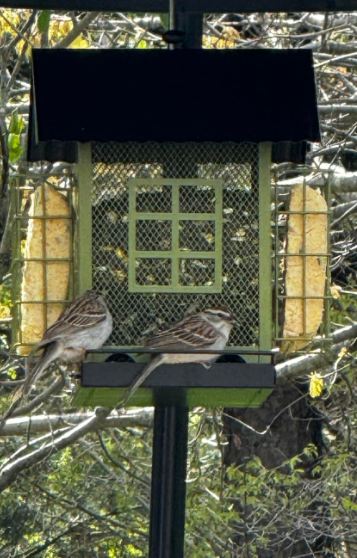
In the ecosystems of American courtyards, the "inventory" in the mouths of birds is not a commodity on the shelves, but a key resource for survival - food. From autumn when berries bloom to winter when everything withers, from temporary food surpluses to sudden resource shortages, courtyard birds have evolved a complete "inventory management system" that covers storage, management, allocation, and risk response. These strategies not only ensure individual survival but also maintain the balance of courtyard ecology.
1、 Inventory reserve: Seizing the window period of "resource hoarding"
The inventory reserve of courtyard birds in the Americas has distinct seasonal characteristics, with the core being to seize the "window period" of abundant food and accumulate resources through specialized physiological structures and efficient behaviors. Among them, the performance of crow birds is the most typical.
The Crown Blue Crow, widely distributed in North American courtyards, enters a high-intensity "stocking period" in autumn. They use their swollen crop as a temporary "transport warehouse" and can carry dozens of acorns or walnuts at a time, shuttling back and forth between food sources and storage points. Research shows that a single crowned blue crow can bury over 200000 seeds in autumn, and these 'stocks' will become the core energy source for winter. Pine crows, which have similar habits to the Blue Crow, pay more attention to "transportation efficiency". They can transport seeds to places thousands of kilometers away from the mother tree and establish hundreds of micro storage points around the courtyard through a "decentralized storage" model. Each point only buries 1-2 seeds, reducing the risk of concentrated theft.
In addition to crow birds, the common star crow in the courtyard has a more precise strategy for storing coniferous tree seeds. When the red pine cones around the courtyard are concentrated and mature, the crow will prioritize selecting plump seeds and bury them at a depth of 1.5-2 centimeters under the layer of dead branches and leaves. On average, 2.4 seeds are placed at each storage point, with a density controlled at around 1.8 seeds per square meter. This scientific "inventory specification" is not only convenient for subsequent use, but also reduces resource waste.
2、 Inventory management: dual guarantee of spatial memory and dynamic updates
Reserves are only the first step, efficient inventory management is the key to ensuring 'what is in stock for use'. American courtyard birds mainly avoid the dilemma of "inventory failure" or "inability to find inventory" through precise spatial memory and dynamic inventory updates.
Spatial memory ability is a core skill in bird inventory management. The hippocampal neuron density of the Blue Crow is significantly higher than that of other birds, allowing it to remember 92% of its storage locations. Even in snow covered winter, it can accurately locate buried species through visual markers (such as specific shaped stones, tree branch orientations) and spatial coordinates. Crows, on the other hand, follow a fixed storage route and concentrate their inventory points in frequently active areas, strengthening their memory through repeated back and forth trips. This "route based management" increases their feeding efficiency by more than 30% during food shortages.
Birds will dynamically update their inventory in response to potential spoilage or theft. Before the arrival of winter, the Star Crow will conduct a comprehensive "inventory" of the inventory points established in autumn, with a high proportion of 55.4% being repurchased. For seeds that are damp or infested with insects, they will decisively discard and re store new resources. Woodpeckers, on the other hand, adopt a "centralized inventory+regular inspection" model, embedding acorns into cracks in tree trunks and conducting regular inspections every day. If any gaps are found to have been eaten by squirrels, they are immediately replenished to ensure a stable total inventory.
We recommend our Flowafoli bird feeder!