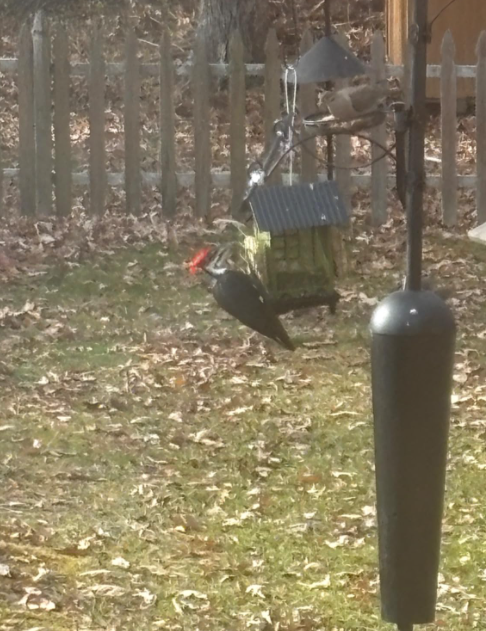
In American courtyards, bird feeders placed by humans are an important source of energy for birds, and the "correct use" of bird feeders by birds is essentially a process of instinctive exploration, environmental adaptation, and group learning, accurately matching the design logic of bird feeders with their own feeding needs. Different types of birds (such as the main Cardinals, Blue Jays, Cardinals, Hummingbirds, etc.) will gradually master the use of bird feeders based on their own body size, beak structure, and feeding habits. The entire process not only reflects the survival wisdom of birds, but also is closely related to the reasonable placement and maintenance of human bird feeders. The following provides a detailed explanation of its usage logic from three dimensions: adaptation process, usage scenarios and behavioral details, and adaptation skills:
Early adaptation: from vigilance and exploration to proactive utilization
Birds do not immediately accept unfamiliar bird feeders, but undergo a gradual process of "vigilant observation - close range probing - first feeding - stable use", which is their instinctive reaction to avoid risks and confirm safety, and also a prerequisite for "correct use".
We recommend our Flowafoli bird feeder!
Firstly, birds will observe the position, shape, and surrounding environment of the bird feeder through hovering in the air, looking far from the branches, and other methods to ensure safety (such as whether there are natural enemies and whether human activities are frequent). This stage may last for several hours to several days, with smaller and more alert birds (such as tits and goldfinches) taking longer, while larger and more adaptable birds (such as blue jays and pigeons) require relatively faster time.
Subsequently, some brave individuals (usually the "explorers" in the group) will gradually approach the bird feeder and test its stability and safety through jumping, pecking, and other actions - such as lightly tapping the shell and bracket of the bird feeder with their beaks to confirm that it will not suddenly shake or send out danger signals. If no threat is encountered during the probing process, they will try to come into contact with the feeding port of the bird feeder (such as ports, grids, trays, etc.), peck at a small amount of food, and quickly evacuate to a safe area to eat. After several repetitions, confirm the "safety" and "food availability" of the bird feeder.
Finally, when an individual confirms safety, they will send signals to the group through vocalizations or other means to attract other members of the same species to come and feed. Other birds in the group will quickly master the technique of approaching the bird feeder through "imitation learning", gradually forming stable feeding habits and completing the transition from "unfamiliar" to "proficient use".
Core usage scenario: Matching bird feeder types for feeding behavior
There are various types of bird feeders designed by humans for courtyard birds in the Americas, such as tray type, tube type, hanging type, and hummingbird specific feeders. Different types of bird feeders correspond to different feeding logics, and birds will choose the appropriate way according to their own characteristics to achieve "correct feeding" - that is, efficiently obtaining food without damaging the bird feeders or their own safety.
1. Tray/platform bird feeder (most universal)
This type of bird feeder usually has a flat tray, and food (grains, seeds, fruit fragments, etc.) is placed directly on the tray. The entrance is unobstructed and suitable for most yard birds (main Cardinals, Blue Jays, Pigeons, Sparrows, etc.). The use of birds is simple and direct:
Larger birds, such as the main Cardinals and Blue Jays, will stand directly at the edge or center of the tray and peck for food with their beaks; Smaller birds, such as tits and goldfinches, will jump onto trays and skillfully peck at seeds in crevices; Some ground feeding birds (such as sparrows and pigeons), if the tray height is low (close to the ground), will directly land on the tray to feed, and even pick up fallen food residues. The core of the "correct use" of this bird feeder is "stable standing+precise pecking". Birds will naturally adjust their standing posture to avoid falling due to unstable center of gravity, and will not excessively peck the tray (only feeding on food, not damaging the equipment).
2. Tubular bird feeders (waste prevention, suitable for small birds)
A tube bird feeder is usually a sealed tubular structure with multiple circular or strip-shaped feeding ports on the side. Food (mostly small seeds such as Nyjer seeds and millet) is placed inside the tube and falls to the feeding ports by gravity. This type of bird feeder is mainly suitable for small birds, and its use reflects the birds' mastery of "structural adaptation":
Birds will use their claws to grasp the support or side of the tube of the bird feeder (some of which are designed with anti slip protrusions), adjust their body posture, align their heads with the feeding mouth, and use their slender beaks to peck seeds into the feeding mouth. For example, the sparrow will tightly grasp the barrel with its claws, with its body suspended or semi suspended, its head flexibly rotating, and accurately pecking at every seed; The goldfinch will stand on a support near its feeding port, with its beak deep into the port to peck and avoid seed dropping. For designs with smaller feeding ports, birds will naturally control the depth of their beaks and will not forcefully strike the ports (to avoid damaging the beaks or damaging the feeding ports). They will also repeatedly peck several times to ensure that the seeds are collected before withdrawing - this "precise positioning+moderate force" behavior is the core of their correct use.
It should be noted that larger birds (such as blue jays) are difficult to adapt to this type of bird feeder due to their size and beak limitations. They usually give up using it or try pecking at the side of the barrel (but cannot effectively feed), which also reflects the birds' judgment of the adaptability of the bird feeder.
We recommend our Flowafoli bird feeder!