1、 Resource allocation: landscape design driven differentiation of foraging behavior
Habitat type determines foraging costs and efficiency
The design of courtyard vegetation directly affects the resource utilization strategy of birds: In a study in Phoenix, Arizona, birds in moist courtyards (mesic, exotic dense vegetation) such as sparrows and mourning doves showed lower "abandonment density" (GUD) - depleting food trays to lower levels, mainly dominated by invasive and companion species. Although arid courtyards (xeric, native drought tolerant vegetation) have higher food residue levels, native birds (such as Albert bunting and curved billed thrush) can efficiently forage by utilizing high-quality alternative resources (such as native plant fruits), demonstrating an adaptive advantage to their native environment.
The bidirectional effect of artificial feeding
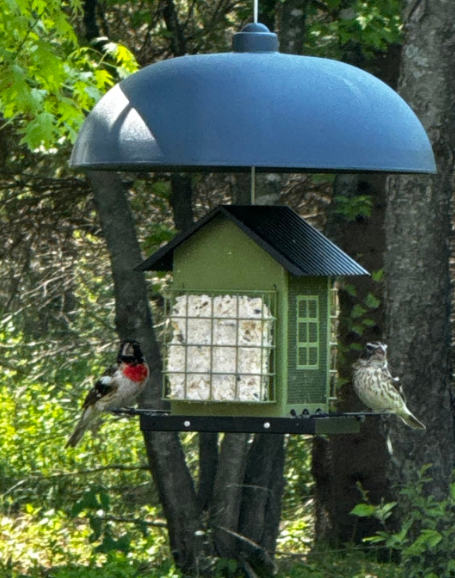
Human feeding has changed traditional resource allocation patterns: A study in the Chicago area found no significant correlation between the number of feeders and native bird richness, but the proportion of fruit bearing plants in the courtyard can increase native bird diversity. The model from the University of Georgia shows that artificial food causes species such as thrushes to abandon migration and form resident populations - these resident birds will occupy reproductive resources in advance, leading to competitive disadvantages for migrating individuals and prolonging the transmission cycle of pathogens such as West Nile virus.
2、 Breeding synergy: balancing interests in cooperative chick rearing
The Reproductive Allocation Game of American Crows
In the cooperative breeding population of American crows, strict resource allocation rules are formed between breeding pairs and auxiliary individuals: female breeders monopolize the maternal rights of all offspring, male breeders account for 82.7% of the paternal rights, auxiliary male birds only receive 6.9% of the breeding share, and the remaining 10.4% is occupied by male birds outside the population. This allocation model is in line with the "reproductive bias theory" - helpers compromise their reproductive rights in exchange for opportunities to inherit territory, while breeders can maintain their dominant position by expelling threats.
The dilemma of the group sports chicks of the big rhinoceros cuckoo
As a communal breeding bird, the large rhinoceros cuckoo has multiple breeding pairs that work together with helpers to care for its chicks, but there is significant inequality in resource allocation: as the number of chicks increases, additional adult caretakers cannot offset the increased demand, resulting in a decrease in the amount of prey each chick receives. Late hatched chicks face a "dual cost" due to asynchronous hatching - they have to compete with more of their own kind and obtain less food due to their size disadvantage, which may limit the expansion of their population size.
3、 Group Adaptation: Policy and Social Environment Response
The indirect impact of biodiversity policies
The policies of local vegetation restoration and wetland conservation promoted by the "Beautiful America" initiative in the United States have created a better collaborative environment for courtyard birds. For example, arid courtyards serve as "micro shelters" with more frequent bird interactions supported by local plant communities, while moist courtyards have lower group collaboration due to invasive alien species. On the contrary, the weakening of environmental policies during the Trump administration has led to habitat fragmentation, forcing birds to adjust their foraging ranges to maintain resource sharing among populations.
Behavioral differentiation under socio-economic gradient
In Latin American cities such as Santiago, Chile, the high vegetation coverage in high-income communities supports the coordinated foraging of more native birds, while low-income communities are dominated by non-native birds (such as domestic pigeons) due to vegetation scarcity - these species form a competitive advantage by seizing human waste resources, further squeezing the resource allocation space of native birds. In addition, research in Chicago shows that collaborative courtyard management among neighbors (such as jointly controlling the number of stray cats) can improve the stability of bird populations more effectively than optimizing a single courtyard.
We recommend our Flowafoli bird feeder!