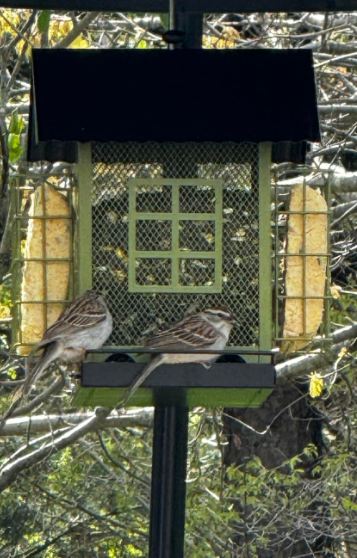
As a common habitat, foraging, and breeding ground for birds, American courtyards often face persistent challenges such as human activities, environmental changes, noise interference, and threats from natural enemies. These regulars in the courtyard (such as the main Cardinals, thrushes, black crowned tits, etc.) rely on adaptive behaviors formed through long-term evolution to flexibly adjust their survival strategies, effectively alleviate difficulties, and ensure their own survival and reproduction. Their coping strategies revolve around the four core dimensions of foraging, habitat, communication, and behavior, combining universality and species specificity.
1、 Foraging strategy adjustment: adapt to the environment, avoid interference
Persistent foraging disturbances, such as human yard activities, pet disturbances, and fluctuations in food resources, are the most common challenges faced by birds. In the Americas, yard birds mainly respond through three ways: "time mismatch," "resource expansion," and "cautious behavior.
As the most iconic resident bird in American courtyards, the main Cardinals actively adjust their foraging time in the face of frequent human activities in the courtyard. They avoid peak human activity periods (such as 10am to 4pm) and choose to forage in the early morning, dusk, or nighttime when the lighting is suitable. They prioritize feeding on seeds and fruits near dense shrubs that are not easily disturbed in the courtyard. They also frequently visit feeding devices set up by humans, using artificial food supplementation to reduce foraging risks and energy consumption. This adaptability is particularly evident in winter when food is scarce. Their thick conical beaks can efficiently break through seed shells without the need for prolonged foraging, further reducing the probability of being disturbed.
The traveling thrush is good at coping with difficulties by expanding their foraging resources. As a bird that mainly feeds on earthworms, insects, and berries, when the number of earthworms and insects decreases due to human pruning and pesticide use on the courtyard lawn, they quickly turn to native fruit trees and berry shrubs (such as dogwood and elm) in the courtyard, while reducing their foraging time in open lawns and instead foraging in hidden places such as under shrubs and fence gaps to avoid exposure to interference. In addition, the thrush is extremely sensitive to pesticides and will actively avoid areas that have been sprayed with pesticides, choosing untreated lawns or wild plant areas to forage and reduce health risks.
Small birds such as black crowned tits rely on "cautious foraging+efficient memory" to cope with difficulties. They are small in size and agile in movement. When foraging, they frequently observe their surroundings. Once they detect interference (such as human proximity or pet activity), they immediately fly to nearby branches or shrubs to avoid it, and return to forage after the interference disappears. At the same time, they have excellent memory abilities and can remember safe foraging points and food storage locations in the courtyard, reducing unnecessary foraging explorations and decreasing the frequency of interference.
2、 Habitat and Nesting: Hidden Site Selection, Flexible Adaptation
Persistent habitat disturbances, such as courtyard renovations, noise, and the presence of natural enemies, can affect the safety of bird habitats. In the Americas, courtyard birds respond through "hidden site selection," "nest type adjustment," and "habitat switching," ensuring the stability of their habitat and reproduction.
Most courtyard birds prefer to choose nest sites with strong concealment to avoid interference. Black crowned tits, velvet woodpeckers, and other cave nesting birds will choose thick dead branches, tree holes, or artificial bird houses in the courtyard to build their nests. These locations can effectively block human vision, resist natural enemies (such as stray cats and squirrels), and reduce noise interference. Velvet woodpeckers also dig deep enough caves when building nests and use sawdust to lay the interior of the nest, further enhancing concealment and safety. Their nesting time also avoids high-frequency interference periods such as courtyard renovations, and they mostly choose to build nests during the early spring when human activities are less frequent.
The main Cardinals, thrushes and other cup-shaped nest birds will build their nests in dense shrubs and deep evergreen leaves in the courtyard, away from areas with frequent human activities (such as the center of the courtyard or near the terrace). The color of the nest is similar to the surrounding vegetation, forming a natural camouflage and reducing the probability of being discovered and disturbed. If the nesting area in the courtyard is continuously disturbed (such as frequent pruning of shrubs), they will promptly abandon their original nest and rebuild in other hidden places in the courtyard, demonstrating strong flexibility.
In addition, some birds will cope with long-term disturbances through "habitat switching". When disturbances in the courtyard persist (such as long-term noise and frequent human activities), birds such as thrushes and blue jays will go to the courtyard to forage during the day and fly to nearby forests, parks, and other areas with less disturbance at night, forming a pattern of "daytime foraging and nighttime refuge" to balance food acquisition and habitat safety. As intelligent opportunistic feeders, blue jays also store nuts and other food, reducing their ability to go out for foraging in times of severe disturbance and further lowering their risk.
3、 Communication adjustment: Adapt to the environment to ensure communication
The chirping of birds is an important way for their territorial defense, courtship, and peer communication, and the persistent noise in American courtyards (such as human conversation, vehicle sounds, and courtyard tool sounds) can interfere with the propagation of chirping. Birds respond to this problem through "acoustic adjustment" to ensure communication efficiency.
Similar to the adaptation strategy of Eurasian robin in non breeding period, resident birds in American yards (such as main cardinals and black crowned tits) will adjust their singing parameters in a noisy environment, increase the minimum frequency of singing, reduce the spectral overlap with low-frequency noise, and at the same time extend the duration of monosyllabic words, simplify the phrase structure, improve the signal to noise ratio, so as to ensure that peers can receive signals clearly. For example, the call of the main Cardinals, which was originally clear and melodious, becomes louder and more frequent in noisy courtyards, and the call interval is shortened to avoid being masked by noise.
In addition, some birds will adjust their chirping time to avoid peak noise periods and choose quieter times such as early morning and dusk to reduce communication interference. The early morning chirping of thrushes is particularly prominent, as they frequently chirp at dawn before human activity begins, completing their territory declaration while avoiding noise interference. At the same time, birds also use body language to assist communication. When their calls are disrupted, they transmit information through movements such as wagging their tails and spreading their wings, making up for the lack of acoustic communication.
We recommend our Flowafoli bird feeder!