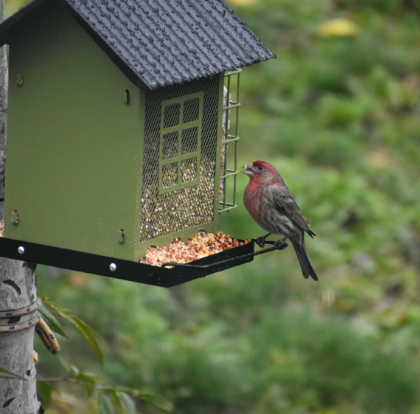
1. Hurricanes and Strong Storms: Aerodynamic Experts Evacuated Early
Perceived signal: The common Blue Jay in American courtyards can predict hurricanes 24-48 hours in advance by sensing changes in atmospheric pressure and infrasound waves (low-frequency vibrations of 1-20Hz generated by storms). Research has found that the special hair cells in the cochlea are 10 times more sensitive to low-frequency vibrations than humans.
Response strategy:
Small birds, such as the American goldfinch, will cluster and fly vertically along the path of storm movement, using the "air flow blind spots" formed by buildings or dense shrubs to seek refuge;
Medium sized birds, such as the North pounder, will reinforce their tree nest by sealing the gaps with soil and moss to reduce the intrusion of wind and rain;
Large birds, such as wild turkeys, choose to lie in low-lying terrain and tighten their feathers to reduce their exposure to wind.
2. Extreme high temperature: efficient heat dissipation and behavioral regulation
Physiological adaptation: Anna's Hummingbird accelerates evaporation and heat dissipation through intermittent breathing, and its body temperature can be maintained below 40 ℃; House Finch can reduce metabolic rate by 30% and decrease calorie production.
Behavioral strategy:
During noon, hide in the dense shade layer of the courtyard trees and use their leaves to block direct sunlight;
Frequent visits to artificial water sources such as sprinklers and bird baths, cooling through water baths or drinking low-temperature water;
Large birds, such as the red headed woodpecker, will peck wet mud and apply it to their bodies, using the soil to evaporate and take away heat.
2、 Geological Hazards: Emergency Evacuation and Habitat Reconstruction
1. Earthquake: Mysterious' infrasound warning system '
The American Robin and Mourning Dove in the courtyard were observed to exhibit abnormal behavior in the minutes leading up to the earthquake: swarming off the ground, frequently flapping their wings, and making rapid calls. Scientists speculate that its leg "vibration receptors" can capture infrasound waves generated by crustal movement, making it a natural "earthquake warning officer".
Post earthquake response: Priority should be given to building temporary nests in undamaged artificial structures (such as under eaves and air conditioning outdoor unit brackets), with human activity areas as the core for foraging, to reduce dependence on damaged natural environments.
2. Mudflows and landslides: rapid transfer and resource reuse
When there are signs of looseness in the surrounding mountains of the courtyard, Cedar Waxwing birds will quickly move to higher rooftops or utility poles, sounding in clusters to warn their peers;
After a disaster, they will actively peck at the undamaged berries and insect larvae in the mud, and use the new soil piles generated by landslides to build nests, transforming the post disaster environment into a living resource.
3、 Ecological disasters: Collaborative defense and adaptive evolution
1. Forest fires: Reverse flight and heat resistance mechanisms
For small-scale fires around the courtyard, the Black crowned Chickadee exhibits a unique "post fire foraging" strategy: flying to the edge of the fire within an hour after the flames go out, pecking at bark insects forced out by high temperatures;
In extreme cases, it will cluster towards the direction of the fire upwind, using hot air currents to climb to a safe height. The wax layer on the surface of its feathers can briefly resist high temperature radiation above 100 ℃.
2. Locust plagues and pests: population collaboration and dietary conversion
When a locust plague occurs in the courtyard, the American mockingbird will form a foraging group of dozens of birds, and through division of labor and cooperation, form a "trapping net". Each bird can hunt more than 200 locusts per day;
If conventional food is destroyed by pests and diseases, Northern Cardinals will quickly switch their diet, shifting from primarily feeding on berries to pecking at seeds and tender leaves of garden flowers, and even consuming grains discarded by humans, demonstrating strong dietary adaptability.
4、 Assisted by human activities: courtyards become a 'survival buffer zone'
Artificial facilities in American courtyards play a crucial role in bird response to disasters:
Windproof and rainproof shelters provide temporary shelter for birds in hurricane prone areas;
Thermostatic bird feeders ensure food supply during extreme high or cold temperatures;
Artificially excavated shallow pits become important water sources during droughts;
The uncleaned piles of dead branches and leaves after the disaster provide nesting materials and foraging grounds for birds.
This dual guarantee of "natural instinct+artificial assistance" enables courtyard birds in the Americas to demonstrate stronger survival resilience than wild populations in the increasingly frequent natural disasters.
We recommend our Flowafoli bird feeder!