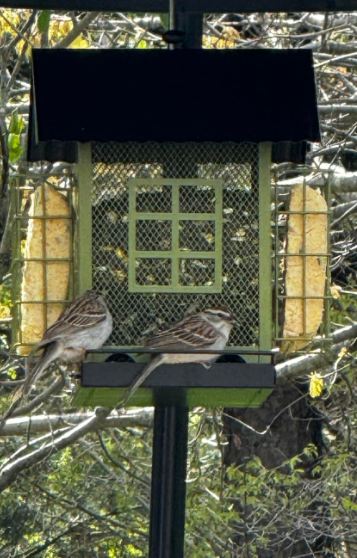
In the ecosystems of American courtyards, birds face a series of continuous survival tasks every day - from early morning foraging explorations, to afternoon nest repairs, to evening brooding and feeding. Each task is closely linked, forming their high-frequency and compact survival routine. These seemingly tiny creatures, with their unique mechanisms of psychological adaptation and behavioral regulation, maintain an efficient survival order in the busy cycle of affairs, demonstrating strategies that are completely different from those of humans when dealing with multitasking but equally ingenious.
1、 Anchoring core affairs with a "goal first" mindset and filtering out secondary distractions
The primary principle for American courtyard birds to cope with continuous affairs is to establish an internal judgment mechanism of "survival needs priority", which is similar to the human "task sorting" mentality, but relies more on the direct correlation between instincts and environmental signals. Taking the North American Cardinals as an example, during the breeding season, female birds need to complete four core tasks every day: "foraging - feeding chicks - cleaning the nest feces - repairing the nest". They prioritize "chick survival" and allocate 70% of their time to foraging and feeding. Even in the event of similar invasions or brief weather fluctuations, they will complete feeding first and then deal with disturbances. This mentality is not "anxiety driven", but stems from the instinctive emphasis on "reproductive success rate" in genes, manifested in focus during action - not frequently looking up when feeding due to surrounding sounds, fixed routes when flying back and forth to the nest, and reducing unnecessary energy consumption.
Similarly, during the non breeding season, domestic sparrows shift their focus to "energy storage". They prioritize "food acquisition efficiency" and choose seeds with high energy density when facing three food sources: scattered seeds in the yard, grains from feeders, and insects. They also cycle between 2-3 foraging points to avoid wasting time due to frequent changes in location. This "target anchoring" mentality keeps them efficient in continuous foraging tasks, even when encountering occasional predators (such as squirrels), they will only briefly avoid and immediately return to their original foraging point, without disrupting the overall rhythm due to interference.
2、 Use 'fragmented time allocation' to regulate transaction pace and avoid energy exhaustion
Although the affairs of courtyard birds in the Americas are continuous, they are not "seamlessly connected". They regulate their energy through "fragmented rest", which is similar to human "intermittent relaxation" but more in line with physiological needs. Taking the Karoo reed wren as an example, they need to shuttle between shrubs and grass in the courtyard every day, catching insects, building nests, and defending their territory. After completing 15-20 minutes of high-intensity activities, they will stop on tree branches and remain still for 3-5 minutes, grooming their feathers and observing the environment. During this time, they not only recover their strength but also monitor potential dangers. This "work rest" cycle is not random, but dynamically adjusted based on energy consumption - in cold weather, due to the need for more energy to maintain body temperature, the rest interval is shortened to about 10 minutes to ensure that excessive consumption does not affect subsequent affairs.
Blue jays exhibit a more flexible time allocation strategy, completing a daily cycle of "searching for nuts, transporting them, and burying them" during the food storage season (autumn). After burying 5-6 nuts, they fly to higher tree trunks to rest, mark their territory through chirping, and remember the burial location. This "transaction interweaving" adjustment method makes a single storage task more "multifunctional", avoiding the boredom of repetitive labor (from a behavioral psychology perspective, diversified tasks can reduce fatigue), and synchronously completing territorial defense, achieving the efficiency improvement of "one stop, multiple effects".
3、 Using 'environmental adaptation behavior' to resolve conflicts and reduce survival pressure
When multiple conflicts arise simultaneously, American courtyard birds respond by adjusting their behavioral patterns. This "flexible adaptability" is essentially a quick adaptation to environmental changes, rather than passive stress. For example, during the breeding season, the North American mockingbird often faces conflicts between "feeding chicks" and "driving away predators from the nest" - when a cat approaches the nest, the male bird will initiate defensive behavior first, intimidating predators by diving and chirping, while the female bird continues to stay in the nest to protect the chicks. After the predator leaves, the male and female birds will work together, with the male bird going out to forage and the female bird responsible for feeding, quickly filling the gap in affairs during the conflict. This "complementary division of labor" adjustment method avoids survival risks caused by delays in a single transaction and reflects a "team collaboration" mentality (although rooted in instinct, the effect is similar to human cooperative response).
In the season of food scarcity, the dark eyed bunting faces dual pressures of "foraging" and "avoiding raptors". They will adjust their foraging behavior - no longer foraging alone on open lawns, but joining small bird flocks. Some individuals in the group are responsible for vigilance, while others focus on foraging, rotating their vigilance roles every 3-4 minutes. This "group collaboration regulation" makes continuous foraging activities safer, while improving foraging efficiency through group "information sharing" (such as chirping when food is found), transforming "survival pressure" into "group advantage", and demonstrating an "active adaptation" rather than a "passive focus" mentality.
4、 Stabilize transaction rhythm with "physiological rhythm synchronization" and reduce internal and external consumption
The scheduling of bird affairs in American courtyards is highly synchronized with their own physiological rhythms. This "biological clock matching" regulation method can minimize energy consumption and ensure the stable progress of continuous affairs. For example, in the case of ordinary myxos, their peak activity coincides perfectly with the activity time of insects in the courtyard - from 5-7 am in the morning (when insects have just awakened, their activity is slow, and they are easy to catch) and from 17-19 pm in the evening (when insects are preparing to return to their nests and have a high degree of aggregation). These two periods focus on completing their main foraging tasks, while at noon (when insect activity decreases and the temperature is higher), they choose to rest under the shade of trees or engage in low-intensity nest maintenance. This kind of 'following the trend' behavior makes the progress of affairs more effortless, avoiding energy waste caused by forcing actions at inappropriate times, and approaching the mentality of 'conforming to nature' rather than 'forcibly controlling'.
Golden winged sparrows adjust their business rhythm according to the duration of sunlight. In summer (with longer daylight), they extend their afternoon rest time and focus more on foraging and social activities in the morning and evening; In winter (with short sunshine), the rest time is compressed and concentrated on the warm period of the day to complete foraging and ensure energy intake. This "rhythm synchronization" regulation ensures that continuous transactions always match one's physiological state, reducing the pressure of rushing to work and maintaining long-term survival balance.
It is not difficult to find from the coping strategies of courtyard birds in the Americas that they do not have the "anxiety" or "procrastination psychology" that humans have when facing multiple tasks. Instead, they adopt an "instinctive drive, efficiency first, and flexible adaptation" mentality, and transform continuous affairs into an orderly survival cycle through time allocation, division of labor and cooperation, and environmental matching. This seemingly simple regulatory mechanism is actually the "optimal survival plan" formed over millions of years of evolution, and provides natural inspiration for humans to understand "how to efficiently cope with continuous affairs" - clear core goals, moderate rest, flexible adaptation, perhaps the common wisdom of all organisms to cope with busy lives.
We recommend our Flowafoli bird feeder!