As a unique space where cities and nature blend, American courtyards often come up with various new plans due to human activities, such as courtyard landscape renovation, food supply adjustment, and the addition of protective facilities. These changes are both challenges and opportunities for birds inhabiting here to adapt to new environments. Different species of courtyard birds in the Americas rely on their physiological characteristics and behavioral habits to cope with and handle these new strategies with diverse "mindsets" (which can be understood as stress responses and adaptation strategies formed by species in long-term evolution), in order to maintain a balance between survival and reproduction in the face of changes.
1、 Facing courtyard landscape renovation: a "dual mentality" of cautious exploration and rapid adaptation
Courtyard landscape renovation is one of the common new plans, which may involve vegetation replacement, terrain adjustment, and addition or removal of building facilities. Faced with such environmental changes, most courtyard birds in the Americas will first observe the new environment with a "cautious exploration" mentality, and then gradually switch to a "rapid adaptation" mode to ensure that their activities are not excessively disturbed.
Taking the Cardinalis cardinalis as an example, this type of bird is more sensitive to the vegetation structure of its habitat. When the original shrubs in the courtyard are replaced with new ornamental plants, the North American Cardinals will not immediately enter the new vegetation area for activity, but will stay on the tall trees at the edge of the courtyard, observing the safety of the new vegetation through frequent chirping and short distance flight (such as whether there are any enemies hiding, and whether a hidden nest location can be provided). This' cautious observation period 'usually lasts for 3-7 days, during which they will reduce their foraging frequency in the courtyard and instead rely on familiar foraging points in the surrounding area. Once it is confirmed that the new vegetation area poses no obvious threat and can provide food such as berries and seeds (some ornamental plant fruits can become their new source of food), North American Cardinals will quickly adapt, expanding their range of activity to the new vegetation area and even building nests in new shrubs - their "mentality" shifts from vigilance to acceptance, adjusting their activity routes and nesting locations to form a new symbiotic relationship with the transformed landscape.
Hirundo rustica, on the other hand, exhibits a stronger "flexible adaptive mentality". If there are structural changes to the eaves involved in courtyard renovation (such as installing canopies or replacing tiles), the mud nests originally built by swallows under the eaves may be damaged or unable to continue to be used. But these birds will not easily leave the courtyard due to environmental changes. Instead, after the renovation project is completed, they will quickly survey the new building structures in the courtyard (such as air conditioning unit brackets, lamp column tops, and newly built flower stands), choose suitable locations to rebuild their nests. Their "mentality" is more inclined towards "actively utilizing new resources", and they will not stay in dependence on old habitats for a long time. Instead, they maintain their breeding activities in the courtyard by quickly adjusting their nesting sites - this adaptation strategy has made the house swallow one of the birds with strong tolerance to landscape modification in American courtyards.
2、 Coping with food supply adjustments: a "dynamic mentality" of proactive experimentation and resource competition
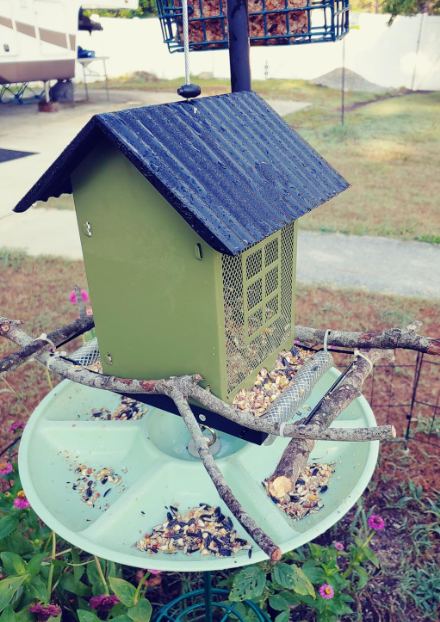
The food provided by humans in American gardens, such as seeds from bird feeders, artificially dropped fruits, and leftover grains from kitchens, is an important source of food for many birds. When there is an adjustment in food supply (such as changing feed types, reducing feeding frequency, or adding feeding points), birds will respond to changes in food resources with a dynamic mentality that combines "active experimentation" with "resource competition".
The Junco hyemalis is a common ground foraging bird in courtyards, with strong adaptability to food. When humans replace the mixed seeds in bird feeders with single sunflower seeds, the dark eyed bunting will not refuse to eat due to changes in food types - they will first peck at the fallen sunflower seeds below the feeder, observe the feeding situation of other birds (such as sparrows and goldfinches), confirm food safety, and then jump onto the feeder to peck directly. This proactive attitude allows them to quickly accept new types of food; At the same time, due to the large population of dark eyed bunting, when food supply decreases, they will compete with other ground foraging birds for limited food resources through short distance chasing, chirping warnings, etc. At this time, the "competitive mentality" will dominate to ensure that they can obtain sufficient energy intake.
Unlike the blue raven (Cyanochita cristata), this bird species has a habit of "storing food" and shows a "precautionary" mentality when faced with adjustments in food supply. If humans add feeding points (such as placing feeders filled with nuts on the other side of the yard), blue ravens will first assess the safety of the new feeding points, then pick up multiple nuts at once and fly them to tree branches or ground crevices in the yard to store them - even if the current food supply is sufficient, they will prepare for possible food shortages in the future. When the feeding frequency decreases, blue jays will prioritize feeding on previously stored food rather than immediately competing with other birds for limited immediate food. This "early reserve+reduced competition" mentality allows them to maintain a more stable survival state when food resources fluctuate.
We recommend our Flowafoli bird feeder!