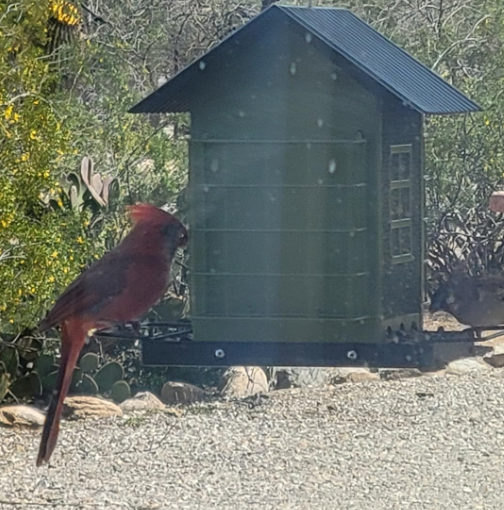
In the courtyards of the Americas, these agile figures often face the "slow process" of nature - waiting for insects to emerge from the soil, waiting for the empty space in the feeder, waiting for rain to wet and dry the seeds, enduring the long silence of the incubation period - from the dark eyed bunting pecking at grass seeds in the morning light, to the main Cardinals waiting by the feeder in the afternoon, and to the Blue Jays grooming their feathers at dusk. They do not have human anxiety about efficiency, but have evolved a mature set of coping strategies with a mentality that adapts to survival needs. Behind these strategies is the survival wisdom accumulated by millions of years of natural selection.
1、 Goal oriented patience: Transforming waiting into a foundation for survival
The most common "slow process" in American courtyards is waiting in foraging scenes. For example, the Eastern Blue Robin will stand still on the lawn for several minutes, keeping its gaze fixed on the ground, waiting for earthworms to show their tracks due to soil loosening; The pounder will maintain a fixed position on the tree trunk and patiently observe the beetle larvae hidden in the crevices of the bark. This kind of waiting is not a passive 'time consuming', but an active hibernation centered on clear survival goals, and its essence is a rational balance of 'benefits outweigh costs'.
Research shows that the "static waiting" time of the Eastern Blue Robin is usually positively correlated with soil moisture - when the soil is moist after rain, earthworms are more active and their waiting time is shortened to 1-2 minutes; During dry seasons, earthworms hide deep underground and their resting time can be extended to 5-8 minutes. During this process, its heart rate will remain stable, and its muscles will be in a "low-energy alert state", which not only avoids meaningless activities that consume energy, but also instantly launches attacks when the target appears. This mentality is like the focused preparation of humans for specific goals, abandoning impatience and transforming "slowness" into a foundation for seizing opportunities.
For birds that rely primarily on feeders as their main source of food, such as the main Cardinals and home Vermilions, "waiting in line" is another common slow process. Especially in winter when food is scarce, a stable "waiting order" is often formed in front of the feeder: larger main Cardinals will stay on nearby branches and wait for the feeder to clear space before flying back, rather than forcibly driving away small birds. Behind this waiting is the mentality of "energy conservation first" - although forced struggle may quickly obtain food, it will consume more energy and may cause feather damage, which is not conducive to long-term survival. Their 'queuing patience' is essentially a precise calculation of the cost of survival.
2、 The composure of "flexible adaptation": switching survival modes in slow processes
When the slow process exceeds expectations, the birds in the American courtyard do not fall into a "obsessive waiting" state, but switch their behavior patterns with a calm attitude, transforming "passive acceptance" into "active adaptation". This flexibility is particularly evident in parent birds during the breeding season. For example, the Karoo reed wren carries dry grass back and forth between its nest and foraging grounds. If it encounters sustained strong winds causing frequent dropping of nesting materials (a typical "slow process disturbance"), it will temporarily give up building its nest after 3-5 failed attempts and instead go foraging to replenish energy. It will start again when the wind weakens.
The strategy of "pause adjust restart" is driven by a calm attitude of "not confronting the environment". Although the brains of birds cannot engage in complex thinking like humans, evolution has enabled them to develop an instinct for "energy balance" - when a process slows down due to environmental factors, forcibly pushing forward will only lead to energy depletion, while temporarily switching tasks can avoid resource waste and wait for more favorable opportunities. This mentality is similar to the "flexible response" of humans when facing unexpected situations, not focusing on "process delays", but on "how to achieve results more efficiently".
Another common adaptation behavior is' resource substitution '. When the berries in the courtyard mature slower due to climate reasons (slow process), the cedar Taiping bird, which originally feeds on berries, will quickly shift its foraging target to insects, nectar, and even grains discarded by humans in the courtyard. They will not be anxious about slowing down the acquisition of 'habitual food', but will accept alternative resources with an open mind. The ease of not sticking to preferences is essentially a profound adaptation to the living environment - in nature, "clinging to a single resource" often means elimination, while "flexible switching" can maintain survival advantages in slow processes.
We recommend our Flowafoli bird feeder!